
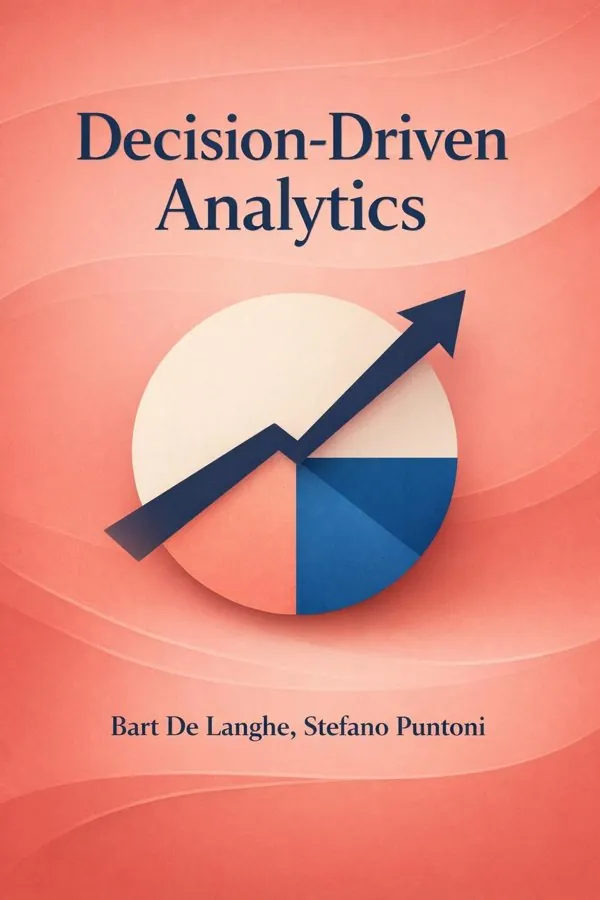
Decision-Driven Analytics: Leveraging Analytics to Make Better Business Decisions: Summary & Key Insights
by Bart De Langhe, Stefano Puntoni
 10 min11 chaptersAudio available
What Is Decision-Driven Analytics: Leveraging Analytics to Make Better Business Decisions About?
Decision-Driven Analytics: Leveraging Analytics to Make Better Business Decisions by Bart De Langhe, Stefano Puntoni is a strategy book spanning 11 pages. Decision-Driven Analytics explains how organizations can use data and analytics to improve decision-making rather than focusing solely on data collection or model building. The authors emphasize aligning analytical efforts with strategic business questions, integrating human judgment with quantitative insights, and fostering a decision-oriented culture within organizations.
This FizzRead summary covers all 11 key chapters of Decision-Driven Analytics: Leveraging Analytics to Make Better Business Decisions in approximately 10 minutes, distilling the most important ideas, arguments, and takeaways from Bart De Langhe, Stefano Puntoni's work. Also available as an audio summary and Key Quotes Podcast.
Decision-Driven Analytics: Leveraging Analytics to Make Better Business Decisions
Decision-Driven Analytics explains how organizations can use data and analytics to improve decision-making rather than focusing solely on data collection or model building. The authors emphasize aligning analytical efforts with strategic business questions, integrating human judgment with quantitative insights, and fostering a decision-oriented culture within organizations.
Who Should Read Decision-Driven Analytics: Leveraging Analytics to Make Better Business Decisions?
This book is perfect for anyone interested in strategy and looking to gain actionable insights in a short read. Whether you're a student, professional, or lifelong learner, the key ideas from Decision-Driven Analytics: Leveraging Analytics to Make Better Business Decisions by Bart De Langhe, Stefano Puntoni will help you think differently.
- ✓Readers who enjoy strategy and want practical takeaways
- ✓Professionals looking to apply new ideas to their work and life
- ✓Anyone who wants the core insights of Decision-Driven Analytics: Leveraging Analytics to Make Better Business Decisions in just 10 minutes
Want the full summary?
Get instant access to this book summary and 100K+ more with Fizz Moment.
Get Free SummaryAvailable on App Store • Free to download
Key Chapters
Every meaningful analysis begins not with data, but with a decision. In the opening chapters, we describe what we call the 'decision context'—the landscape in which organizational decisions take shape. Before analysts open databases or build models, they need to understand the stakes, the actors, and the constraints of the decision.
Too often, management teams jump directly into analytics projects without clearly defining what decision they intend to improve. This leads to beautiful analyses that answer no real question. We show that clarity about decisions—who decides, what alternatives they have, what trade-offs they face—is the foundation for productive analytics. Framing a decision context means articulating not just the problem but the operational realities and values attached to it.
Consider, for example, a marketing team tasked with improving customer retention. Without specifying whether the goal is to retain high-value customers, reduce churn across all segments, or adjust pricing tactics, analytical effort scatters. But when the decision context is explicit, the analysis becomes purpose-driven: every variable, every model, connects to the decision at hand. This alignment transforms analytics from a generic exercise into a targeted strategic tool.
By tying analytics to decision contexts, organizations also improve accountability. Decision-makers can see how evidence supports or challenges assumptions, and analysts understand how their work directly influences outcomes. The result is not only better decisions but a culture of deliberate thinking.
Data by itself is inert. The real art lies in translating data into insights that inform action. In this section, we discuss how to make that translation happen.
Organizations often mistake data-driven approaches—collect everything, analyze later—for smart analytics. But as we argue, being data-driven without being decision-driven leads to paralysis by analysis. The key is to begin with the end in mind: what decision will this data inform, and how will we act on it?
In practice, translating data into decisions requires reframing analytical questions around outcomes. Instead of asking, 'What does customer data tell us about behavior?' you should ask, 'What product recommendations will help increase retention among this segment?' That subtle shift in question turns raw information into a tool for improvement.
We illustrate this principle with cases where companies successfully converted analytical insight into decisive action. A logistics firm did not simply model delivery times; it focused on decisions about resource allocation across distribution centers. A healthcare provider reframed patient data analysis to focus on diagnostic decisions—thus reducing both errors and costs.
When data serves a decision rather than the other way around, organizations move from insight generation to insight implementation. The conversation changes—from 'what did the data show?' to 'what shall we do differently?'. That moment—when analysis meets action—is where value is created.
+ 9 more chapters — available in the FizzRead app
All Chapters in Decision-Driven Analytics: Leveraging Analytics to Make Better Business Decisions
About the Authors
Bart De Langhe is a professor of marketing and behavioral scientist known for his research on consumer judgment and decision-making. Stefano Puntoni is a professor of marketing at the Wharton School, University of Pennsylvania, specializing in consumer behavior, identity, and technology. Together, they combine academic expertise and practical insights to help organizations make smarter, evidence-based decisions.
Get This Summary in Your Preferred Format
Read or listen to the Decision-Driven Analytics: Leveraging Analytics to Make Better Business Decisions summary by Bart De Langhe, Stefano Puntoni anytime, anywhere. FizzRead offers multiple formats so you can learn on your terms — all free.
Available formats: App · Audio · PDF · EPUB — All included free with FizzRead
Download Decision-Driven Analytics: Leveraging Analytics to Make Better Business Decisions PDF and EPUB Summary
Key Quotes from Decision-Driven Analytics: Leveraging Analytics to Make Better Business Decisions
“Every meaningful analysis begins not with data, but with a decision.”
“The real art lies in translating data into insights that inform action.”
Frequently Asked Questions about Decision-Driven Analytics: Leveraging Analytics to Make Better Business Decisions
Decision-Driven Analytics: Leveraging Analytics to Make Better Business Decisions by Bart De Langhe, Stefano Puntoni is a strategy book that explores key ideas across 11 chapters. Decision-Driven Analytics explains how organizations can use data and analytics to improve decision-making rather than focusing solely on data collection or model building. The authors emphasize aligning analytical efforts with strategic business questions, integrating human judgment with quantitative insights, and fostering a decision-oriented culture within organizations.
You Might Also Like

Mastery
Robert Greene
10 min
Cut Costs Not Corners: A Practical Guide to Staying Competitive and Improving Profits
Colin Barrow
10 min
Good Strategy/Bad Strategy: The Difference and Why It Matters
Richard P. Rumelt
10 min
On Grand Strategy
John Lewis Gaddis
10 min
The Six Disciplines of Digital Transformation
George Westerman
10 min
7 Powers: The Foundations of Business Strategy
Hamilton Helmer
10 minBrowse by Category
Ready to read Decision-Driven Analytics: Leveraging Analytics to Make Better Business Decisions?
Get the full summary and 100K+ more books with Fizz Moment.