
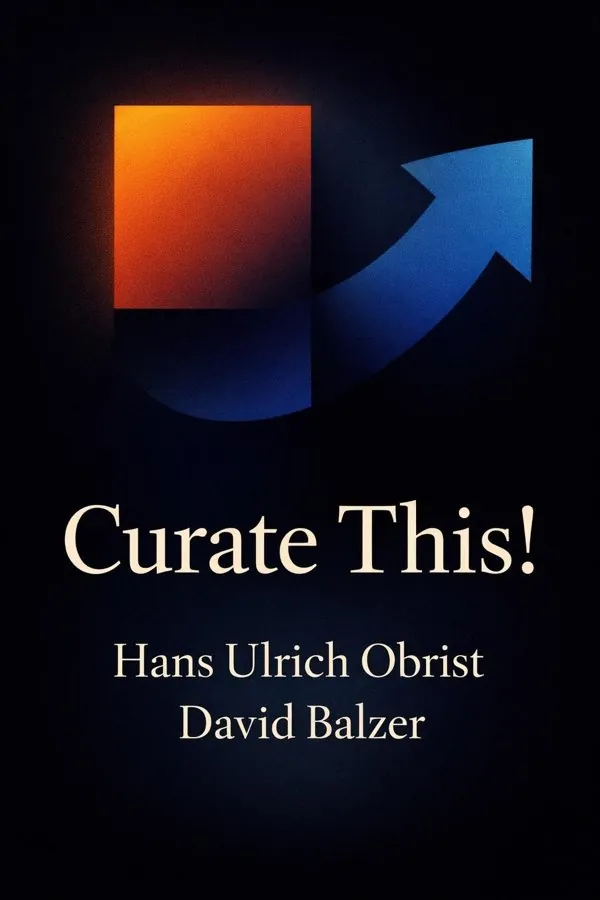
Curate This!: Summary & Key Insights
by Hans Ulrich Obrist, David Balzer
 10 min8 chaptersAudio available
What Is Curate This! About?
Curate This! by Hans Ulrich Obrist, David Balzer is a design book spanning 8 pages. Curate This! is a collection of essays and interviews exploring the evolving role of the curator in contemporary art and culture. The book examines how curatorial practice has expanded beyond the museum and gallery into everyday life, social media, and digital spaces, questioning what it means to 'curate' in the 21st century.
This FizzRead summary covers all 8 key chapters of Curate This! in approximately 10 minutes, distilling the most important ideas, arguments, and takeaways from Hans Ulrich Obrist, David Balzer's work. Also available as an audio summary and Key Quotes Podcast.
Curate This!
Curate This! is a collection of essays and interviews exploring the evolving role of the curator in contemporary art and culture. The book examines how curatorial practice has expanded beyond the museum and gallery into everyday life, social media, and digital spaces, questioning what it means to 'curate' in the 21st century.
Who Should Read Curate This!?
This book is perfect for anyone interested in design and looking to gain actionable insights in a short read. Whether you're a student, professional, or lifelong learner, the key ideas from Curate This! by Hans Ulrich Obrist, David Balzer will help you think differently.
- ✓Readers who enjoy design and want practical takeaways
- ✓Professionals looking to apply new ideas to their work and life
- ✓Anyone who wants the core insights of Curate This! in just 10 minutes
Want the full summary?
Get instant access to this book summary and 100K+ more with Fizz Moment.
Get Free SummaryAvailable on App Store • Free to download
Key Chapters
To understand the present fluidity of curatorial practice, we look first to its roots. The word ‘curator’ derives from the Latin *curare*, to care—a guardian of collections, a keeper of knowledge and artifacts. In the early museum tradition, curators were caretakers of objects, stewards of taxonomies that classified the world. Enlightenment collections treated art and natural specimens alike as assemblies of human understanding, and the curator’s authority was closely tied to institutional power.
But as the twentieth century unfolded, cracks appeared in that authority. The rise of independent curators in the 1960s and 70s—figures like Harald Szeemann—redefined the role into one of imagination and authorship. Szeemann’s revolutionary exhibitions transformed the curator into a kind of artist, one who could create meaning through selection itself. This independence liberated the practice from the permanent collection and turned it toward conceptually driven projects, toward relationships rather than accumulation.
By tracing this historical movement, we observed how the curator’s role migrated from safeguarding heritage to provoking discourse. The museum became a site of encounter, then a network of conversation. The curator’s portable imagination mirrored the transformations of globalization and the art world’s expansion. This shift laid the groundwork for our central argument: if the curator’s duty was once material care, it is now increasingly relational care—an ethics of attention to artists, publics, and contexts. The twentieth century’s curatorial revolution was not simply institutional; it was philosophical, setting the stage for the hybrid, fluid forms examined throughout our book.
We now live in a world saturated by curation. The expansion of curatorial practice far beyond art institutions marks one of the most distinctive cultural phenomena of the early twenty-first century. In our interviews and essays, contributors revisit how the verb ‘to curate’ escaped its professional confines and became part of everyday speech—your social feed, your Spotify list, your wardrobe. This diffusion reflects both a democratization and a dilution. On one hand, curation as an accessible act empowers everyone to shape meaning actively rather than passively consuming it. On the other hand, it risks becoming a superficial emblem of taste or self-branding.
As curatorial methods infiltrate social media and commerce, the act of selection takes on new technological mediators: algorithms, analytics, platforms that organize the chaos of cultural production. Our contributors challenge us to see this not simply as loss of professional exclusivity but as a moment of transformation. The curator’s power to contextualize, to weave connections, now faces an immense data landscape—one that demands new literacy in networks and interfaces. Digital curation asks not just what we choose, but what the systems choose for us.
For professional curators, this means extending their sphere of influence beyond static spaces into flows of information. For individuals, it raises questions of agency and care in a world curated by invisible code. The expansion of curatorial practice thus mirrors the broader condition of contemporary culture: permanent selection amidst endless abundance. If we understand curation properly, we begin to reclaim that selective gesture as mindful engagement rather than automated preference.
+ 6 more chapters — available in the FizzRead app
All Chapters in Curate This!
About the Authors
Hans Ulrich Obrist is a Swiss art curator, critic, and historian, currently Artistic Director at the Serpentine Galleries in London. David Balzer is a Canadian writer, editor, and critic known for his work on art, culture, and media.
Get This Summary in Your Preferred Format
Read or listen to the Curate This! summary by Hans Ulrich Obrist, David Balzer anytime, anywhere. FizzRead offers multiple formats so you can learn on your terms — all free.
Available formats: App · Audio · PDF · EPUB — All included free with FizzRead
Download Curate This! PDF and EPUB Summary
Key Quotes from Curate This!
“To understand the present fluidity of curatorial practice, we look first to its roots.”
“We now live in a world saturated by curation.”
Frequently Asked Questions about Curate This!
Curate This! by Hans Ulrich Obrist, David Balzer is a design book that explores key ideas across 8 chapters. Curate This! is a collection of essays and interviews exploring the evolving role of the curator in contemporary art and culture. The book examines how curatorial practice has expanded beyond the museum and gallery into everyday life, social media, and digital spaces, questioning what it means to 'curate' in the 21st century.
You Might Also Like

The Design of Everyday Things
Don Norman
10 min
The Better Angels of Our Nature
Steven Pinker
10 min
A Designer's Art
Paul Rand
10 min
Architects' Sketchbooks
Various Editors
10 min
Architectural Graphic Standards
The American Institute of Architects
10 min
Design Is Storytelling
Ellen Lupton
10 minBrowse by Category
Ready to read Curate This!?
Get the full summary and 100K+ more books with Fizz Moment.