
Crush: Summary & Key Insights
 10 min9 chaptersAudio available
Key Takeaways from Crush
Some books describe love as a gentle awakening; Crush insists it can feel more like impact.
One of the most unsettling truths in Crush is that intimacy does not automatically make us safe.
When reality cannot be changed, memory often becomes a form of control.
In Crush, the beloved is never just a person.
Sometimes ordinary language cannot hold overwhelming feeling, so the mind borrows from other arts.
What Is Crush About?
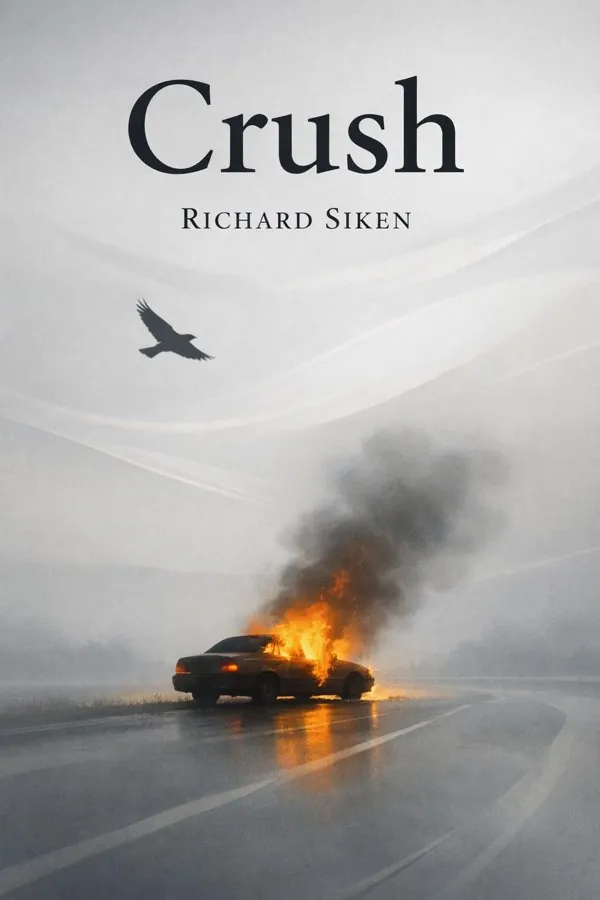
Crush by Richard Siken is a classics book spanning 11 pages. Richard Siken’s Crush is a poetry collection about desire at its most ecstatic and most dangerous. First published in 2005, the book moves through love, grief, obsession, fear, memory, and emotional survival with startling intensity. These are not polite poems about romance. They are poems about wanting someone so deeply that the feeling reshapes perception, disturbs time, and blurs the line between tenderness and harm. Again and again, Siken presents love as pursuit, collision, confession, and aftermath. The result is a work that feels both intimate and cinematic, as if every emotion were unfolding under a harsh, unforgettable light. What makes Crush matter is not only its raw honesty, but its form. Siken writes in long, rushing lines, abrupt turns, and vivid images drawn from film, myth, art, and everyday life. His poems capture how the mind behaves under emotional pressure: repetitive, fractured, urgent, and hyperaware. Siken’s authority comes from his rare ability to transform private anguish into language that feels universally recognizable. Awarded the Yale Series of Younger Poets Prize, Crush has become a defining collection for readers seeking poetry that tells the truth about longing, vulnerability, and what it takes to keep going after devastation.
This FizzRead summary covers all 9 key chapters of Crush in approximately 10 minutes, distilling the most important ideas, arguments, and takeaways from Richard Siken's work. Also available as an audio summary and Key Quotes Podcast.
Crush
Richard Siken’s Crush is a poetry collection about desire at its most ecstatic and most dangerous. First published in 2005, the book moves through love, grief, obsession, fear, memory, and emotional survival with startling intensity. These are not polite poems about romance. They are poems about wanting someone so deeply that the feeling reshapes perception, disturbs time, and blurs the line between tenderness and harm. Again and again, Siken presents love as pursuit, collision, confession, and aftermath. The result is a work that feels both intimate and cinematic, as if every emotion were unfolding under a harsh, unforgettable light.
What makes Crush matter is not only its raw honesty, but its form. Siken writes in long, rushing lines, abrupt turns, and vivid images drawn from film, myth, art, and everyday life. His poems capture how the mind behaves under emotional pressure: repetitive, fractured, urgent, and hyperaware. Siken’s authority comes from his rare ability to transform private anguish into language that feels universally recognizable. Awarded the Yale Series of Younger Poets Prize, Crush has become a defining collection for readers seeking poetry that tells the truth about longing, vulnerability, and what it takes to keep going after devastation.
Who Should Read Crush?
This book is perfect for anyone interested in classics and looking to gain actionable insights in a short read. Whether you're a student, professional, or lifelong learner, the key ideas from Crush by Richard Siken will help you think differently.
- ✓Readers who enjoy classics and want practical takeaways
- ✓Professionals looking to apply new ideas to their work and life
- ✓Anyone who wants the core insights of Crush in just 10 minutes
Want the full summary?
Get instant access to this book summary and 100K+ more with Fizz Moment.
Get Free SummaryAvailable on App Store • Free to download
Key Chapters
Some books describe love as a gentle awakening; Crush insists it can feel more like impact. From its opening movements, Richard Siken establishes a speaker whose emotional life is already in motion, already speeding toward disaster or revelation. Desire does not unfold neatly here. It erupts. It strikes. It rearranges the body and the mind before the speaker has time to explain what is happening. This is one of the collection’s great achievements: it portrays infatuation and attachment not as calm understanding, but as an event that overwhelms language even as it demands to be spoken.
Siken’s opening poems often feel cinematic because they mimic the speed and fragmentation of heightened emotion. Scenes cut abruptly. Images flash and vanish. Violence and beauty coexist in the same frame. The effect is not decorative; it is psychological. When a person is consumed by longing, perception itself can become unstable. Every glance matters too much. Every gesture becomes evidence. Every memory is replayed with obsessive force. Siken gives that experience shape.
In practical terms, this opening insight helps readers understand why the collection feels so urgent. Crush is not asking us to admire emotions from a safe distance. It invites us into the actual tempo of emotional overwhelm. Anyone who has experienced a relationship that seemed to overtake ordinary life will recognize the sensation. Love can feel less like a choice than a force field, pulling thought and action into its orbit.
A useful way to read these poems is to notice where intensity creates both clarity and distortion. What does the speaker suddenly see more sharply? What becomes exaggerated or impossible to control? Actionable takeaway: when reading Crush, track the moments where desire appears as impact rather than feeling, because those moments unlock the collection’s emotional logic.
One of the most unsettling truths in Crush is that intimacy does not automatically make us safe. Siken presents a central relationship charged with hunger, tenderness, fear, and instability. The beloved is not a simple romantic ideal. He is magnetic, vulnerable, elusive, and at times threatening in the way all deeply desired figures can become threatening: they gain power over the emotional world of the one who loves them. In this collection, desire does not soothe the speaker. It exposes him.
That exposure is what gives the poems their force. The relationship at the heart of the book feels sacred and feral at once. There are moments of devotion, but also control, panic, dependency, and the terror of losing what one cannot bear to lose. Siken refuses to separate beauty from risk. He understands that to love someone deeply is to enter uncertainty. You may become more alive, but also more fragile. The poems return to this dynamic again and again, revealing how closeness intensifies both pleasure and fear.
This insight matters beyond poetry because it names an emotional contradiction many people live with but struggle to articulate. We often assume healthy love should feel calm at all times, yet real attachment can awaken insecurity, old wounds, and desperate impulses. Siken is not celebrating destructiveness; he is documenting the emotional weather that can gather around longing when it meets vulnerability.
Readers can apply this idea by paying attention to how the collection describes power. Who is pursued? Who is protected? Who is endangered by needing too much? These questions can also illuminate our own relationships and emotional habits. Actionable takeaway: use Crush as a lens for examining where your idea of intimacy includes both comfort and fear, and ask which parts arise from love and which from unresolved longing.
When reality cannot be changed, memory often becomes a form of control. In Crush, storytelling is not just self-expression; it is an attempt to reconstruct loss, preserve the beloved, and revise unbearable events through language. Siken’s speaker returns obsessively to scenes, details, bodies, and conversations as though repetition might hold them in place. The poems understand a painful paradox: remembering can keep love alive, but it can also keep pain from healing.
This is why the collection often feels recursive. Images recur with slight changes. Narratives seem retold from another angle. The speaker circles back, not because he has nothing new to say, but because grief itself behaves this way. It revisits. It restages. It searches for a version of the story that might finally make sense. By treating memory as an active, unstable force, Siken captures how people use narrative to survive what they cannot undo.
There is a practical wisdom in this portrayal. Many readers know the urge to replay a relationship or a rupture, trying to identify the exact moment things changed. We revisit texts, photographs, rooms, roads, and words because recollection feels like agency. Crush shows both the necessity and the limitation of that impulse. Memory can honor love, but it can also become a trap if we mistake recollection for repair.
A helpful way to approach these poems is to notice how remembering alters what is remembered. Does the speaker become more truthful with repetition, or more mythic? Does the beloved become clearer or more unreal? These questions reveal how memory creates narrative rather than merely storing facts. Actionable takeaway: after reading, reflect on one memory you retell often and ask whether you are preserving truth, seeking closure, or trying to keep something from disappearing.
In Crush, the beloved is never just a person. He becomes symbol, obsession, muse, threat, fantasy, and source of injury. This doubling is essential to the collection. Siken does not present love as a stable encounter between two fully knowable people. Instead, he shows how desire transforms the beloved into an emotional landscape onto which hope, terror, tenderness, and rage are projected. The result is a figure who inspires art while also causing collapse.
This is not simply romantic exaggeration. It is a serious examination of what happens when one person carries too much psychic weight. The beloved becomes the center of meaning, and that centrality distorts both perception and selfhood. A gentle gesture can feel salvific. A withdrawal can feel annihilating. Siken’s poems repeatedly stage this tension, allowing affection and aggression to coexist without flattening either one. That honesty is part of what makes the collection so powerful.
In life, we often turn people into stories before we understand them as humans. We cast them as rescuer, destroyer, answer, or evidence of our worth. Crush exposes this habit with unusual clarity. The poems suggest that intense desire can make us less interested in the beloved as a separate self than in what he activates within us. That recognition is painful, but useful.
Readers can apply this insight by considering where admiration turns into idealization. Are we seeing someone as they are, or as the role they play in our emotional script? In the collection, the muse is inseparable from the wound because projection guarantees disappointment. Actionable takeaway: while reading, mark moments when the beloved shifts from person to symbol, and use those shifts to reflect on how longing can blur the difference between loving someone and needing them to mean everything.
Sometimes ordinary language cannot hold overwhelming feeling, so the mind borrows from other arts. One of Crush’s most distinctive qualities is its use of cinematic and visual imagery to express fractured perception. Siken writes as though scenes are being edited in real time: jump cuts, close-ups, repeated takes, sudden changes of angle. This aesthetic is not a stylish extra. It reveals how emotional extremity breaks experience into charged fragments.
The collection repeatedly shows that identity itself can feel unstable under pressure. The speaker is not standing outside events and describing them calmly. He is inside them, half-watching, half-performing, trying to understand himself through the images available to him. Film becomes a model for memory, fantasy, and self-consciousness. Art allows the poems to capture the strangeness of feeling both intensely present and somehow outside oneself.
This idea has broad relevance. In moments of crisis or desire, people often narrate their lives through scenes rather than arguments. We remember the look in a hallway, the headlights on a road, the hand at the door, the body in a room. Siken understands that emotion is often visual before it is conceptual. By leaning into image, he gives readers access to states of mind that logic alone could not explain.
Practically, this means Crush can be read with the eyes as much as with the intellect. Notice recurring motifs, visual cuts, and tableau-like moments. Ask what the image accomplishes that a direct explanation would weaken. The answer is often that image preserves contradiction: beauty and danger can occupy the same frame. Actionable takeaway: read each poem as if it were a short film, and identify the images that linger longest; those images often carry the book’s deepest emotional arguments.
At a certain point, obsession turns inward. Crush does not remain only a book about wanting another person; it becomes a book about what that wanting reveals in the self. As the collection deepens, the speaker confronts guilt, shame, dependency, emotional exhaustion, and the difficult fact of survival. Love may have been the catalyst, but the poems increasingly ask a harsher question: who am I when the drama quiets and I am left with what I have done, desired, feared, and endured?
This shift toward self-reflection is crucial because it prevents the collection from becoming merely a spectacle of intensity. Siken understands that after the chase, after the fantasy, after the rupture, a person still has to live with himself. The poems examine this aftermath with painful honesty. Vulnerability here is not sentimental openness. It is the willingness to look directly at one’s own contradictions: tenderness mixed with manipulation, devotion mixed with self-erasure, longing mixed with resentment. Survival does not erase these tensions; it means carrying them.
Many readers connect deeply with this part of the collection because it mirrors the emotional work that follows any consuming experience. After heartbreak, grief, or obsession, the central task is not just understanding the other person. It is understanding what the experience exposed in us. What patterns did it awaken? What fears did it confirm? What strengths emerged under pressure?
A practical reading strategy is to track moments when the speaker stops describing the beloved and starts assessing himself. These passages often contain the collection’s most durable wisdom. They suggest that survival begins when self-mythology cracks and self-recognition starts. Actionable takeaway: use these poems as prompts for honest inventory, asking not only what hurt you, but what your response to hurt reveals about the life you need to rebuild.
Few writers capture the instability of closeness as vividly as Siken. In Crush, love often takes the form of movement: chasing, fleeing, circling, arriving too late, leaving too soon. These recurring patterns of pursuit and escape reveal a central truth of the collection: intimacy is rarely static. People who long to be known may also fear being fully seen. People who want union may panic when it becomes possible. Siken’s poems inhabit that tension without resolving it into easy lessons.
The speaker repeatedly moves toward the beloved and away from certainty. Desire drives contact, but fear disturbs it. This dynamic gives the collection its nervous propulsion. The poems feel restless because attachment itself is restless. To want another person is to negotiate distance constantly: How close can I come? How much can I say? What happens if I am left? What happens if I stay? Crush turns these questions into rhythm and image.
This insight is practical because many relationships are shaped by alternating hunger and retreat. In modern emotional language, we might speak of ambivalence, avoidance, or attachment patterns. Siken dramatizes these ideas at a visceral level. He shows that instability is not always the absence of feeling; sometimes it is feeling intensified beyond what the self can calmly manage.
Readers can use this key idea to pay attention to motion in the poems. Who moves? Who waits? Who runs? Who returns? Movement often reveals what direct statements conceal. It can also illuminate our own habits in intimacy. Do we pursue unavailable people? Do we withdraw when closeness becomes real? Actionable takeaway: notice the push-pull choreography in Crush and let it sharpen your awareness of how desire and fear may be partnering in your own relationships.
What gives Crush part of its emotional severity is the sense that love is always occurring under the sign of loss. Mortality, vulnerability, and exhaustion haunt the collection. Even in moments of desire, there is an awareness of fragility: bodies can disappear, relationships can break, and emotional resources can be depleted. This creates a pressure that makes each confession feel urgent. The speaker is not simply declaring love; he is speaking as though time is short and silence would be a kind of death.
Siken’s confrontation with mortality works on more than one level. There is literal fear of bodily harm and disappearance, but there is also the smaller, constant mortality of relationships themselves. Every attachment contains the possibility of ending. Every intimate moment is temporary. Crush does not sentimentalize this truth. Instead, it lets that awareness intensify attention. Because things can vanish, they become almost unbearably vivid.
This is one reason the collection resonates so deeply with readers who have experienced grief, illness, heartbreak, or the aftermath of trauma. Siken knows that emotional life is shaped by finitude. We speak differently when we know something precious can be lost. We cling, confess, idealize, and panic. Yet the poems also suggest that the awareness of mortality can deepen love rather than invalidate it. Temporary things still matter. In fact, their temporary nature may be what makes them sacred.
A practical way to engage this theme is to ask how urgency changes the tone of each poem. Where does fear of loss sharpen the speaker’s attention? Where does it tip into desperation? Those distinctions matter. Actionable takeaway: let Crush remind you to treat fragility as a source of seriousness, not avoidance; what may not last deserves clearer attention, not less.
The closing force of Crush lies in its refusal to offer neat healing. Siken does not end by solving longing, erasing damage, or turning pain into a tidy moral lesson. Instead, the collection moves toward a more difficult kind of acceptance: love can wound, memory can persist, and a person can continue anyway. Endurance becomes the final form of meaning. Not triumph. Not closure. Continuation.
This matters because many narratives of heartbreak promise transformation that feels cleaner than real life. Crush offers something truer. Emotional ruin does not necessarily disappear. The beloved may remain present in memory. Desire may outlast the relationship that produced it. The self may never become fully unmarked. But survival is still possible. More than possible: it can become a subtle, daily practice of carrying what cannot be repaired without allowing it to end the story.
The final movement of the book suggests that acceptance is not forgetting. It is learning to live without total resolution. That lesson is especially powerful for readers who feel ashamed that they still miss someone, still revisit a loss, or still feel shaped by old emotional catastrophes. Siken grants dignity to persistence. He shows that continuing after devastation is not a failure to move on. It is often what courage actually looks like.
Practically, this final insight invites a gentler understanding of recovery. Not every wound closes cleanly. Not every love becomes harmless in retrospect. Yet life goes on, and art can help carry what remains. Actionable takeaway: finish Crush by asking not whether the speaker is healed, but whether he can continue, because the book’s deepest answer is that endurance itself is a form of grace.
All Chapters in Crush
About the Author
Richard Siken is an American poet, painter, and filmmaker whose work is known for its emotional intensity, visual precision, and lyrical urgency. Born in New York, he emerged as a major contemporary literary voice with his debut collection, Crush, published in 2005. The book received the Yale Series of Younger Poets Prize and quickly became influential for its fearless treatment of desire, grief, obsession, and vulnerability. Siken’s writing is often described as cinematic because of its vivid imagery, fragmented motion, and ability to capture thought under emotional pressure. In addition to poetry, his background in visual art informs the striking, scene-based quality of his language. He remains an important figure in contemporary American poetry, especially for readers drawn to intimate, high-voltage, and formally inventive work.
Get This Summary in Your Preferred Format
Read or listen to the Crush summary by Richard Siken anytime, anywhere. FizzRead offers multiple formats so you can learn on your terms — all free.
Available formats: App · Audio · PDF · EPUB — All included free with FizzRead
Download Crush PDF and EPUB Summary
Key Quotes from Crush
“Some books describe love as a gentle awakening; Crush insists it can feel more like impact.”
“One of the most unsettling truths in Crush is that intimacy does not automatically make us safe.”
“When reality cannot be changed, memory often becomes a form of control.”
“In Crush, the beloved is never just a person.”
“Sometimes ordinary language cannot hold overwhelming feeling, so the mind borrows from other arts.”
Frequently Asked Questions about Crush
Crush by Richard Siken is a classics book that explores key ideas across 9 chapters. Richard Siken’s Crush is a poetry collection about desire at its most ecstatic and most dangerous. First published in 2005, the book moves through love, grief, obsession, fear, memory, and emotional survival with startling intensity. These are not polite poems about romance. They are poems about wanting someone so deeply that the feeling reshapes perception, disturbs time, and blurs the line between tenderness and harm. Again and again, Siken presents love as pursuit, collision, confession, and aftermath. The result is a work that feels both intimate and cinematic, as if every emotion were unfolding under a harsh, unforgettable light. What makes Crush matter is not only its raw honesty, but its form. Siken writes in long, rushing lines, abrupt turns, and vivid images drawn from film, myth, art, and everyday life. His poems capture how the mind behaves under emotional pressure: repetitive, fractured, urgent, and hyperaware. Siken’s authority comes from his rare ability to transform private anguish into language that feels universally recognizable. Awarded the Yale Series of Younger Poets Prize, Crush has become a defining collection for readers seeking poetry that tells the truth about longing, vulnerability, and what it takes to keep going after devastation.
You Might Also Like






Browse by Category
Ready to read Crush?
Get the full summary and 100K+ more books with Fizz Moment.