
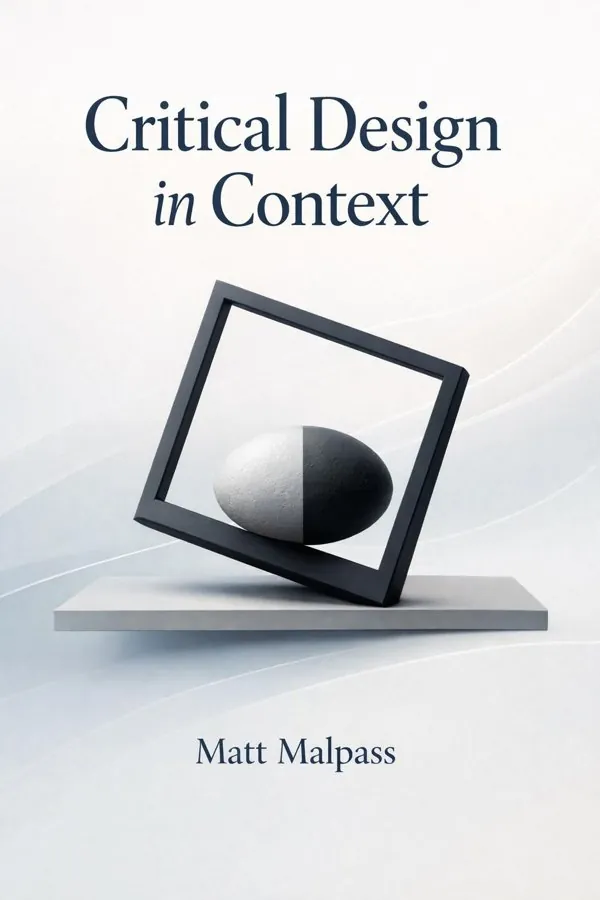
Critical Design in Context: History, Theory, and Practices: Summary & Key Insights
by Matt Malpass
 10 min9 chaptersAudio available
What Is Critical Design in Context: History, Theory, and Practices About?
Critical Design in Context: History, Theory, and Practices by Matt Malpass is a design book spanning 9 pages. Critical Design in Context is the first book to introduce critical design as a disciplinary field, offering a history of its development, theoretical influences, and contemporary practices. Matt Malpass explores how design can serve as a form of cultural and social critique, moving away from traditional approaches focused on commercial product creation to emphasize reflection and questioning of design’s values and assumptions.
This FizzRead summary covers all 9 key chapters of Critical Design in Context: History, Theory, and Practices in approximately 10 minutes, distilling the most important ideas, arguments, and takeaways from Matt Malpass's work. Also available as an audio summary and Key Quotes Podcast.
Critical Design in Context: History, Theory, and Practices
Critical Design in Context is the first book to introduce critical design as a disciplinary field, offering a history of its development, theoretical influences, and contemporary practices. Matt Malpass explores how design can serve as a form of cultural and social critique, moving away from traditional approaches focused on commercial product creation to emphasize reflection and questioning of design’s values and assumptions.
Who Should Read Critical Design in Context: History, Theory, and Practices?
This book is perfect for anyone interested in design and looking to gain actionable insights in a short read. Whether you're a student, professional, or lifelong learner, the key ideas from Critical Design in Context: History, Theory, and Practices by Matt Malpass will help you think differently.
- ✓Readers who enjoy design and want practical takeaways
- ✓Professionals looking to apply new ideas to their work and life
- ✓Anyone who wants the core insights of Critical Design in Context: History, Theory, and Practices in just 10 minutes
Want the full summary?
Get instant access to this book summary and 100K+ more with Fizz Moment.
Get Free SummaryAvailable on App Store • Free to download
Key Chapters
To understand critical design in any meaningful way, we have to begin with the radical design movements of the 1960s and 1970s. During these decades, designers in Italy and beyond—groups such as Superstudio, Archizoom, and the Anti-Design movement—challenged the consumerist and technocratic ideologies of modernism. Their work was often provocative, fantastical, and deeply reflective, blending architecture, art, and theory. They rejected the idea that design should simply solve problems or beautify environments; instead, they used design to make visible the contradictions and excesses of capitalist society.
In those radical years, design was commonly discussed in political and philosophical terms. The Italian radicals used speculative proposals—renderings of utopian cities, imaginary living systems—to make visible how everyday life was entangled with ideology. This practice of designing alternative worlds was not intended to be realized but to function as critique. It was here that the seed of critical design was planted: the notion that design artifacts could serve as discursive tools rather than functional products.
As the decades evolved, these impulses lay dormant until the late twentieth century, when designers like Anthony Dunne and Fiona Raby revived and formalized them under the banner of “critical design.” Dunne’s early work at the Royal College of Art, especially *Hertzian Tales*, drew attention to the invisible energies and social behaviors surrounding technology. He proposed a kind of design that did not conform to commercial expectations but aimed instead to provoke reflection and discussion. This was the moment when critical design, as a deliberate disciplinary term, began to take shape.
Throughout this historical arc, one can see design gradually decoupling from industrial production and reorienting itself toward speculation and commentary. The designer ceased to be merely a producer for markets and became instead a producer of meaning. What distinguished critical design from radical design, however, was its institutional integration—whereas radical design was predominantly a countercultural movement, critical design emerged as a recognized and studied practice within academia. Its historical legacy thus sets the stage for understanding it not merely as reaction, but as a sustained position within design discourse.
The theoretical backbone of critical design draws heavily from critical theory and postmodern philosophy. From Theodor Adorno and Herbert Marcuse, we inherit the idea that art and cultural production can reveal contradictions within society—that aesthetics can be used critically, not just romantically. Design, in this sense, becomes a medium for inquiry, a way of uncovering hidden ideologies embedded in objects.
Postmodernism reinforces this mode of questioning. Thinkers like Jean Baudrillard remind us that objects and commodities are not neutral; they mediate relationships and meanings. The postmodern designer, aware of this, treats the object not as a solution but as a statement. Critical design embraces this reflexive stance—it asks what values are materialized through design, what assumptions about humanity or technology are being normalized. This movement away from “truth” and “function” towards interpretation and narrative marks design’s shift from a modernist discipline to a critical one.
Another intellectual influence is speculative thought. If critical design aims to provoke reflection about the present, speculative design looks toward future scenarios that make such reflection vivid. It becomes a philosophical exercise in imagination. By constructing fictional objects or artificial systems, designers can dramatize ethical and social dilemmas before they materialize. The designer here is not a prophet but a critic, using fiction as method.
The synthesis of these theoretical influences gives critical design its distinctive sensibility. It refuses to accept things as they are. It insists that design is a language of exploration, capable of expressing doubt, irony, and possibility. Through this lens, every design object is situated within cultural discourse. Every prototype is a hypothesis about society.
+ 7 more chapters — available in the FizzRead app
All Chapters in Critical Design in Context: History, Theory, and Practices
About the Author
Matt Malpass is a British designer and academic specializing in critical and speculative design. He is a professor at the University of London, and his work focuses on the relationship between design, culture, and critical thinking.
Get This Summary in Your Preferred Format
Read or listen to the Critical Design in Context: History, Theory, and Practices summary by Matt Malpass anytime, anywhere. FizzRead offers multiple formats so you can learn on your terms — all free.
Available formats: App · Audio · PDF · EPUB — All included free with FizzRead
Download Critical Design in Context: History, Theory, and Practices PDF and EPUB Summary
Key Quotes from Critical Design in Context: History, Theory, and Practices
“To understand critical design in any meaningful way, we have to begin with the radical design movements of the 1960s and 1970s.”
“The theoretical backbone of critical design draws heavily from critical theory and postmodern philosophy.”
Frequently Asked Questions about Critical Design in Context: History, Theory, and Practices
Critical Design in Context: History, Theory, and Practices by Matt Malpass is a design book that explores key ideas across 9 chapters. Critical Design in Context is the first book to introduce critical design as a disciplinary field, offering a history of its development, theoretical influences, and contemporary practices. Matt Malpass explores how design can serve as a form of cultural and social critique, moving away from traditional approaches focused on commercial product creation to emphasize reflection and questioning of design’s values and assumptions.
You Might Also Like

The Design of Everyday Things
Don Norman
10 min
The Better Angels of Our Nature
Steven Pinker
10 min
A Designer's Art
Paul Rand
10 min
Architects' Sketchbooks
Various Editors
10 min
Architectural Graphic Standards
The American Institute of Architects
10 min
Design Is Storytelling
Ellen Lupton
10 minBrowse by Category
Ready to read Critical Design in Context: History, Theory, and Practices?
Get the full summary and 100K+ more books with Fizz Moment.