
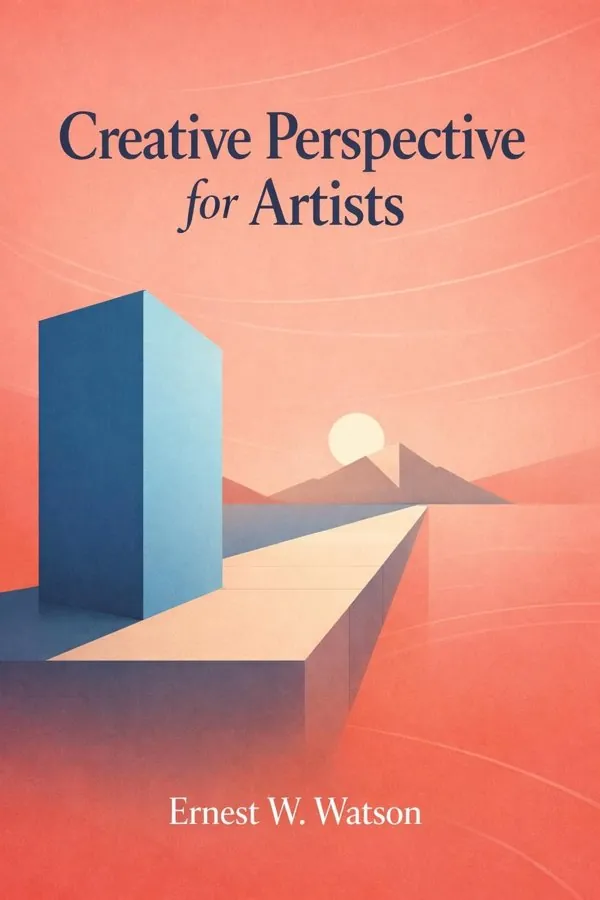
Creative Perspective for Artists: Summary & Key Insights
 10 min6 chaptersAudio available
What Is Creative Perspective for Artists About?
Creative Perspective for Artists by Ernest W. Watson is a design book spanning 6 pages. A comprehensive guide to understanding and applying the principles of perspective in art, this book by Ernest W. Watson offers clear explanations and practical exercises for artists seeking to master spatial representation. It covers linear and atmospheric perspective, composition, and the creative use of perspective to enhance artistic expression.
This FizzRead summary covers all 6 key chapters of Creative Perspective for Artists in approximately 10 minutes, distilling the most important ideas, arguments, and takeaways from Ernest W. Watson's work. Also available as an audio summary and Key Quotes Podcast.
Creative Perspective for Artists
A comprehensive guide to understanding and applying the principles of perspective in art, this book by Ernest W. Watson offers clear explanations and practical exercises for artists seeking to master spatial representation. It covers linear and atmospheric perspective, composition, and the creative use of perspective to enhance artistic expression.
Who Should Read Creative Perspective for Artists?
This book is perfect for anyone interested in design and looking to gain actionable insights in a short read. Whether you're a student, professional, or lifelong learner, the key ideas from Creative Perspective for Artists by Ernest W. Watson will help you think differently.
- ✓Readers who enjoy design and want practical takeaways
- ✓Professionals looking to apply new ideas to their work and life
- ✓Anyone who wants the core insights of Creative Perspective for Artists in just 10 minutes
Want the full summary?
Get instant access to this book summary and 100K+ more with Fizz Moment.
Get Free SummaryAvailable on App Store • Free to download
Key Chapters
Every artist must begin with an understanding of linear perspective—the geometric basis that describes how parallel lines seem to converge in the distance. Imagine standing on a long, straight road. The edges appear to meet at a point far ahead, though we know they remain apart in reality. That illusion of convergence is the essence of perspective, and mastering it allows you to command the illusion of depth.
I begin by defining the horizon line, which corresponds to the level of your eyes. If you move higher, the horizon rises; if you kneel, it lowers. From this simple fact flows all spatial order. On this horizon, we identify vanishing points—those places where receding lines from real structures appear to meet. Once you understand that every set of parallel lines shares a common vanishing point, compositions begin to feel grounded, logical, and believable.
But perspective is more than lines—it’s the visual language of space. When you employ linear perspective confidently, your drawing gains structure and command. A simple interior scene becomes coherent; a street view acquires rhythm and clarity. The artist’s task is not just to copy nature’s appearance but to interpret its spatial relationships. A building rendered with clean, accurate perspective seems to stand solidly in space; a poorly drawn one collapses, betraying the viewer’s trust.
Yet beyond its precision, linear perspective can serve creativity. The placement of vanishing points, the choice of viewpoint, and the angle of view all influence mood and expression. Shift the horizon low, and your viewer feels uplifted; raise it high, and you convey dominance or weight. In this, perspective becomes a design choice, a compositional element that speaks as vividly as color or texture.
When artists first encounter one-point perspective, they often find it manageable: all receding lines converge toward a single vanishing point on the horizon. This technique is ideal for simple interiors, roads, and straightforward compositions. It teaches discipline—the understanding that spatial alignment anchors form.
However, the world seldom aligns with simplicity. As soon as a structure turns or the viewer shifts position, we enter the richer domain of two-point perspective. Here, we recognize that objects receding in different directions require distinct vanishing points. By learning to handle these, you create dynamic compositions—a sense that space extends both left and right, that the scene breathes.
For the most advanced sense of realism—particularly in architectural rendering or dramatic aerial views—three-point perspective becomes essential. The third vanishing point, above or below the horizon, introduces vertical recession. Buildings seem to soar or descend convincingly; figures seen from above gain monumentality, those viewed from below appear towering.
The beauty of mastering these systems lies in their flexibility. Once you know how each works, you’re free to manipulate them intuitively. Perspective ceases to be a rigid formula and becomes a living tool. Whether you’re sketching an urban alley or designing a fantastical cityscape, the application of multi-point perspective transforms imagination into believable structure.
The secret is practice and observation. I often advise students to move through their environment actively—note how walls converge, how heights compress with distance. The more you see, the more natural perspective becomes, until you instinctively place vanishing points without conscious calculation.
+ 4 more chapters — available in the FizzRead app
All Chapters in Creative Perspective for Artists
About the Author
Ernest W. Watson (1884–1969) was an American artist, educator, and co-founder of Watson-Guptill Publications. He was known for his contributions to art education and for authoring several influential books on drawing and design.
Get This Summary in Your Preferred Format
Read or listen to the Creative Perspective for Artists summary by Ernest W. Watson anytime, anywhere. FizzRead offers multiple formats so you can learn on your terms — all free.
Available formats: App · Audio · PDF · EPUB — All included free with FizzRead
Download Creative Perspective for Artists PDF and EPUB Summary
Key Quotes from Creative Perspective for Artists
“Every artist must begin with an understanding of linear perspective—the geometric basis that describes how parallel lines seem to converge in the distance.”
“When artists first encounter one-point perspective, they often find it manageable: all receding lines converge toward a single vanishing point on the horizon.”
Frequently Asked Questions about Creative Perspective for Artists
Creative Perspective for Artists by Ernest W. Watson is a design book that explores key ideas across 6 chapters. A comprehensive guide to understanding and applying the principles of perspective in art, this book by Ernest W. Watson offers clear explanations and practical exercises for artists seeking to master spatial representation. It covers linear and atmospheric perspective, composition, and the creative use of perspective to enhance artistic expression.
You Might Also Like
The Design of Everyday Things
Don Norman
10 min
The Better Angels of Our Nature
Steven Pinker
10 min
A Designer's Art
Paul Rand
10 min
Architects' Sketchbooks
Various Editors
10 min
Architectural Graphic Standards
The American Institute of Architects
10 min
Design Is Storytelling
Ellen Lupton
10 minBrowse by Category
Ready to read Creative Perspective for Artists?
Get the full summary and 100K+ more books with Fizz Moment.