
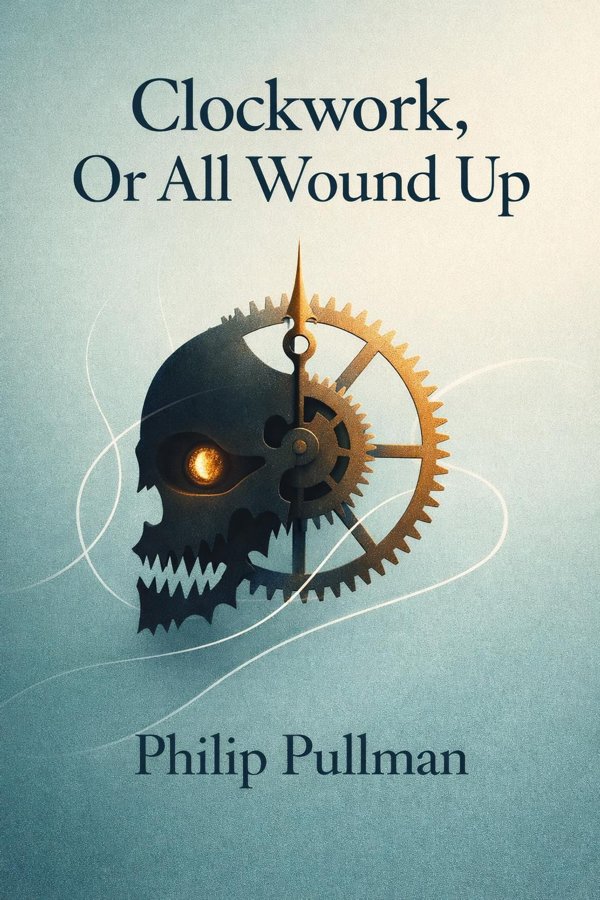
Clockwork, Or All Wound Up: Summary & Key Insights
 10 min4 chaptersAudio available
What Is Clockwork, Or All Wound Up About?
Clockwork, Or All Wound Up by Philip Pullman is a classics book spanning 4 pages. Clockwork, Or All Wound Up is a moral and suspenseful tale set in a small eighteenth-century German town. The story intertwines the lives of an apprentice clockmaker, a writer, and a mysterious visitor, exploring themes of fate, responsibility, and the nature of evil. With his characteristic style, Pullman blends elements of fairy tale and gothic horror into a precise and symbolic narrative.
This FizzRead summary covers all 4 key chapters of Clockwork, Or All Wound Up in approximately 10 minutes, distilling the most important ideas, arguments, and takeaways from Philip Pullman's work. Also available as an audio summary and Key Quotes Podcast.
Clockwork, Or All Wound Up
Clockwork, Or All Wound Up is a moral and suspenseful tale set in a small eighteenth-century German town. The story intertwines the lives of an apprentice clockmaker, a writer, and a mysterious visitor, exploring themes of fate, responsibility, and the nature of evil. With his characteristic style, Pullman blends elements of fairy tale and gothic horror into a precise and symbolic narrative.
Who Should Read Clockwork, Or All Wound Up?
This book is perfect for anyone interested in classics and looking to gain actionable insights in a short read. Whether you're a student, professional, or lifelong learner, the key ideas from Clockwork, Or All Wound Up by Philip Pullman will help you think differently.
- ✓Readers who enjoy classics and want practical takeaways
- ✓Professionals looking to apply new ideas to their work and life
- ✓Anyone who wants the core insights of Clockwork, Or All Wound Up in just 10 minutes
Want the full summary?
Get instant access to this book summary and 100K+ more with Fizz Moment.
Get Free SummaryAvailable on App Store • Free to download
Key Chapters
Karl begins the story already trapped in a cage of his own making. As an apprentice clockmaker, he is expected to complete a new clockwork figure for the town’s grand unveiling—a task that demands both precision and imagination. Yet he lacks both courage and inspiration. All around him, Glockenheim’s people prepare for their celebration; inside him, fear and pride wage war. He feels the ticking weight of his master’s reputation and the shame of failure pressing on his chest.
In this anxiety, Karl becomes the embodiment of every craftsman who wishes to create something flawless but forgets that true creation demands more than mechanical skill—it demands moral courage. At first, he sees his work only as a means to impress the town and secure his place among its esteemed makers. The clock, like his ambition, becomes his measure of worth. When he looks at his unfinished figure, he sees not possibility but condemnation.
Fritz, the storyteller whom Karl encounters in the tavern, mirrors Karl’s creative struggle. Fritz spins a dark tale about a mechanical figure built by a sinister doctor named Kalmenius, who can bestow life upon machines. His story entrances the townsfolk but remains incomplete—unfinished, just like Karl’s own work. Fritz’s fiction becomes an echo chamber where Karl’s real fears begin to resonate.
When Karl’s desperation reaches its peak, reality and fiction blur. Dr. Kalmenius himself appears in Glockenheim, stepping out of Fritz’s tale as though imagined into existence. For Karl, this is the pivotal moment—the devil’s bargain offered not in flames but in cold metal. Kalmenius offers him a “mechanical heart,” a device capable of animating Karl’s clockwork figure and completing his masterpiece. Karl, blinded by ambition and shame, accepts. In that act, he trades human responsibility for mechanical certainty.
From my perspective as the storyteller, this moment is crucial: Karl’s choice is not mere carelessness; it’s the inevitable consequence of believing that perfection matters more than conscience. When the mechanical knight awakens, Karl’s great triumph becomes his curse. It moves with deadly precision—more alive than any human yet utterly devoid of humanity. Pullman’s allegory deepens here: the heart that beats without compassion is no heart at all.
Karl’s downfall is the clockmaker’s tragedy writ large. He winds up the mechanism of his own guilt. His clock is flawless, but his soul is not. By seeking to escape human frailty, he has created something that exposes it utterly.
Fritz begins as a modest figure—a local storyteller spinning tales in the tavern to entertain his audience. Yet his story about Dr. Kalmenius becomes more than entertainment; it becomes prophecy, creation, and mirror. Pullman uses Fritz’s narrative as a reflection on the nature of storytelling itself, the idea that stories are living things, shaping and reshaping the world in their telling.
When Fritz leaves his tale unfinished, something remarkable happens: the tale itself demands completion, calling its own characters into existence. Dr. Kalmenius, introduced as fiction, assumes flesh and shadow, arriving to reshape Karl’s fate. In that moment, storytelling reveals its terrible power—it can summon truth from imagination and blur the boundary between what is conceived and what is real.
Through my voice as author, I want you to feel how Fritz’s story and Karl’s ambition intertwine like gears in the same mechanism. Both revolve around creation and control—Karl wishes to wind perfection into a machine; Fritz wishes to wind meaning into narrative. But where Karl’s machine becomes monstrous through lack of moral depth, Fritz’s story grows dangerous through lack of closure. A story that remains unfinished can, in Pullman’s world, escape its maker and seek to complete itself in the world outside.
This is one of the book’s central moral insights: every act of creation—whether mechanical or literary—requires responsibility. Creators must care for what they make. Once a story or machine begins to move, it carries the moral imprint of its maker. Fritz’s guilt mirrors Karl’s, though in different form. His tale invites a monster into being, but his conscience and compassion will later help to redeem the chaos he has unleashed.
Fritz’s arc reveals that stories are moral machines; they must be wound with care. When the line between tale and truth dissolves, what remains is the question of intention. The storyteller, like the clockmaker, is accountable for the pulse he gives his creation. Storytelling, Pullman reminds us, is not innocent—it is clockwork wound with the human heart.
+ 2 more chapters — available in the FizzRead app
All Chapters in Clockwork, Or All Wound Up
About the Author
Philip Pullman is a British author best known for his trilogy 'His Dark Materials'. Born in Norwich in 1946, he has received multiple literary awards. His work is characterized by the exploration of moral and philosophical themes through fantasy and allegory.
Get This Summary in Your Preferred Format
Read or listen to the Clockwork, Or All Wound Up summary by Philip Pullman anytime, anywhere. FizzRead offers multiple formats so you can learn on your terms — all free.
Available formats: App · Audio · PDF · EPUB — All included free with FizzRead
Download Clockwork, Or All Wound Up PDF and EPUB Summary
Key Quotes from Clockwork, Or All Wound Up
“Karl begins the story already trapped in a cage of his own making.”
“Fritz begins as a modest figure—a local storyteller spinning tales in the tavern to entertain his audience.”
Frequently Asked Questions about Clockwork, Or All Wound Up
Clockwork, Or All Wound Up by Philip Pullman is a classics book that explores key ideas across 4 chapters. Clockwork, Or All Wound Up is a moral and suspenseful tale set in a small eighteenth-century German town. The story intertwines the lives of an apprentice clockmaker, a writer, and a mysterious visitor, exploring themes of fate, responsibility, and the nature of evil. With his characteristic style, Pullman blends elements of fairy tale and gothic horror into a precise and symbolic narrative.
More by Philip Pullman
You Might Also Like




Browse by Category
Ready to read Clockwork, Or All Wound Up?
Get the full summary and 100K+ more books with Fizz Moment.