
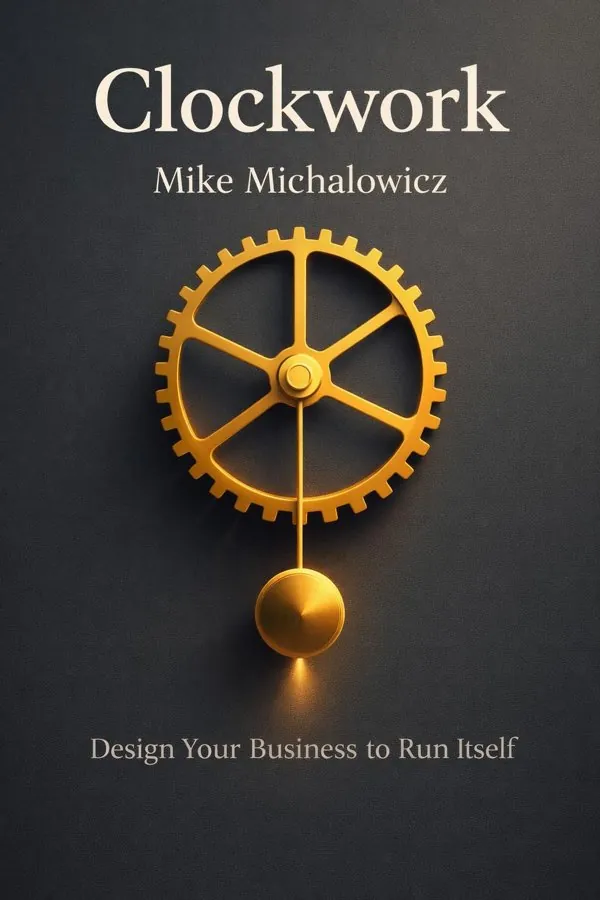
Clockwork: Design Your Business to Run Itself: Summary & Key Insights
 10 min9 chaptersAudio available
Key Takeaways from Clockwork: Design Your Business to Run Itself
Success can quietly become a prison when a business grows around the owner instead of beyond them.
Every successful business has one core function that matters more than all the others, and if that function fails, the business weakens fast.
Most owners do not hold on to work because they love every task; they hold on because they have never developed a reliable method for letting go.
Chaos thrives where knowledge lives only in people’s heads.
A business breaks down not only when processes are weak, but also when people are placed in roles that drain them or confuse accountability.
What Is Clockwork: Design Your Business to Run Itself About?
Clockwork: Design Your Business to Run Itself by Mike Michalowicz is a entrepreneurship book spanning 9 pages. Most entrepreneurs start a business to gain freedom, only to discover they have built a machine that cannot function without them. That is the central problem Mike Michalowicz tackles in Clockwork: Design Your Business to Run Itself. This book is not about working harder, hiring more people blindly, or chasing productivity hacks. It is about redesigning a business so that its essential functions operate smoothly, predictably, and profitably even when the owner steps away. Michalowicz argues that owner dependence is one of the greatest hidden threats to a company’s growth. When every decision, approval, sale, and emergency flows through the founder, the business becomes fragile. To solve this, he offers a practical framework built around identifying the company’s most vital function, documenting repeatable systems, delegating effectively, and testing whether the operation can run independently. Mike Michalowicz brings unusual authority to this topic. As an entrepreneur, investor, and bestselling author of Profit First, The Pumpkin Plan, and Fix This Next, he has spent years helping small-business owners build stronger companies. In Clockwork, he combines sharp insight, memorable metaphors, and step-by-step guidance to show how a business can finally serve its owner instead of consuming them.
This FizzRead summary covers all 9 key chapters of Clockwork: Design Your Business to Run Itself in approximately 10 minutes, distilling the most important ideas, arguments, and takeaways from Mike Michalowicz's work. Also available as an audio summary and Key Quotes Podcast.
Clockwork: Design Your Business to Run Itself
Most entrepreneurs start a business to gain freedom, only to discover they have built a machine that cannot function without them. That is the central problem Mike Michalowicz tackles in Clockwork: Design Your Business to Run Itself. This book is not about working harder, hiring more people blindly, or chasing productivity hacks. It is about redesigning a business so that its essential functions operate smoothly, predictably, and profitably even when the owner steps away.
Michalowicz argues that owner dependence is one of the greatest hidden threats to a company’s growth. When every decision, approval, sale, and emergency flows through the founder, the business becomes fragile. To solve this, he offers a practical framework built around identifying the company’s most vital function, documenting repeatable systems, delegating effectively, and testing whether the operation can run independently.
Mike Michalowicz brings unusual authority to this topic. As an entrepreneur, investor, and bestselling author of Profit First, The Pumpkin Plan, and Fix This Next, he has spent years helping small-business owners build stronger companies. In Clockwork, he combines sharp insight, memorable metaphors, and step-by-step guidance to show how a business can finally serve its owner instead of consuming them.
Who Should Read Clockwork: Design Your Business to Run Itself?
This book is perfect for anyone interested in entrepreneurship and looking to gain actionable insights in a short read. Whether you're a student, professional, or lifelong learner, the key ideas from Clockwork: Design Your Business to Run Itself by Mike Michalowicz will help you think differently.
- ✓Readers who enjoy entrepreneurship and want practical takeaways
- ✓Professionals looking to apply new ideas to their work and life
- ✓Anyone who wants the core insights of Clockwork: Design Your Business to Run Itself in just 10 minutes
Want the full summary?
Get instant access to this book summary and 100K+ more with Fizz Moment.
Get Free SummaryAvailable on App Store • Free to download
Key Chapters
Success can quietly become a prison when a business grows around the owner instead of beyond them. That is the painful truth Michalowicz puts at the center of Clockwork. Many entrepreneurs begin by doing everything themselves because it is efficient, necessary, and often cheaper. They sell, deliver, manage clients, solve problems, approve invoices, and answer every urgent question. In the early days, this feels heroic. Over time, it becomes dangerous.
The problem is not hard work itself. The problem is when the business becomes structurally dependent on one person’s constant availability. If customers expect only the founder to solve issues, employees wait for approval before moving, and operations break down whenever the owner is gone, then the company has not become a real business. It has become a highly stressful job.
Michalowicz argues that owner dependence creates bottlenecks, burnout, and stalled growth. A founder who touches everything can never think strategically for long because daily operational fires consume all attention. It also lowers company value. A business that cannot run without its owner is far less transferable, scalable, or resilient.
Imagine a design agency where the founder personally reviews every deliverable before it goes out. At first, this protects quality. Later, it causes delays, frustrates the team, and limits how many clients the agency can serve. The founder believes they are protecting the business, but in reality they are restricting it.
The first shift is mental: stop seeing yourself as the engine of the company and start seeing yourself as the architect of a system. A business should create freedom, not dependency. Actionable takeaway: list the daily, weekly, and monthly tasks only you currently do, then identify which of them are truly strategic and which are simply habits of control.
Every successful business has one core function that matters more than all the others, and if that function fails, the business weakens fast. Michalowicz calls this the Queen Bee Role, or QBR. Borrowing from a beehive, he explains that while many bees perform different jobs, the hive ultimately organizes itself around protecting the queen’s ability to produce. In business, the QBR is not always a person. It is the single most essential activity that drives value and keeps the company alive.
This idea is powerful because many companies confuse busywork with mission-critical work. They chase meetings, reports, and secondary projects while neglecting the one function customers truly depend on. In a hotel, the QBR may be room readiness. In a software company, it may be reliable platform performance. In a bakery, it may be fresh daily production. Everything else should support that central function.
Identifying the QBR changes how leaders make decisions. Hiring, training, accountability, and investment become more focused. Instead of asking, “Is this task important?” the better question becomes, “Does this directly protect or support our QBR?” That clarity helps teams prioritize under pressure.
For example, if a digital marketing agency defines its QBR as campaign execution accuracy and timeliness, then client communication, project management, analytics review, and staff scheduling should all be aligned to make sure campaigns launch correctly and on time. A flashy rebranding project may be less urgent than improving the handoff system between strategists and implementers.
The QBR also reduces internal confusion. Teams often underperform not because they lack talent, but because they lack a shared understanding of what matters most. Actionable takeaway: define your company’s Queen Bee Role in one sentence, then review your current tasks, meetings, and metrics to ensure they clearly support it.
Most owners do not hold on to work because they love every task; they hold on because they have never developed a reliable method for letting go. Michalowicz introduces the 4D Mix as a practical tool for deciding what to do with tasks that consume the entrepreneur’s time. The four actions are doing, deciding, delegating, and designing. While many owners stay trapped in the first two, sustainable businesses require a shift toward the last two.
Doing means personally completing the task. Deciding means being the one who approves, chooses, or resolves. Delegating means assigning work to others with clear ownership. Designing means creating the systems, rules, and processes that allow work to happen consistently without constant supervision. The long-term goal is not simply to delegate more, but to design a business where routine tasks and decisions happen automatically through structure.
This framework exposes why many delegations fail. An owner may delegate social media posting but still decide every caption, image, and calendar date. That is not real delegation. Likewise, assigning invoice follow-up to an employee without giving them a script, authority, or schedule creates confusion rather than leverage.
Consider a home services company where the founder handles customer scheduling. Using the 4D Mix, the owner could first document the criteria for urgent versus flexible appointments, then train an office manager to schedule accordingly, and finally set software rules for reminders and confirmations. What began as constant doing becomes a designed system.
The 4D Mix also helps owners see where their time is being wasted on low-value repetition. If you are still involved in tasks that can be codified, your business is asking for design work, not more personal effort. Actionable takeaway: take one recurring task you currently do, and map it through the 4Ds until you can either delegate it fully or design a system that removes your direct involvement.
Chaos thrives where knowledge lives only in people’s heads. One of Michalowicz’s most practical lessons is that businesses become scalable and resilient when they capture systems instead of relying on memory, heroics, and informal habits. Systems are simply documented ways of doing important work so that results become more consistent regardless of who performs the task.
Many entrepreneurs resist documentation because they imagine thick manuals nobody will read. Clockwork advocates a simpler, more useful approach. Start by recording the critical repeatable activities that affect quality, speed, customer experience, and revenue. Focus on what matters most, not on documenting every tiny action from day one.
The value of system capture is huge. It reduces training time, lowers errors, and protects the business from disruption when a team member leaves. It also makes delegation possible. You cannot expect someone to own a process you have never clearly defined.
A small e-commerce company, for instance, might document its order fulfillment process: when orders are printed, how items are checked, how packaging standards work, when customers receive tracking updates, and what to do when inventory is missing. That one system can improve customer satisfaction and reduce support tickets.
Michalowicz emphasizes that systems should be living tools, not static files. They should be easy to access, easy to update, and simple enough that the team actually uses them. Video walkthroughs, checklists, templates, and short written procedures often work better than complex operating manuals.
The deeper message is that if your business depends on people remembering everything, you do not have a reliable operation. You have a collection of personal habits. Actionable takeaway: choose three recurring activities that most affect customer experience or cash flow, and document each one in a simple, usable format this week.
A business breaks down not only when processes are weak, but also when people are placed in roles that drain them or confuse accountability. Michalowicz argues that a clockwork business requires team balance: the right people doing the right work, with clear responsibilities that support the company’s central function. Too often, small businesses build teams reactively. They hire whoever is available, give people mixed responsibilities, and assume loyalty can compensate for poor fit.
That approach creates hidden friction. A creative employee may be forced into detail-heavy administrative work. A reliable operator may be stretched into sales. A founder may keep a weak employee because they are nice, familiar, or inexpensive, even though they create delays for everyone else. The result is uneven execution and constant managerial intervention.
Balanced teams are built on clarity. Each role should exist for a clear reason, with measurable outcomes and boundaries of authority. People should know what they own, how success is evaluated, and how their work supports the Queen Bee Role. This reduces overlap, politics, and hesitation.
For example, in a consulting firm, one person may own client onboarding, another project delivery, and another invoicing and follow-up. If these responsibilities are vague, clients get inconsistent experiences and the founder gets pulled in to solve simple issues. If they are defined, the team can operate with confidence.
Michalowicz also encourages leaders to notice where energy rises and falls. Roles aligned with strengths create momentum. Roles built around convenience create drag. Team balance is not about making everyone happy all the time; it is about structuring work so people can perform reliably without constant rescue.
Actionable takeaway: review your team role by role and ask three questions: What does this person truly own, what result are they accountable for, and does their role match their strengths well enough to support independent performance?
If you do not know where your time goes, you cannot redesign your business intelligently. One of the most eye-opening practices in Clockwork is tracking how the owner actually spends time. Entrepreneurs often believe they are working on growth, leadership, and strategy, but when they log their activities honestly, they discover hours lost to interruptions, approvals, low-value communication, and tasks someone else could handle.
Michalowicz treats time not just as a personal productivity issue, but as an operational diagnostic tool. The founder’s calendar reveals where the business is underbuilt. If you spend hours solving customer service issues, your support process is weak. If payroll, scheduling, or invoicing always lands on your desk, your administrative systems are incomplete. If your team constantly asks for approval, decision rights are unclear.
This perspective shifts the goal from squeezing more output into your day to removing the need for your involvement in routine work. Time management, then, is not about becoming a more disciplined overworker. It is about identifying structural causes of overload.
For example, a restaurant owner might discover that every morning begins with inventory checks, staff questions, and vendor follow-up. Rather than trying to move faster, the better fix may be a standing inventory checklist, a shift lead with authority, and a vendor order template with reorder thresholds.
Michalowicz’s larger point is that busyness is often mistaken for importance. But being busy can simply mean you are trapped in an inefficient design. Time awareness helps owners distinguish between work that only they should do and work that should no longer reach them at all.
Actionable takeaway: track your activities in 30-minute blocks for one full week, then highlight every task that could be delegated, automated, or eliminated. Use that list as your blueprint for system improvements.
A business’s independence is best measured not by what the owner says, but by what happens when the owner disappears. Michalowicz’s famous four-week vacation test is both a practical experiment and a mindset shift. The idea is simple: if you stepped away for four weeks with minimal contact, what would happen? Many entrepreneurs instantly feel anxious at the question. That reaction is the point.
The test exposes all the hidden dependencies that day-to-day involvement conceals. Maybe clients would panic because only the founder holds key relationships. Maybe approvals would stall because nobody else has authority. Maybe quality would drop because no process exists for review. Maybe cash collection would slow because billing depends on the owner’s attention. Whatever breaks during the thought experiment identifies where the business needs redesign.
The vacation itself is not the ultimate goal. Freedom is. A company that can survive a significant absence is usually more robust, more systematic, and more valuable. It has decision-making distributed to the right people, processes documented, and priorities clearly understood.
A founder of a landscaping company, for instance, may realize a long absence would disrupt scheduling, estimates, and client communication. That insight can lead to assigning route planning to an operations manager, creating estimate templates, and establishing customer response guidelines. Each improvement strengthens the company even before the vacation happens.
The four-week test also helps owners confront emotional attachments. Sometimes the founder likes being needed because it validates their importance. Clockwork challenges that ego. Real leadership means building something that does not collapse without your presence.
Actionable takeaway: write down everything that would likely fail if you were gone for four weeks, rank those risks by severity, and fix the top one first through delegation, documentation, or clear authority transfer.
A system that works today can quietly become tomorrow’s bottleneck if nobody revisits it. Michalowicz makes clear that building a clockwork business is not a one-time reorganization project. It is an ongoing discipline of observing, refining, and strengthening operations as the company grows. Processes must evolve with customer expectations, team capabilities, technology, and scale.
Many businesses make an initial push toward structure and then stop. They write procedures, assign responsibilities, and feel temporarily organized. But without regular review, systems become outdated, workarounds reappear, and founder dependence slowly returns. Continuous improvement prevents that regression.
This does not require heavy bureaucracy. It requires attention. Teams should be encouraged to flag friction points, recurring mistakes, delays, and handoff problems. Leaders should ask where confusion keeps appearing and what process change would remove it. Improvement becomes easier when people are trained to solve root causes instead of compensating for them.
Imagine a subscription box business that experiences frequent shipping errors during peak months. Rather than blaming temporary staff each season, the company could review packing instructions, barcode checks, station layout, and final verification steps. A modest system change might eliminate hundreds of future errors.
Continuous improvement also reinforces ownership. When employees are invited to improve the systems they use, they become more engaged and less dependent on the founder for every fix. The company becomes smarter at every level.
Michalowicz’s philosophy is practical: perfection is not required, but iteration is. Small improvements, made consistently, create major gains in reliability over time. Actionable takeaway: establish a simple monthly review where your team identifies one recurring operational problem, finds its root cause, and updates the process to prevent it from happening again.
Entrepreneurs often say they want freedom, but many structure their business in ways that guarantee the opposite. One of Clockwork’s most important contributions is philosophical as much as operational: your business should support your life, not consume it. Michalowicz challenges the cultural myth that constant hustle is a badge of honor. If your company requires endless sacrifice just to keep functioning, something is broken.
This mindset matters because many owners normalize exhaustion. They postpone vacations, family time, health, and creative thinking because they believe full availability is the price of success. Clockwork argues that this is not noble. It is poor design. A business that drains the owner eventually weakens decision-making, damages relationships, and limits long-term growth.
Designing a self-running company does not mean becoming lazy or detached. It means focusing your energy where it has the highest value. The owner’s best contribution often lies in vision, culture, key relationships, innovation, and strategic choices, not in processing routine tasks or solving every small operational issue.
Take a founder who spends evenings catching up on administrative details because the day was consumed by team questions. By building clear processes, assigning ownership, and narrowing involvement to truly strategic areas, that founder can regain space to think, rest, and lead well. The business often improves as the owner stops becoming its bottleneck.
This mindset also creates sustainability. Companies built around one exhausted person are fragile. Companies built around clear systems and capable teams are far more durable.
Actionable takeaway: decide what kind of life your business is meant to support, then identify one recurring commitment or responsibility you can redesign so your schedule begins to reflect that vision instead of contradicting it.
All Chapters in Clockwork: Design Your Business to Run Itself
About the Author
Mike Michalowicz is an American entrepreneur, business writer, and speaker known for creating practical frameworks that help small-business owners build stronger, more sustainable companies. After launching and selling multiple businesses, he turned his attention to teaching entrepreneurs how to improve profitability, focus, and operational health. He is the bestselling author of several influential business books, including Profit First, The Pumpkin Plan, Fix This Next, and Clockwork. Michalowicz is widely appreciated for his clear, accessible style and his ability to translate complicated business challenges into memorable concepts that owners can apply immediately. His work has helped thousands of founders rethink growth, reduce chaos, and build companies that support both financial success and personal freedom.
Get This Summary in Your Preferred Format
Read or listen to the Clockwork: Design Your Business to Run Itself summary by Mike Michalowicz anytime, anywhere. FizzRead offers multiple formats so you can learn on your terms — all free.
Available formats: App · Audio · PDF · EPUB — All included free with FizzRead
Download Clockwork: Design Your Business to Run Itself PDF and EPUB Summary
Key Quotes from Clockwork: Design Your Business to Run Itself
“Success can quietly become a prison when a business grows around the owner instead of beyond them.”
“Every successful business has one core function that matters more than all the others, and if that function fails, the business weakens fast.”
“Most owners do not hold on to work because they love every task; they hold on because they have never developed a reliable method for letting go.”
“Chaos thrives where knowledge lives only in people’s heads.”
“A business breaks down not only when processes are weak, but also when people are placed in roles that drain them or confuse accountability.”
Frequently Asked Questions about Clockwork: Design Your Business to Run Itself
Clockwork: Design Your Business to Run Itself by Mike Michalowicz is a entrepreneurship book that explores key ideas across 9 chapters. Most entrepreneurs start a business to gain freedom, only to discover they have built a machine that cannot function without them. That is the central problem Mike Michalowicz tackles in Clockwork: Design Your Business to Run Itself. This book is not about working harder, hiring more people blindly, or chasing productivity hacks. It is about redesigning a business so that its essential functions operate smoothly, predictably, and profitably even when the owner steps away. Michalowicz argues that owner dependence is one of the greatest hidden threats to a company’s growth. When every decision, approval, sale, and emergency flows through the founder, the business becomes fragile. To solve this, he offers a practical framework built around identifying the company’s most vital function, documenting repeatable systems, delegating effectively, and testing whether the operation can run independently. Mike Michalowicz brings unusual authority to this topic. As an entrepreneur, investor, and bestselling author of Profit First, The Pumpkin Plan, and Fix This Next, he has spent years helping small-business owners build stronger companies. In Clockwork, he combines sharp insight, memorable metaphors, and step-by-step guidance to show how a business can finally serve its owner instead of consuming them.
More by Mike Michalowicz

Profit First: Transform Your Business from a Cash-Eating Monster to a Money-Making Machine
Mike Michalowicz
10 min
Fix This Next: Make the Vital Change That Will Level Up Your Business
Mike Michalowicz
10 min
Get Different: Marketing That Can't Be Ignored!
Mike Michalowicz
10 min
The Pumpkin Plan: A Simple Strategy to Grow a Remarkable Business in Any Field
Mike Michalowicz
10 minYou Might Also Like

Lean Analytics
Alistair Croll, Benjamin Yoskovitz
10 min
21 Days To A Big Idea: Creating Breakthrough Business Concepts
Bryan Mattimore
10 min
Sam Walton: Made in America: My Story
Sam Walton
10 min
10x Is Easier Than 2x: How World-Class Entrepreneurs Achieve More by Doing Less
Dan Sullivan, Benjamin Hardy
10 min
12 Months to $1 Million: How to Pick a Winning Product, Build a Real Business, and Become a Seven-Figure Entrepreneur
Ryan Daniel Moran
10 min
24 Assets: Create a Digital, Scalable, Valuable Business
Daniel Priestley
10 minFeatured In
Browse by Category
Ready to read Clockwork: Design Your Business to Run Itself?
Get the full summary and 100K+ more books with Fizz Moment.