
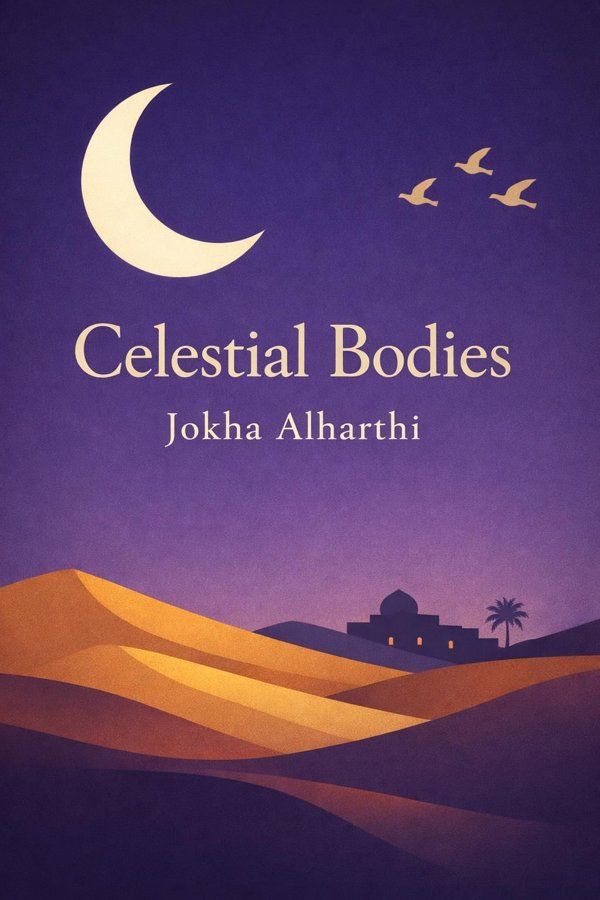
Celestial Bodies: Summary & Key Insights
 10 min9 chaptersAudio available
Key Takeaways from Celestial Bodies
A village can hold an entire civilization inside it.
People raised under the same roof can still become entirely different worlds.
The past does not disappear just because a nation modernizes; it continues speaking through sons and daughters.
Romance in Celestial Bodies is never just about feeling; it is always entangled with class, family, honor, memory, and timing.
A society’s deepest wounds often survive long after the law changes.
What Is Celestial Bodies About?
Celestial Bodies by Jokha Alharthi is a classics book spanning 5 pages. What happens to a family when an entire society begins to change beneath its feet? In Celestial Bodies, Jokha Alharthi answers that question through the intimate, layered lives of three sisters in the Omani village of al-Awafi. On the surface, the novel traces marriages, disappointments, desires, and family obligations. Beneath that surface, it reveals something larger: the transformation of Oman from a traditional, hierarchical society into a modern nation shaped by education, mobility, and new possibilities. Rather than presenting history as a list of events, Alharthi shows how change is felt in kitchens, bedrooms, courtyards, and silences passed down between generations. The result is a novel that is both deeply local and universally human, exploring love, memory, class, gender, slavery, and the burdens of inheritance. Its English translation by Marilyn Booth won the 2019 Man Booker International Prize, bringing deserved global attention to one of the most distinctive voices in contemporary Arabic literature. Alharthi writes not as an outsider explaining Oman, but as a master storyteller rendering its emotional and social complexities from within.
This FizzRead summary covers all 9 key chapters of Celestial Bodies in approximately 10 minutes, distilling the most important ideas, arguments, and takeaways from Jokha Alharthi's work. Also available as an audio summary and Key Quotes Podcast.
Celestial Bodies
What happens to a family when an entire society begins to change beneath its feet? In Celestial Bodies, Jokha Alharthi answers that question through the intimate, layered lives of three sisters in the Omani village of al-Awafi. On the surface, the novel traces marriages, disappointments, desires, and family obligations. Beneath that surface, it reveals something larger: the transformation of Oman from a traditional, hierarchical society into a modern nation shaped by education, mobility, and new possibilities. Rather than presenting history as a list of events, Alharthi shows how change is felt in kitchens, bedrooms, courtyards, and silences passed down between generations. The result is a novel that is both deeply local and universally human, exploring love, memory, class, gender, slavery, and the burdens of inheritance. Its English translation by Marilyn Booth won the 2019 Man Booker International Prize, bringing deserved global attention to one of the most distinctive voices in contemporary Arabic literature. Alharthi writes not as an outsider explaining Oman, but as a master storyteller rendering its emotional and social complexities from within.
Who Should Read Celestial Bodies?
This book is perfect for anyone interested in classics and looking to gain actionable insights in a short read. Whether you're a student, professional, or lifelong learner, the key ideas from Celestial Bodies by Jokha Alharthi will help you think differently.
- ✓Readers who enjoy classics and want practical takeaways
- ✓Professionals looking to apply new ideas to their work and life
- ✓Anyone who wants the core insights of Celestial Bodies in just 10 minutes
Want the full summary?
Get instant access to this book summary and 100K+ more with Fizz Moment.
Get Free SummaryAvailable on App Store • Free to download
Key Chapters
People raised under the same roof can still become entirely different worlds. Mayya, Asma, and Khawla, the three sisters at the emotional core of Celestial Bodies, embody distinct responses to love, duty, and womanhood. By shaping each sister differently, Alharthi avoids reducing women’s lives to a single cultural script. Instead, she shows how personality, longing, and circumstance interact within the limits of tradition.
Mayya is quiet, interior, and marked by emotional withdrawal. Her marriage is not the fulfillment of romance but an entry into compromise and endurance. Asma is more intellectual and reflective, drawn to knowledge and duty, and her choices suggest a willingness to find meaning within accepted structures. Khawla, by contrast, is defined by fierce attachment to an absent beloved, turning waiting itself into a kind of resistance. Together, the sisters reveal that conformity, rebellion, resignation, and hope are never simple opposites. They overlap in subtle, painful ways.
Their differences matter because the novel asks readers to reject stereotypes about women in traditional societies. There is no single female experience here. Each sister negotiates the same social world differently, reminding us that agency can appear as speech, silence, patience, refusal, or inward survival.
In everyday life, this insight is useful whenever we assume that people from similar families, classes, or cultures will want the same things. Even within tightly structured environments, individuals interpret duty and desire in highly personal ways.
Actionable takeaway: Resist one-size-fits-all judgments. To understand someone’s choices, pay attention to the private emotional logic behind them, not just the social role they occupy.
The past does not disappear just because a nation modernizes; it continues speaking through sons and daughters. One of the most revealing voices in Celestial Bodies is Abdallah, whose inner life exposes the emotional cost of inherited authority, fear, and masculine expectation. His narrative shows that patriarchy does not only restrict women; it also wounds men who are shaped by harsh fathers, emotional distance, and the demand to perform control rather than vulnerability.
Abdallah’s memories of his father haunt his marriage and his sense of self. He is not presented as a simple villain or hero. Instead, Alharthi gives him contradiction: he desires tenderness yet reproduces patterns of dominance; he seeks connection yet is trapped by habits of silence and insecurity. Through him, the novel demonstrates how family systems perpetuate themselves. What one generation normalizes, the next may unconsciously repeat.
This makes Abdallah more than an individual character. He becomes a study in legacy: how shame, power, obedience, and emotional deprivation travel across time. His perspective complicates any simplistic reading of men as merely beneficiaries of tradition. Yes, he moves within systems that privilege him, but he is also deformed by them.
This idea has practical value for readers reflecting on family dynamics. Many people inherit scripts about masculinity, authority, and affection without realizing it. Abdallah’s struggle invites us to ask which parts of our upbringing we are carrying forward uncritically.
Actionable takeaway: Examine the emotional habits you inherited from your family. Naming them is the first step toward breaking harmful cycles rather than repeating them.
A society’s deepest wounds often survive long after the law changes. One of the most important and unsettling dimensions of Celestial Bodies is its treatment of slavery and its afterlives in Omani society. Alharthi does not treat this history as a distant footnote. Instead, she shows how slavery continues to shape memory, status, belonging, and human relationships, even in a changing modern nation.
By including formerly enslaved characters and their descendants within the novel’s social fabric, she exposes the persistence of hierarchy beneath the language of progress. The trauma is not only historical but personal. It lives in stories not fully told, in the unequal distribution of dignity, and in the invisible lines that structure who belongs where. This gives the novel moral depth: modernization is not presented as an automatic cleansing force. Material progress can coexist with unresolved historical injustice.
What makes this portrayal especially powerful is its refusal of easy closure. The past cannot be repaired simply by moving forward. It must be remembered, confronted, and integrated into a fuller account of national identity. In many societies, similar patterns exist. Legacies of enslavement, colonialism, caste, or racial exclusion remain active in social life even when official narratives prefer to celebrate development and unity.
For readers, this becomes a lesson in historical literacy. To understand a community honestly, we must ask whose suffering has been omitted from its self-image and how that omission still shapes the present.
Actionable takeaway: Do not mistake legal or political change for complete justice. Look for the hidden continuities of history in present-day attitudes, opportunities, and silences.
Human lives are not experienced in straight lines, and Celestial Bodies refuses to pretend otherwise. Alharthi structures the novel through shifting perspectives, recollections, interruptions, and nonlinear returns to the past. This fragmented movement through time mirrors the way memory actually works: the present is constantly invaded by childhood, regret, fantasy, and inherited stories.
This narrative design is not merely stylistic elegance. It reinforces one of the book’s central insights: no one lives only in the now. Each character is shaped by remembered humiliation, old longing, family legend, or buried grief. The result is a textured understanding of identity. People are not defined solely by what they do in the present moment, but by what they continue to carry within them.
The nonlinear form also encourages readers to be patient interpreters. Initial judgments often soften or become more complex as new memories surface. A character who appears cold may turn out to be wounded; someone who seems powerful may be bound by fear. In this way, structure becomes ethics: the novel teaches readers not to rush to simplistic conclusions.
This has clear application outside fiction. In real life, we often interpret people based on a narrow slice of behavior, ignoring the layered histories behind it. Family conflicts, workplace tensions, and personal misunderstandings all become easier to navigate when we remember that present behavior usually has a longer story behind it.
Actionable takeaway: When someone’s actions confuse or frustrate you, ask what history might be shaping the present. Context often reveals what surface behavior conceals.
Not all silence is emptiness; sometimes it is a language formed under pressure. In Celestial Bodies, women are often denied direct power, but Alharthi shows that silence itself can carry emotion, refusal, endurance, irony, and sorrow. This does not romanticize oppression. Rather, it reveals how people communicate when open speech is risky, unwelcome, or culturally constrained.
Mayya in particular illustrates this dynamic. Her inwardness is not simple passivity. Her reserve becomes a complex mode of survival, a way of withholding herself from a world that expects compliance without asking what she feels. Across the novel, gestures, pauses, absences, and unspoken disappointments become as meaningful as overt declarations. Domestic life is shown as full of encoded expression.
This matters because many readers are trained to equate agency with loud defiance. Alharthi offers a subtler picture. In restrictive settings, strength may appear as persistence, emotional opacity, strategic patience, or the refusal to give one’s inner life away. At the same time, the novel never lets us forget the cost of such containment. Silence protects, but it also isolates.
The broader lesson applies in homes, workplaces, and communities today. People who seem quiet may be making deliberate choices shaped by power imbalances, fear of judgment, or long practice in self-protection. Listening well means noticing what is not said, and why.
Actionable takeaway: Pay attention to indirect forms of communication. Silence, hesitation, and withdrawal often convey important truths that direct speech cannot safely express.
Progress changes lives, but it rarely does so without creating new forms of uncertainty. Celestial Bodies portrays Oman’s modernization with nuance, showing it neither as pure liberation nor as simple cultural loss. Education expands horizons, mobility creates possibilities, and economic development alters expectations. Yet these gains also unsettle identities, weaken inherited certainties, and expose emotional gaps that old structures once concealed.
This balanced vision is one of the novel’s great achievements. Alharthi resists nostalgia for a supposedly harmonious past, because that past contained inequality, gender restrictions, and slavery. But she also resists naïve celebration of the new. Modern life does not automatically produce emotional fulfillment, justice, or self-knowledge. Instead, people must improvise new ways of relating while carrying old habits into changing conditions.
For families, modernization often means generational divergence. Elders may value obedience and continuity, while younger people pursue education, romance, migration, or self-definition. Such transitions can produce misunderstanding even when everyone believes they are acting out of love or responsibility. The novel captures this beautifully through small shifts in expectation rather than grand ideological debates.
This idea resonates globally. Across the world, people live through similar tensions involving technology, urbanization, migration, and changing gender roles. Celestial Bodies reminds us that progress is real, but adaptation is emotionally uneven.
Actionable takeaway: When assessing social progress, ask two questions at once: what new freedoms have emerged, and what new forms of confusion or loss have accompanied them?
The family in Celestial Bodies is a source of care, identity, pressure, and repetition all at once. Alharthi understands that family is rarely simple. It offers belonging and continuity, but it also transmits fear, hierarchy, resentment, and unrealized dreams. Characters are nurtured by kinship ties even as they are constrained by them.
This double nature explains much of the novel’s emotional power. Family members do not merely influence one another through explicit decisions like arranging marriages or enforcing expectations. They shape each other through mood, memory, favoritism, silence, and the stories they tell about what a good life should be. In this way, family becomes a mechanism of destiny. People may try to escape inherited patterns, but those patterns live inside them.
At the same time, the novel does not reduce family to oppression. It recognizes tenderness, obligation, and the deep human need to remain connected to those who made us. That complexity is essential. Most people do not relate to family through pure love or pure rebellion, but through ongoing negotiation.
The practical relevance is immediate. Many readers will recognize how family expectations continue to shape career choices, partnerships, self-esteem, and emotional habits long into adulthood. Understanding this can make personal decisions clearer. It can also make forgiveness more intelligent, because we begin to see how individuals are formed within systems larger than themselves.
Actionable takeaway: Reflect on which family patterns have genuinely supported your growth and which ones you are treating as destiny when they are actually choices you can revise.
All Chapters in Celestial Bodies
About the Author
Jokha Alharthi is an acclaimed Omani writer and scholar born in 1978. She studied Arabic language and literature in Oman and later earned a PhD in Classical Arabic Literature from the University of Edinburgh. Alongside her literary career, she teaches at Sultan Qaboos University and has published novels, short stories, and children’s books. Alharthi is celebrated for bringing Omani history, social life, and women’s experiences into contemporary fiction with unusual subtlety and emotional precision. Her international breakthrough came with Celestial Bodies, translated into English by Marilyn Booth, which won the 2019 Man Booker International Prize. The award marked a historic milestone as the first time an Arabic-language novel received the honor, introducing Alharthi’s work to a wide global readership.
Get This Summary in Your Preferred Format
Read or listen to the Celestial Bodies summary by Jokha Alharthi anytime, anywhere. FizzRead offers multiple formats so you can learn on your terms — all free.
Available formats: App · Audio · PDF · EPUB — All included free with FizzRead
Download Celestial Bodies PDF and EPUB Summary
Key Quotes from Celestial Bodies
“A village can hold an entire civilization inside it.”
“People raised under the same roof can still become entirely different worlds.”
“The past does not disappear just because a nation modernizes; it continues speaking through sons and daughters.”
“Romance in Celestial Bodies is never just about feeling; it is always entangled with class, family, honor, memory, and timing.”
“A society’s deepest wounds often survive long after the law changes.”
Frequently Asked Questions about Celestial Bodies
Celestial Bodies by Jokha Alharthi is a classics book that explores key ideas across 9 chapters. What happens to a family when an entire society begins to change beneath its feet? In Celestial Bodies, Jokha Alharthi answers that question through the intimate, layered lives of three sisters in the Omani village of al-Awafi. On the surface, the novel traces marriages, disappointments, desires, and family obligations. Beneath that surface, it reveals something larger: the transformation of Oman from a traditional, hierarchical society into a modern nation shaped by education, mobility, and new possibilities. Rather than presenting history as a list of events, Alharthi shows how change is felt in kitchens, bedrooms, courtyards, and silences passed down between generations. The result is a novel that is both deeply local and universally human, exploring love, memory, class, gender, slavery, and the burdens of inheritance. Its English translation by Marilyn Booth won the 2019 Man Booker International Prize, bringing deserved global attention to one of the most distinctive voices in contemporary Arabic literature. Alharthi writes not as an outsider explaining Oman, but as a master storyteller rendering its emotional and social complexities from within.
You Might Also Like






Browse by Category
Ready to read Celestial Bodies?
Get the full summary and 100K+ more books with Fizz Moment.