
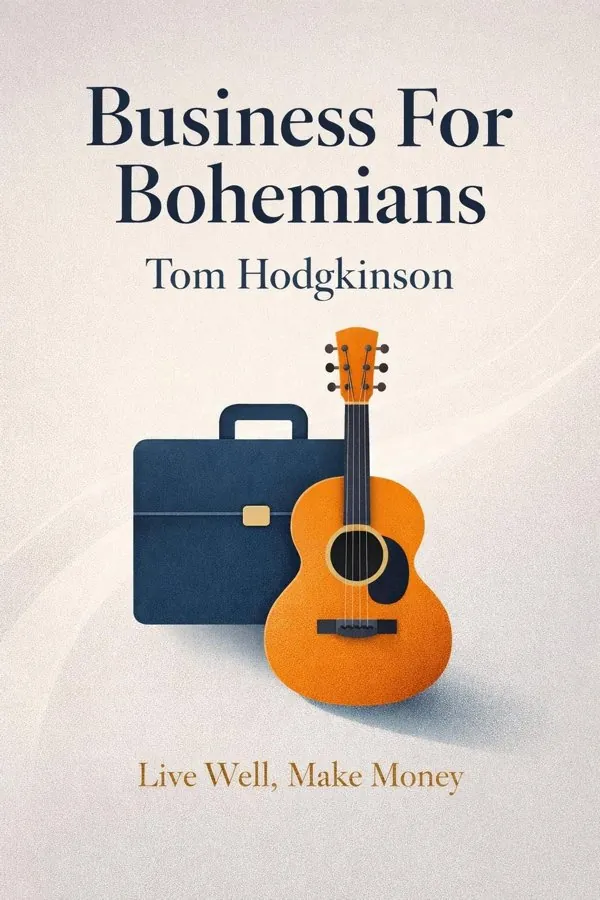
Business For Bohemians: Live Well, Make Money: Summary & Key Insights
 10 min10 chaptersAudio available
Key Takeaways from Business For Bohemians: Live Well, Make Money
A business does not have to look like a corporation to be real.
The strongest businesses often begin not with a market gap but with a human being.
Money is often treated as either a dirty compromise or the ultimate scoreboard.
Many creative people dislike marketing because they associate it with hype, pressure, and insincerity.
One of the book’s most distinctive claims is that idleness is not the enemy of work; it is often the source of good work.
What Is Business For Bohemians: Live Well, Make Money About?
Business For Bohemians: Live Well, Make Money by Tom Hodgkinson is a entrepreneurship book spanning 11 pages. Business For Bohemians: Live Well, Make Money is Tom Hodgkinson’s spirited alternative to the standard business manual. Rather than telling readers to chase growth at all costs, optimize every waking hour, or imitate corporate culture, Hodgkinson argues that it is possible to earn a living while preserving creativity, independence, and pleasure. The book is aimed at artists, freelancers, makers, writers, and unconventional entrepreneurs who want their work to reflect their values rather than crush them. Its central question is simple but powerful: how can you build a business that supports a good life instead of consuming it? What makes the book especially compelling is Hodgkinson’s voice. He writes with wit, irreverence, and hard-won experience, drawing on his years founding and running The Idler magazine, a publication devoted to leisure, freedom, and thoughtful living. He understands both the romance and the difficulty of working for yourself. This gives the book unusual credibility: it is philosophical without being vague, and practical without becoming soulless. For anyone tired of hustle culture and eager to create a livelihood on more humane terms, this book offers a refreshing and surprisingly useful blueprint.
This FizzRead summary covers all 10 key chapters of Business For Bohemians: Live Well, Make Money in approximately 10 minutes, distilling the most important ideas, arguments, and takeaways from Tom Hodgkinson's work. Also available as an audio summary and Key Quotes Podcast.
Business For Bohemians: Live Well, Make Money
Business For Bohemians: Live Well, Make Money is Tom Hodgkinson’s spirited alternative to the standard business manual. Rather than telling readers to chase growth at all costs, optimize every waking hour, or imitate corporate culture, Hodgkinson argues that it is possible to earn a living while preserving creativity, independence, and pleasure. The book is aimed at artists, freelancers, makers, writers, and unconventional entrepreneurs who want their work to reflect their values rather than crush them. Its central question is simple but powerful: how can you build a business that supports a good life instead of consuming it?
What makes the book especially compelling is Hodgkinson’s voice. He writes with wit, irreverence, and hard-won experience, drawing on his years founding and running The Idler magazine, a publication devoted to leisure, freedom, and thoughtful living. He understands both the romance and the difficulty of working for yourself. This gives the book unusual credibility: it is philosophical without being vague, and practical without becoming soulless. For anyone tired of hustle culture and eager to create a livelihood on more humane terms, this book offers a refreshing and surprisingly useful blueprint.
Who Should Read Business For Bohemians: Live Well, Make Money?
This book is perfect for anyone interested in entrepreneurship and looking to gain actionable insights in a short read. Whether you're a student, professional, or lifelong learner, the key ideas from Business For Bohemians: Live Well, Make Money by Tom Hodgkinson will help you think differently.
- ✓Readers who enjoy entrepreneurship and want practical takeaways
- ✓Professionals looking to apply new ideas to their work and life
- ✓Anyone who wants the core insights of Business For Bohemians: Live Well, Make Money in just 10 minutes
Want the full summary?
Get instant access to this book summary and 100K+ more with Fizz Moment.
Get Free SummaryAvailable on App Store • Free to download
Key Chapters
A business does not have to look like a corporation to be real. One of Hodgkinson’s most liberating ideas is that modern business culture has sold us a very narrow definition of success: long hours, constant expansion, professional jargon, polished branding, and an almost religious devotion to efficiency. In that worldview, business is treated as a grim arena where seriousness proves legitimacy. Hodgkinson pushes back against this. He argues that many people, especially creative people, fail before they begin because they assume they must adopt an alien identity in order to earn money.
His alternative is not laziness or fantasy. It is the recognition that a small, personal, values-driven enterprise can be every bit as viable as a conventional company. A writer selling courses, a ceramic artist running a workshop studio, a café owner creating a neighborhood hub, or a musician teaching and performing independently may all be building authentic businesses, even if they have no investors, no corporate structure, and no five-year scaling plan. The point is not to imitate the business elite; it is to create an economic life that suits your temperament.
This shift matters because once you stop trying to perform professionalism in someone else’s image, you can focus on what actually works: serving real people, making something worthwhile, keeping costs sane, and staying consistent. Hodgkinson reframes entrepreneurship as self-possession rather than self-betrayal.
Actionable takeaway: write down three assumptions you have absorbed about what a “real business” should look like, then cross out any that would force you to abandon your personality, values, or way of life.
The strongest businesses often begin not with a market gap but with a human being. Hodgkinson argues that if you are creating a bohemian business, the starting point is not a spreadsheet or trend report but your own nature: your skills, enthusiasms, habits, tastes, and worldview. In other words, the business should emerge from who you are, not from what you imagine the market wants from a generic entrepreneur.
This does not mean ignoring customers. It means recognizing that originality has commercial value. If you love books, host lively conversations, and have an eye for curation, perhaps your business is not “retail” but a literary community with products attached. If you are a gifted baker who also loves hospitality, you may be building a place people return to for warmth and character, not just pastries. The most memorable independent businesses feel personal because they are personal.
Hodgkinson’s insight is especially useful for people who feel uneasy about branding themselves. He suggests that authenticity is not a performance but a practical advantage. When your business reflects your genuine interests, decisions become easier: what to sell, how to communicate, whom to collaborate with, and what opportunities to decline. You conserve energy because you are not pretending.
The challenge, of course, is clarity. Many creative people have multiple interests and fears. The answer is to begin with a simple offer shaped around your strongest abilities and your preferred way of living, then refine it through experience rather than endless planning.
Actionable takeaway: list your top three skills, top three pleasures, and top three values, then design one business idea that naturally combines at least one item from each list.
Money is often treated as either a dirty compromise or the ultimate scoreboard. Hodgkinson rejects both extremes. For the bohemian entrepreneur, money should be understood as a tool: necessary, useful, and morally neutral. Its purpose is not merely accumulation but freedom. You need enough income to pay your bills, reduce anxiety, support your craft, and buy back your time. Once you understand this, financial thinking becomes less frightening and more humane.
A key part of his argument is that creative independence depends on financial realism. If you refuse to think about pricing, cash flow, or costs, you may end up more dependent, not less. The artist who never sends invoices, the freelancer who undercharges out of embarrassment, and the founder who expands too quickly without reserves all become vulnerable. On the other hand, a modest business with healthy margins and low overhead can provide a surprisingly stable and liberating life.
Hodgkinson encourages readers to keep their needs simple. Freedom often comes less from earning vast sums than from reducing unnecessary expenses and avoiding status-driven consumption. A designer who works from a small studio and keeps expenses lean may have more actual freedom than someone with a prestigious office and constant financial pressure. The goal is to make enough, keep enough, and avoid building a life that requires permanent overwork.
This perspective also changes how you price your work. Fair pricing is not greed; it is what allows you to continue serving people well without exhaustion or resentment.
Actionable takeaway: calculate your true monthly personal and business costs, define the income level that gives you stability, and set prices based on sustainability rather than guilt or guesswork.
Many creative people dislike marketing because they associate it with hype, pressure, and insincerity. Hodgkinson’s refreshing argument is that marketing does not have to be manipulative. At its best, it is simply the art of making yourself known in a way that reflects your character. For bohemian entrepreneurs, the most effective marketing often comes through voice, story, taste, and genuine connection rather than aggressive selling tactics.
This means you do not need to become a different person to promote your work. If you run a small publishing venture, your marketing might be thoughtful essays, engaging newsletters, live events, and conversations with readers. If you make handmade products, your marketing may come from sharing your process, showing the care behind the work, and building trust through consistency. People are drawn to independent businesses because they feel human. That human quality is not separate from marketing; it is the foundation of it.
Hodgkinson also suggests that wit, style, and generosity matter. A well-written email, a memorable poster, a friendly invitation, or a strong point of view can do more than expensive campaigns. Word of mouth remains one of the strongest engines of growth for small businesses, and word of mouth thrives when customers feel delighted, seen, or part of something meaningful.
The practical lesson is to choose methods that you can sustain and enjoy. Marketing that feels false will usually be abandoned. Marketing that feels like an extension of your work becomes easier to maintain.
Actionable takeaway: pick two marketing channels that match your natural strengths, such as writing, speaking, hosting, or visual storytelling, and commit to showing up consistently there for the next 30 days.
One of the book’s most distinctive claims is that idleness is not the enemy of work; it is often the source of good work. Hodgkinson has long championed leisure as a condition for reflection, imagination, and sanity. In a culture that glorifies busyness, this can sound irresponsible, but his point is practical: exhausted minds produce dull ideas, and overworked entrepreneurs often lose the very spark that made their enterprise interesting in the first place.
For creative business owners, leisure is not simply time off after the real work is done. It is part of the process. Walking, reading, daydreaming, meeting friends, lingering over meals, gardening, or sitting quietly can all nourish insight. A magazine editor may discover themes while wandering through a market. A craftsperson may solve design problems away from the bench. A teacher may develop richer material by living a fuller life. Constant activity can create the illusion of productivity while reducing actual originality.
This does not mean abandoning discipline. Hodgkinson is not advocating drift without responsibility. Rather, he is urging readers to resist a machine-like relationship to time. A humane rhythm of work and rest can produce better output over the long term than relentless strain. It also makes self-employment worth choosing.
This idea is especially important because many independent workers recreate the worst parts of office culture for themselves, becoming their own harsh managers. The bohemian alternative is intentional spaciousness.
Actionable takeaway: schedule one recurring period each week with no administrative tasks, no social media, and no pressure to produce, then use that time for reading, walking, or reflection to replenish your creative mind.
A romantic vision can start a business, but practical competence keeps it alive. Hodgkinson acknowledges that many creative people are tempted to ignore the duller aspects of enterprise: bookkeeping, contracts, invoicing, taxes, inventory, customer communication, and basic planning. Yet he insists that learning these skills is not a betrayal of art. On the contrary, they are the protective framework that allows artful work to continue.
What is striking in his approach is that he demystifies administration. You do not need to become a corporate manager or financial wizard. You need enough competence to remain independent. If you know how to track income and costs, issue invoices promptly, keep simple records, communicate expectations clearly, and deliver work on time, you already possess an enormous advantage. Many businesses fail not because the product is bad but because the operations are chaotic.
Consider a freelance illustrator. Talent may bring attention, but if proposals are unclear, payment terms are vague, and deadlines are mishandled, stress quickly replaces freedom. By contrast, a simple system for proposals, deposits, file delivery, and follow-up can make the business feel reliable to clients and manageable to the artist. The same applies to small shops, coaches, makers, and event hosts.
Hodgkinson’s larger point is empowering: practical skills can be learned gradually. They do not have to dominate your identity. You can remain imaginative while becoming orderly enough to protect your livelihood.
Actionable takeaway: identify the one administrative weakness that creates the most stress in your business—such as invoicing, bookkeeping, or client agreements—and build a single simple system to handle it consistently this month.
Technology can be both liberating and enslaving, and Hodgkinson urges discernment in how small business owners use it. Digital tools make it easier than ever to publish, sell, communicate, and manage work without gatekeepers. A writer can build an audience through email, a maker can sell directly online, and a teacher can offer classes across borders. For independent entrepreneurs, this is a historic opportunity. You no longer need to wait for institutions to grant permission.
Yet the same technology can trap you in distraction, dependency, and constant responsiveness. If every platform demands content, every customer expects immediate replies, and every hour is fractured by notifications, then the tools that promised freedom begin to erode it. Hodgkinson’s concern is not anti-technology; it is anti-servitude. He encourages readers to use digital systems intentionally, choosing those that support autonomy rather than colonize attention.
This might mean prioritizing an email list you control over chasing every social platform, using accounting software to simplify finances, or setting boundaries around communication hours. It may also mean recognizing that not every new app deserves entry into your workflow. Tools should serve the business’s character and goals, not dictate them.
For bohemians especially, the temptation is either total resistance or total immersion. Hodgkinson offers a middle path: adopt useful tools, ignore status-driven tech trends, and preserve your inner life. Independence today requires technical literacy, but also the courage to remain unreachable at times.
Actionable takeaway: audit the digital tools you use in your business and remove or limit any platform, app, or habit that consumes attention without clearly helping you earn, create, or connect.
The lone genius is an appealing myth, but most sustainable creative businesses are supported by relationships. Hodgkinson emphasizes that bohemian enterprise flourishes in community: among friends, collaborators, loyal customers, local networks, and fellow independents who exchange ideas and encouragement. Business, in this sense, is not merely transactional. It is social and cultural.
This matters because small independent ventures often compete not on scale but on belonging. People return to an independent bookstore, workshop, café, studio, or publication because it offers not only a product but a feeling of participation. A business with character becomes a gathering point. That gathering point may be physical or digital, but in either case, trust and shared identity drive loyalty.
Collaboration also reduces the burden of doing everything alone. A photographer can partner with a writer on a project, a local food producer can co-host an event with a wine merchant, a designer can trade expertise with a web developer, and a small publisher can build an audience through alliances with booksellers and teachers. These partnerships expand reach while preserving independence.
Hodgkinson’s view is especially encouraging for those intimidated by competition. Instead of obsessing over rivals, ask how you can become part of an ecosystem. Community offers referrals, resilience, and creative stimulation. It also makes work more enjoyable, which is no trivial benefit.
Actionable takeaway: make a list of five people or organizations aligned with your values—locally or online—and reach out to one this week with a concrete idea for collaboration, mutual support, or shared promotion.
Fear is one of the hidden costs of independence. Hodgkinson understands that many talented people remain stuck not because they lack ideas but because they fear judgment, failure, poverty, or exposure. The inner voice says the project is too eccentric, the market too uncertain, the timing too late, the competition too strong. Left unchallenged, that voice can turn potential into permanent postponement.
His answer is not macho confidence but practical courage. Most business fears become less overwhelming when translated into manageable experiments. Instead of asking, “Can I build a successful creative enterprise?” ask, “Can I sell one offering to ten people?” Instead of waiting for certainty, test a workshop, publish a newsletter, open pre-orders, host a supper club, or pitch a pilot service. Action generates information, and information reduces fantasy-driven fear.
Hodgkinson also reminds readers that self-doubt never fully disappears. The goal is not to become fearless, but to stop requiring emotional certainty before making moves. Creative entrepreneurship always involves vulnerability because your work carries something personal. Yet that same personal quality is often what gives it value. If you hide it completely, the business loses its soul.
This insight is crucial for bohemians because they may be especially sensitive to rejection or reluctant to commodify what they love. But the alternative to risk is often stagnation. Better to begin imperfectly and learn publicly than remain faithful only to unrealized dreams.
Actionable takeaway: choose one small, visible step you have been avoiding—launching a page, naming your offer, pitching a client, or announcing a date—and complete it within the next seven days before overthinking returns.
The deepest question in the book is not how to build a business, but what a business is for. Hodgkinson’s answer is clear: it should support a life worth living. That means the final measure of success is not endless growth, prestige, or domination of a market. It is whether your work allows you to live with dignity, pleasure, freedom, and enough money to sustain yourself and those you care about.
This is a radical message in an entrepreneurial culture obsessed with scale. Many founders are taught to maximize, automate, raise, expand, and optimize until the business becomes unrecognizable or overwhelming. Hodgkinson suggests that “enough” is an intelligent target. A business that pays well, serves a community, leaves room for family and friendship, and reflects your values may already be successful, even if it never becomes large.
This perspective encourages deliberate design. You can choose clients you respect, keep the business at a manageable size, avoid debt-fueled growth, and preserve the qualities that made the work meaningful. A craft workshop with waiting lists, a steady subscription publication, a thriving private practice, or a beloved neighborhood venture may all represent excellent outcomes. Bigger is not always better; often, better is better.
For readers exhausted by hustle culture, this is perhaps the book’s greatest gift. It grants permission to define success in human terms rather than abstract ones. Business becomes part of the good life, not a postponement of it.
Actionable takeaway: write a one-paragraph description of your ideal ordinary week—how you work, earn, rest, and relate to others—then use that vision as your benchmark for business decisions instead of defaulting to growth for its own sake.
All Chapters in Business For Bohemians: Live Well, Make Money
About the Author
Tom Hodgkinson is a British writer, editor, and cultural critic known for championing independence, leisure, and alternative ways of living and working. He is the founder of The Idler magazine, a publication that became associated with thoughtful resistance to overwork and consumerist definitions of success. Across his books and journalism, Hodgkinson has explored subjects such as idleness, freedom, education, work, and everyday philosophy, often with wit and a distinctly anti-corporate sensibility. What sets him apart is his ability to combine practical advice with cultural criticism, making him both entertaining and useful. In Business For Bohemians, he draws on years of firsthand experience building a creative enterprise, offering guidance to readers who want to make a living without sacrificing individuality, pleasure, or principle.
Get This Summary in Your Preferred Format
Read or listen to the Business For Bohemians: Live Well, Make Money summary by Tom Hodgkinson anytime, anywhere. FizzRead offers multiple formats so you can learn on your terms — all free.
Available formats: App · Audio · PDF · EPUB — All included free with FizzRead
Download Business For Bohemians: Live Well, Make Money PDF and EPUB Summary
Key Quotes from Business For Bohemians: Live Well, Make Money
“A business does not have to look like a corporation to be real.”
“The strongest businesses often begin not with a market gap but with a human being.”
“Money is often treated as either a dirty compromise or the ultimate scoreboard.”
“Many creative people dislike marketing because they associate it with hype, pressure, and insincerity.”
“One of the book’s most distinctive claims is that idleness is not the enemy of work; it is often the source of good work.”
Frequently Asked Questions about Business For Bohemians: Live Well, Make Money
Business For Bohemians: Live Well, Make Money by Tom Hodgkinson is a entrepreneurship book that explores key ideas across 10 chapters. Business For Bohemians: Live Well, Make Money is Tom Hodgkinson’s spirited alternative to the standard business manual. Rather than telling readers to chase growth at all costs, optimize every waking hour, or imitate corporate culture, Hodgkinson argues that it is possible to earn a living while preserving creativity, independence, and pleasure. The book is aimed at artists, freelancers, makers, writers, and unconventional entrepreneurs who want their work to reflect their values rather than crush them. Its central question is simple but powerful: how can you build a business that supports a good life instead of consuming it? What makes the book especially compelling is Hodgkinson’s voice. He writes with wit, irreverence, and hard-won experience, drawing on his years founding and running The Idler magazine, a publication devoted to leisure, freedom, and thoughtful living. He understands both the romance and the difficulty of working for yourself. This gives the book unusual credibility: it is philosophical without being vague, and practical without becoming soulless. For anyone tired of hustle culture and eager to create a livelihood on more humane terms, this book offers a refreshing and surprisingly useful blueprint.
You Might Also Like
Lean Analytics
Alistair Croll, Benjamin Yoskovitz
10 min
21 Days To A Big Idea: Creating Breakthrough Business Concepts
Bryan Mattimore
10 min
Sam Walton: Made in America: My Story
Sam Walton
10 min
10x Is Easier Than 2x: How World-Class Entrepreneurs Achieve More by Doing Less
Dan Sullivan, Benjamin Hardy
10 min
12 Months to $1 Million: How to Pick a Winning Product, Build a Real Business, and Become a Seven-Figure Entrepreneur
Ryan Daniel Moran
10 min
24 Assets: Create a Digital, Scalable, Valuable Business
Daniel Priestley
10 minFeatured In
Browse by Category
Ready to read Business For Bohemians: Live Well, Make Money?
Get the full summary and 100K+ more books with Fizz Moment.