
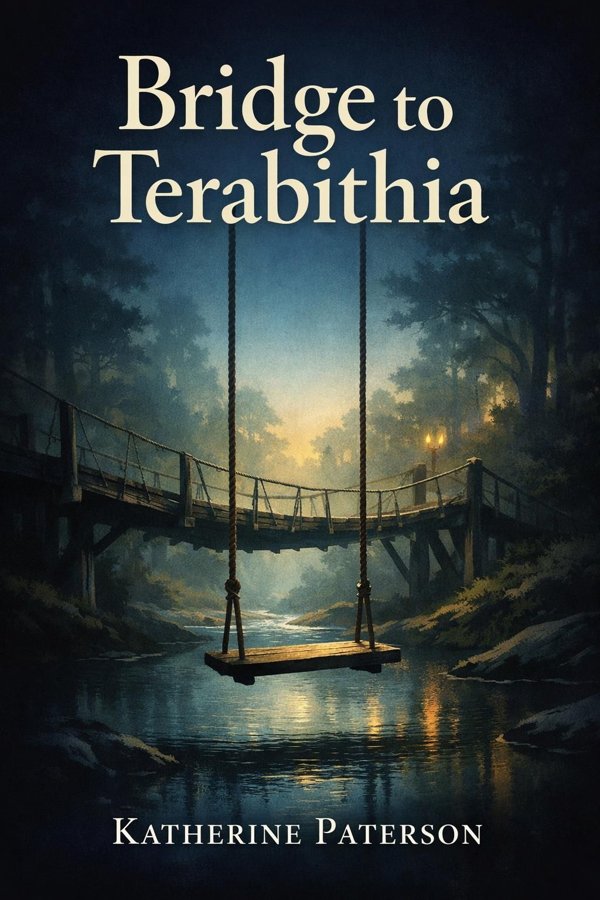
Bridge to Terabithia: Summary & Key Insights
 10 min8 chaptersAudio available
Key Takeaways from Bridge to Terabithia
Many children do not act out because they are difficult; they ache because they feel invisible.
The people who change our lives most often arrive in forms we did not expect.
Imagination is often dismissed as make-believe, but in Bridge to Terabithia it becomes a tool for survival.
Some of childhood’s deepest wounds come not from dramatic events but from ordinary humiliation.
What looks like weakness in one setting may be strength in another.
What Is Bridge to Terabithia About?
Bridge to Terabithia by Katherine Paterson is a classics book spanning 5 pages. Bridge to Terabithia is a timeless children’s classic that begins as a story about loneliness and friendship and deepens into something far more powerful: a meditation on imagination, identity, grief, and emotional resilience. Katherine Paterson follows Jess Aarons, a boy who feels unseen in his large working-class family, and Leslie Burke, the bright, unconventional new girl who becomes his closest friend. Together they create Terabithia, an imaginary kingdom in the woods where they reign as king and queen, transforming ordinary childhood struggles into grand adventures. What makes the novel endure is its honesty. Paterson does not sentimentalize childhood; she treats children’s inner lives with seriousness, showing how deeply they feel rejection, hope, wonder, and loss. The novel explores how creativity can offer refuge without denying reality, and how love can continue shaping us even after tragedy. Paterson, one of the most respected voices in children’s literature and a multiple Newbery Medal winner, writes with unusual emotional clarity. Bridge to Terabithia matters because it helps readers of any age understand that imagination is not an escape from life, but a way of learning how to live it.
This FizzRead summary covers all 8 key chapters of Bridge to Terabithia in approximately 10 minutes, distilling the most important ideas, arguments, and takeaways from Katherine Paterson's work. Also available as an audio summary and Key Quotes Podcast.
Bridge to Terabithia
Bridge to Terabithia is a timeless children’s classic that begins as a story about loneliness and friendship and deepens into something far more powerful: a meditation on imagination, identity, grief, and emotional resilience. Katherine Paterson follows Jess Aarons, a boy who feels unseen in his large working-class family, and Leslie Burke, the bright, unconventional new girl who becomes his closest friend. Together they create Terabithia, an imaginary kingdom in the woods where they reign as king and queen, transforming ordinary childhood struggles into grand adventures.
What makes the novel endure is its honesty. Paterson does not sentimentalize childhood; she treats children’s inner lives with seriousness, showing how deeply they feel rejection, hope, wonder, and loss. The novel explores how creativity can offer refuge without denying reality, and how love can continue shaping us even after tragedy. Paterson, one of the most respected voices in children’s literature and a multiple Newbery Medal winner, writes with unusual emotional clarity. Bridge to Terabithia matters because it helps readers of any age understand that imagination is not an escape from life, but a way of learning how to live it.
Who Should Read Bridge to Terabithia?
This book is perfect for anyone interested in classics and looking to gain actionable insights in a short read. Whether you're a student, professional, or lifelong learner, the key ideas from Bridge to Terabithia by Katherine Paterson will help you think differently.
- ✓Readers who enjoy classics and want practical takeaways
- ✓Professionals looking to apply new ideas to their work and life
- ✓Anyone who wants the core insights of Bridge to Terabithia in just 10 minutes
Want the full summary?
Get instant access to this book summary and 100K+ more with Fizz Moment.
Get Free SummaryAvailable on App Store • Free to download
Key Chapters
Many children do not act out because they are difficult; they ache because they feel invisible. Jess Aarons begins Bridge to Terabithia with that ache. Growing up in rural Virginia in a crowded family with financial strain, Jess feels overlooked at home and constrained at school. He is a boy with inner depth, artistic sensitivity, and a strong desire to be noticed, but the world around him rewards other qualities. He pours his hopes into training for the school race, believing that winning will finally earn him the respect and identity he craves.
Running becomes more than exercise. It is Jess’s private project, his proof that he can be excellent at something. In a life where he has little control, discipline offers him dignity. Paterson uses this early ambition to show how children often build their self-worth around a single achievement. Jess is not just trying to win a race; he is trying to answer the question, “Do I matter?”
That question remains relevant far beyond childhood. Adults also tie their value to promotions, grades, social approval, or public success. But Paterson gently reveals the fragility of this approach. Recognition sought only from the outside can disappear in an instant. Jess’s emotional journey begins when his carefully built plan for significance is disrupted, forcing him to discover that identity cannot rest on competition alone.
In practical terms, Jess’s story invites readers to notice where they seek validation. A student may focus entirely on being top of the class. A worker may believe one title will finally make them feel secure. A parent may think praise from others confirms their worth. The lesson is not to stop striving, but to understand that ambition without inner grounding leaves us vulnerable.
Actionable takeaway: Identify one area where you depend too heavily on external approval, and pair that goal with a private source of meaning that no one else can take away.
The people who change our lives most often arrive in forms we did not expect. Leslie Burke enters Jess’s world as an outsider: confident, imaginative, talkative, and unconcerned with the rigid expectations of their small community. She dresses differently, thinks differently, and comes from a family that values books, ideas, and open expression. At first, she seems almost too unusual to fit into Jess’s life. Then she beats all the boys in the race Jess expected to win.
That moment matters because it shatters Jess’s assumptions. Leslie is not merely the new girl next door; she is a challenge to his understanding of strength, status, and gender. Instead of shrinking under social pressure, Leslie remains fully herself. Her friendship with Jess grows not because they are alike on the surface, but because she recognizes something essential in him that others overlook. She sees his imagination, his intelligence, and his loneliness.
Paterson presents friendship here as both comfort and expansion. Leslie does not just make Jess feel less alone; she enlarges his world. Through her, he encounters new words, new stories, new ways of thinking. Healthy friendship, the novel suggests, is not only about acceptance. It is about becoming more fully oneself in the presence of another person.
This idea applies widely. A meaningful friendship may come from someone outside your usual circle, someone whose background or style initially feels unfamiliar. In schools, workplaces, and communities, the instinct to stay with what is familiar can prevent real growth. Leslie’s presence reminds us that difference can be a gift.
The friendship also models mutual healing. Jess offers Leslie loyalty and companionship in a place where she, too, is isolated. She offers him emotional and imaginative freedom. Their bond works because it is reciprocal.
Actionable takeaway: Reach toward one person who seems different from you but consistently shows curiosity, kindness, or originality; meaningful friendship often begins where comfort ends.
Imagination is often dismissed as make-believe, but in Bridge to Terabithia it becomes a tool for survival. Jess and Leslie create Terabithia by swinging across a creek into the woods and declaring the hidden space their kingdom. There they are king and queen, ruling over forests, battling enemies, and turning fears into stories they can face. This imaginary world is not trivial decoration; it is the emotional center of the novel.
Terabithia gives the children a place where ordinary limitations lose their power. At school Jess is insecure and exposed. At home he is burdened and often misunderstood. In Terabithia he can be brave, articulate, and creative. Leslie, too, finds a realm where her intelligence and unconventional spirit are not mocked but celebrated. The kingdom allows both children to reinterpret reality without denying it.
Paterson’s insight is subtle but profound: imagination does not oppose truth. It helps us approach truth in manageable form. Children naturally use fantasy to process fear, conflict, and desire. Adults do something similar through journaling, storytelling, art, faith, or even strategic planning. We create symbolic spaces in which life becomes understandable.
Terabithia also shows the importance of shared imagination. Jess and Leslie build a world together, and because they invest it with meaning, it becomes a sanctuary. Families and teams do this too. A bedtime ritual, a nickname, a long walk taken every Sunday, or a shared creative project can become a private kingdom that strengthens connection.
The key is that imagination here is active, not passive. The children do not consume a fantasy someone else made for them; they create one. In a world saturated with entertainment, Paterson quietly argues for the deeper value of making, not just watching.
Actionable takeaway: Build one small imaginative practice into your life—draw, invent stories, create a ritual with someone you love, or reframe a difficulty through metaphor—to turn emotional pressure into creative meaning.
Some of childhood’s deepest wounds come not from dramatic events but from ordinary humiliation. Bridge to Terabithia captures the daily social realities of school with unusual accuracy: teasing, exclusion, competition, class difference, and the pressure to conform. Jess and Leslie both experience school as a place where status is constantly negotiated and vulnerability is quickly punished.
Jess feels the sting of being poor, awkward, and artistically inclined in an environment that prizes toughness and popularity. Leslie’s challenges are different but related. Her family’s unconventional habits and relative privilege mark her as strange. She does not know the unwritten rules, and she does not care enough to obey them. This independence makes her admirable, but it also makes her a target.
Paterson uses these school dynamics to show how social systems train children early in what is valued and what is dismissed. Boys are expected to be hard and athletic. Girls who do not fit expectations are judged. Wealth, clothes, speech, and family background all shape belonging. Even teachers, often well-meaning, can unintentionally reinforce hierarchies.
The novel remains relevant because those patterns persist. Today the mechanisms may include social media, curated identities, or academic pressure, but the emotional core is the same. Children are constantly reading the room, deciding what parts of themselves are safe to reveal.
What makes the book helpful is that it does not reduce school cruelty to villains and victims alone. It shows how fear, insecurity, and conformity drive much of the behavior. That complexity matters for readers trying to understand conflict rather than simply label it.
In practical life, this idea encourages empathy and intervention. Parents can ask children not only what happened at school, but how power operated. Teachers can notice who is left out. Students can learn to defend peers quietly and effectively.
Actionable takeaway: In any group you belong to, pay attention to who is being subtly minimized or excluded, and take one concrete step to include or affirm that person.
The most painful truths in life often arrive without warning, and no amount of imagination can prevent them. The emotional turning point of Bridge to Terabithia is the sudden death of Leslie, an event that transforms the novel from a story of friendship into a story of grief. Paterson handles this tragedy with remarkable restraint. She does not sensationalize it. Instead, she focuses on Jess’s inner response: disbelief, guilt, anger, confusion, and the desperate wish that reality might somehow be undone.
What makes this section so powerful is its honesty about grief’s first impact. Jess does not respond nobly or neatly. He resists the truth. He feels guilty for surviving and for not being there. He lashes out internally at others and struggles to understand how a world that held Terabithia could also contain irreversible loss. This is psychologically accurate. Grief rarely begins as wisdom; it begins as rupture.
The broken bridge is both literal and symbolic. The rope swing, the creek, and the crossing into Terabithia all represented freedom and companionship. Leslie’s death breaks Jess’s assumptions about safety and continuity. Childhood itself is interrupted. He learns that love does not shield us from suffering.
Yet Paterson’s treatment of loss also offers guidance. Grief must be felt, not bypassed. Jess cannot solve it through logic or fantasy. He has to move through shock toward acceptance. Readers facing loss of any kind—a person, a dream, a role, a future they expected—can recognize this progression.
In practical terms, the novel reminds us not to rush people through mourning. Children especially need room for contradictory feelings. They may laugh one moment, cry the next, and ask practical questions that mask deeper pain.
Actionable takeaway: When facing loss, resist the urge to explain it away too quickly; name what has happened honestly and allow grief to unfold before demanding resolution.
Healing does not mean forgetting; it means learning how to carry love forward. After Leslie’s death, Jess must decide what Terabithia will become. Will it remain a sealed place of pain, a reminder of what has been lost? Or can it be transformed into a living legacy? The answer emerges in the symbolic act of building a bridge.
The bridge matters because it replaces a fragile crossing with a deliberate one. The old rope swing depended on risk, momentum, and youthful spontaneity. The new bridge represents maturity, continuity, and intention. Jess is no longer simply escaping into imagination with Leslie. He is taking responsibility for preserving what she gave him and extending it to someone else.
This movement is essential to the book’s emotional architecture. Grief initially isolates Jess, but healing begins when he reconnects. He invites his younger sister May Belle into Terabithia, making her the new princess. In doing so, he acknowledges two truths at once: Leslie is gone, and what she awakened in him is still alive. Legacy becomes the answer to loss.
This idea has broad application. We honor people not only by remembering them privately but by embodying what they gave us. A teacher’s influence may continue when we mentor someone else. A friend’s courage may live on when we take a creative risk they would have encouraged. A parent’s kindness may endure in how we raise children or care for others.
Paterson’s message is not that pain disappears. The bridge does not erase the creek. It simply allows passage. In the same way, healing creates a path through sorrow, not around it.
Actionable takeaway: Think of one gift someone important gave you—confidence, humor, discipline, imagination—and pass it on intentionally to another person as a form of living remembrance.
One of the novel’s greatest strengths is its refusal to treat childhood as a simplified version of adult life. Katherine Paterson writes children not as symbols of innocence, but as full human beings with complex inner worlds. Jess is jealous, tender, ashamed, hopeful, selfish, and brave. Leslie is fearless in some ways and vulnerable in others. Their emotions are not watered down because they are young.
This matters because literature often either sentimentalizes children or turns them into lessons for adults. Paterson does neither. She shows that children experience class anxiety, family disappointment, spiritual confusion, and existential shock. They do not have adult vocabulary for these feelings, but the feelings themselves are real. That truth is one reason the novel has remained so influential.
The practical value of this insight is significant for parents, teachers, and anyone working with young people. Adults often underestimate children’s emotional seriousness. They may dismiss grief as temporary, embarrassment as trivial, or imagination as mere play. But when adults minimize children’s experiences, they teach them to distrust their own inner lives.
Paterson models a better approach: respect without overexplaining. She allows readers to feel alongside Jess rather than lecturing them about what to think. This creates emotional literacy. Young readers learn that difficult feelings can be named, survived, and transformed.
The same principle applies across ages. People flourish when their emotional reality is taken seriously. A workplace, classroom, or family becomes healthier when it leaves room for complexity rather than demanding constant performance.
Ultimately, the book argues that emotional truth is not a luxury. It is foundational to growth. Jess matures not by becoming less sensitive, but by learning to live responsibly with sensitivity.
Actionable takeaway: The next time a child—or anyone vulnerable—expresses a big feeling, respond first with curiosity and validation before trying to correct, solve, or minimize it.
All Chapters in Bridge to Terabithia
About the Author
Katherine Paterson is one of the most respected authors in children’s literature, known for writing stories that treat young readers with emotional seriousness and literary care. Born in China to missionary parents and later raised in the United States, she developed a broad perspective on culture, faith, and human struggle that would shape her fiction. Paterson has written numerous acclaimed novels for children and young adults, often exploring themes of friendship, loneliness, courage, imagination, and loss. She has received many major honors, including two Newbery Medals and two National Book Awards. Her best-known novel, Bridge to Terabithia, remains a landmark in children’s fiction for its honesty, warmth, and insight into childhood grief. Paterson’s work continues to influence readers, teachers, and writers around the world.
Get This Summary in Your Preferred Format
Read or listen to the Bridge to Terabithia summary by Katherine Paterson anytime, anywhere. FizzRead offers multiple formats so you can learn on your terms — all free.
Available formats: App · Audio · PDF · EPUB — All included free with FizzRead
Download Bridge to Terabithia PDF and EPUB Summary
Key Quotes from Bridge to Terabithia
“Many children do not act out because they are difficult; they ache because they feel invisible.”
“The people who change our lives most often arrive in forms we did not expect.”
“Imagination is often dismissed as make-believe, but in Bridge to Terabithia it becomes a tool for survival.”
“Some of childhood’s deepest wounds come not from dramatic events but from ordinary humiliation.”
“What looks like weakness in one setting may be strength in another.”
Frequently Asked Questions about Bridge to Terabithia
Bridge to Terabithia by Katherine Paterson is a classics book that explores key ideas across 8 chapters. Bridge to Terabithia is a timeless children’s classic that begins as a story about loneliness and friendship and deepens into something far more powerful: a meditation on imagination, identity, grief, and emotional resilience. Katherine Paterson follows Jess Aarons, a boy who feels unseen in his large working-class family, and Leslie Burke, the bright, unconventional new girl who becomes his closest friend. Together they create Terabithia, an imaginary kingdom in the woods where they reign as king and queen, transforming ordinary childhood struggles into grand adventures. What makes the novel endure is its honesty. Paterson does not sentimentalize childhood; she treats children’s inner lives with seriousness, showing how deeply they feel rejection, hope, wonder, and loss. The novel explores how creativity can offer refuge without denying reality, and how love can continue shaping us even after tragedy. Paterson, one of the most respected voices in children’s literature and a multiple Newbery Medal winner, writes with unusual emotional clarity. Bridge to Terabithia matters because it helps readers of any age understand that imagination is not an escape from life, but a way of learning how to live it.
You Might Also Like





Browse by Category
Ready to read Bridge to Terabithia?
Get the full summary and 100K+ more books with Fizz Moment.