
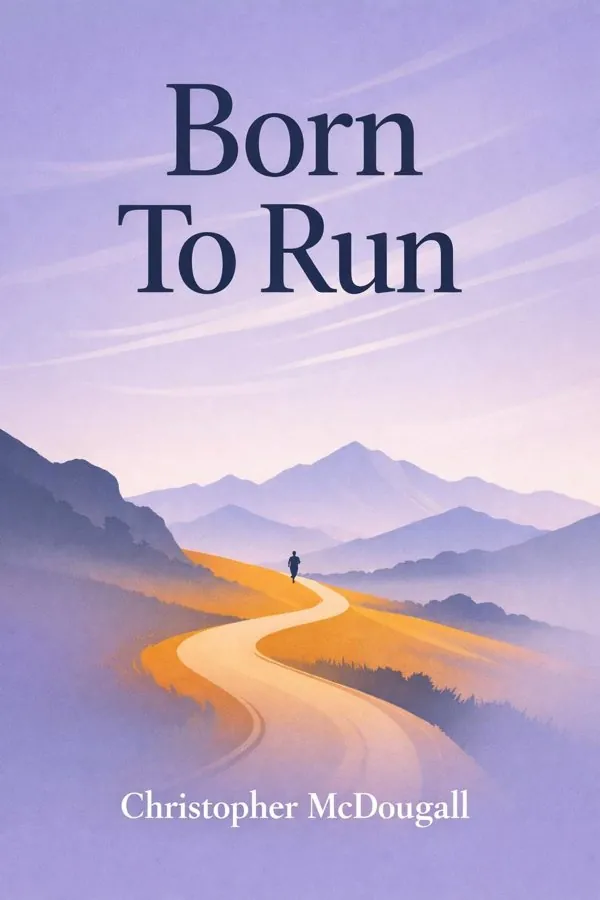
Born to Run: Summary & Key Insights
 10 min9 chaptersAudio available
Key Takeaways from Born to Run
Sometimes a personal problem becomes the doorway to a much larger truth.
Isolation can preserve ways of living that the modern world has forgotten.
One of the book’s most radical ideas is also one of its simplest: running does not have to feel like self-punishment.
Transformative figures often matter not because they dominate a field, but because they connect worlds that rarely meet.
A provocative scientific claim runs through the book: humans may be among the planet’s best endurance runners not in spite of our bodies, but because of them.
What Is Born to Run About?
Born to Run by Christopher McDougall is a sports book published in 2009 spanning 8 pages. Born to Run is a thrilling work of narrative nonfiction that blends adventure, sports science, anthropology, and memoir into one unforgettable question: why do so many modern runners get injured doing something the human body may have evolved to do brilliantly? Christopher McDougall begins with his own frustration as a capable runner plagued by chronic pain, then follows that mystery into Mexico’s Copper Canyons, where the Tarahumara—also known as the Rarámuri—have built a culture around running extraordinary distances with apparent ease and joy. Along the way, he introduces eccentric ultrarunners, reclusive mentors, skeptical scientists, and bold theories about barefoot movement, endurance, and human evolution. What makes the book matter is not just its celebration of extreme athletes, but its challenge to modern assumptions about fitness, footwear, and performance. McDougall writes with the curiosity of a reporter and the momentum of a novelist, drawing on his background as a journalist to investigate evidence while telling a deeply human story. The result is a book that invites readers to rethink running not as punishment, but as freedom, connection, and one of humanity’s oldest gifts.
This FizzRead summary covers all 9 key chapters of Born to Run in approximately 10 minutes, distilling the most important ideas, arguments, and takeaways from Christopher McDougall's work. Also available as an audio summary and Key Quotes Podcast.
Born to Run
Born to Run is a thrilling work of narrative nonfiction that blends adventure, sports science, anthropology, and memoir into one unforgettable question: why do so many modern runners get injured doing something the human body may have evolved to do brilliantly? Christopher McDougall begins with his own frustration as a capable runner plagued by chronic pain, then follows that mystery into Mexico’s Copper Canyons, where the Tarahumara—also known as the Rarámuri—have built a culture around running extraordinary distances with apparent ease and joy. Along the way, he introduces eccentric ultrarunners, reclusive mentors, skeptical scientists, and bold theories about barefoot movement, endurance, and human evolution. What makes the book matter is not just its celebration of extreme athletes, but its challenge to modern assumptions about fitness, footwear, and performance. McDougall writes with the curiosity of a reporter and the momentum of a novelist, drawing on his background as a journalist to investigate evidence while telling a deeply human story. The result is a book that invites readers to rethink running not as punishment, but as freedom, connection, and one of humanity’s oldest gifts.
Who Should Read Born to Run?
This book is perfect for anyone interested in sports and looking to gain actionable insights in a short read. Whether you're a student, professional, or lifelong learner, the key ideas from Born to Run by Christopher McDougall will help you think differently.
- ✓Readers who enjoy sports and want practical takeaways
- ✓Professionals looking to apply new ideas to their work and life
- ✓Anyone who wants the core insights of Born to Run in just 10 minutes
Want the full summary?
Get instant access to this book summary and 100K+ more with Fizz Moment.
Get Free SummaryAvailable on App Store • Free to download
Key Chapters
Sometimes a personal problem becomes the doorway to a much larger truth. Born to Run begins with Christopher McDougall’s own mystery: despite being fit, motivated, and experienced, he could not run consistently without getting hurt. Doctors offered familiar solutions—rest, orthotics, motion-control shoes, anti-inflammatory treatments—but rarely answered the central question of why running seemed to damage a body supposedly designed for movement. That frustration gives the book its emotional core. McDougall is not investigating running from a distance; he is trying to solve a problem that affects millions of ordinary people.
This search matters because it reframes injury. Instead of accepting pain as inevitable, McDougall asks whether the problem lies in how modern people run, what they wear, and how disconnected they are from natural movement patterns. His personal quest becomes an investigation into biomechanics, evolutionary history, and cultural practices that challenge mainstream sports advice. In that sense, the book is not just for elite athletes. It speaks to anyone who has felt confused by contradictory health guidance: train harder, rest more, buy better gear, fix your form, trust the experts.
A practical lesson emerges immediately: if a common activity repeatedly causes breakdown, it is worth questioning the assumptions surrounding it. Runners can apply this by tracking when pain appears, examining shoe choice, reducing overstriding, and experimenting with gentler, more efficient movement rather than simply adding more equipment. McDougall’s opening insight encourages curiosity over resignation. Actionable takeaway: when recurring pain appears, do not only treat symptoms—investigate the system, habits, and beliefs that may be creating them.
Isolation can preserve ways of living that the modern world has forgotten. In Mexico’s Copper Canyons, a vast, rugged network of ravines and cliffs, the Tarahumara developed in a landscape that rewards resilience, mobility, and self-sufficiency. The terrain is not a scenic backdrop; it shapes the people who live there. Villages are scattered, roads are limited, and travel often depends on foot. In such an environment, running is not a hobby added to life. It is part of survival, community, and identity.
McDougall shows how geography influences culture. The Tarahumara became legendary for covering astonishing distances through mountainous trails in simple sandals, often while treating running not as grim labor but as celebration. Their environment demanded toughness, but their culture turned that necessity into an art. This matters because modern training often happens in artificial conditions—flat roads, treadmills, heavily cushioned shoes, and highly controlled workouts. The Tarahumara remind us that human adaptability grows when movement is embedded in daily life, not separated into isolated fitness sessions.
The Copper Canyons also symbolize how hidden places can challenge dominant assumptions. While sports brands and training manuals defined what “serious” running should look like, these remote runners quietly embodied another model: minimal gear, efficient mechanics, patience, and endurance built over years.
For everyday readers, the practical application is simple: stop thinking of fitness as something that only happens at the gym or during a formal workout. Walk more, choose stairs, hike uneven trails, spend time outdoors, and let movement become part of your environment. Actionable takeaway: redesign your surroundings so that movement is natural and frequent, rather than occasional and forced.
One of the book’s most radical ideas is also one of its simplest: running does not have to feel like self-punishment. McDougall contrasts the modern image of the exhausted, injured, guilt-driven exerciser with the Tarahumara approach, where running is often social, rhythmic, and joyful. For them, endurance is not merely a test of suffering; it is tied to play, ceremony, storytelling, and community. This reorientation changes everything. If running is approached with fear, ego, or constant pressure, it becomes easier to force bad mechanics, overtrain, and disconnect from the body’s signals.
McDougall suggests that many people quit running because they meet it in its most distorted form: too hard, too fast, too competitive, and too tied to self-judgment. But when running is experienced as steady movement, curiosity, and connection, it becomes sustainable. This echoes a larger truth about performance: intrinsic motivation outlasts external pressure. People stick with activities that make them feel alive, not activities that make them feel constantly inadequate.
In practical terms, this means redefining success. A good run is not always a personal best. It may be a run where breathing settles, posture improves, and the mind clears. It may be a conversation run with a friend or an easy trail jog that ends with energy still in the tank. For beginners, it means starting slowly enough to enjoy the experience rather than endure it.
The lesson applies beyond sport. Any discipline—work, creativity, learning—becomes more sustainable when joy is treated as fuel rather than indulgence. Actionable takeaway: at least once a week, run without chasing pace or distance, and judge the session by how natural, relaxed, and enjoyable it feels.
Transformative figures often matter not because they dominate a field, but because they connect worlds that rarely meet. In Born to Run, that figure is Caballo Blanco, the mysterious American drifter Micah True, who immerses himself in the Copper Canyons and becomes obsessed with the Tarahumara way of running. McDougall presents him as both eccentric and visionary: a man fleeing parts of modern life while trying to preserve something beautiful and fragile. Caballo is not just a character; he is a bridge between elite ultrarunners from the United States and the deeply traditional endurance culture of the Tarahumara.
Through Caballo, the book explores devotion, reinvention, and the search for a purer relationship with movement. He sees in the Tarahumara a style of running built on humility, patience, and respect—qualities often overshadowed in modern sports by branding, ego, and spectacle. His dream of bringing different runners together in a race through the canyons becomes the narrative thread that ties the book’s ideas into action.
There is a practical lesson here about mentorship and translation. Sometimes knowledge exists, but it remains inaccessible until someone carries it across cultural or conceptual boundaries. In work, education, and health, progress often depends on people who can interpret one world to another without flattening its meaning.
For readers, Caballo’s example encourages intentional communities around practice. Find people who care about the deeper values of your activity, not just its metrics. Learn from outsiders, elders, and unconventional guides. Actionable takeaway: identify one mentor, book, or community that helps you connect technical improvement with a more meaningful purpose.
A provocative scientific claim runs through the book: humans may be among the planet’s best endurance runners not in spite of our bodies, but because of them. McDougall draws on researchers who argue that human anatomy—springy tendons, large gluteal muscles, stable necks, sweat-based cooling, and upright posture—makes us unusually capable of covering long distances, especially in heat. Unlike faster animals that dominate in short bursts, humans can outlast. This theory reframes running from a niche athletic skill into a central part of human evolution.
The deeper significance is psychological. Many people think of running as an acquired torture, suitable only for the gifted or obsessed. The evolutionary perspective suggests the opposite: endurance may be part of our inheritance. If so, then the issue is not whether humans are meant to run, but under what conditions they run well. The body responds best to efficiency, gradual adaptation, and natural mechanics—not sudden overload or heavily distorted movement patterns.
This idea also broadens the meaning of training. Endurance is not only about cardiovascular fitness; it is about coordination, tissue resilience, pacing, and economy. A relaxed runner using less energy can often go farther than a stronger but more wasteful one. In everyday life, this principle applies to work and decision-making too: sustainable output beats flashy intensity.
For practical use, runners can focus on form cues that encourage efficiency: short strides, light footfalls, upright posture, and relaxed shoulders. Beginners can build endurance by increasing duration gradually while keeping effort conversational. Actionable takeaway: train for economy before intensity by practicing smooth, quiet, relaxed running at an easy pace.
Extreme events can illuminate what ordinary training hides. One of Born to Run’s most entertaining and persuasive dimensions is its cast of ultrarunners—athletes who race far beyond the marathon distance and often discover that success depends less on brute force than on patience, adaptability, and mental steadiness. McDougall introduces colorful competitors whose stories make ultrarunning feel both outrageous and strangely accessible. These runners are not superheroes in a comic-book sense; many are quirky, vulnerable, and imperfect. What unites them is a willingness to move beyond conventional limits.
Ultrarunning matters in the book because it challenges common beliefs about fatigue and aging. In shorter races, youth, explosive speed, and aggressive tactics can dominate. In longer races, pacing, emotional control, nutrition, and resilience become more important. This suggests that human performance is multidimensional. Endurance rewards self-knowledge as much as raw power.
For everyday readers, the ultrarunning examples offer a practical model of progress: break large challenges into manageable segments, stay calm under discomfort, and avoid wasting energy early. The same principles apply to a long work project, caregiving, studying, or entrepreneurship. Start within yourself, not against the clock.
Ultrarunners also demonstrate the value of supportive communities. Aid stations, pacers, shared suffering, and encouragement often matter as much as training plans. Achievement does not have to be solitary.
Actionable takeaway: approach big goals the ultrarunning way—pace conservatively, focus on consistency, solve problems one at a time, and build a support system before you need it.
More technology does not always mean better movement. One of the book’s most debated arguments concerns footwear: McDougall questions whether modern cushioned running shoes, especially those designed to control motion and absorb impact, may contribute to the very injuries they promise to prevent. His case is not that all shoes are harmful in every context, but that excessive cushioning and support can dull feedback, alter stride mechanics, and encourage harder heel striking. In trying to protect runners from discomfort, the industry may have reduced their ability to move naturally.
The key principle is sensory intelligence. Bare feet and minimal footwear force attention to how the body lands, balances, and propels itself. Painful impact becomes immediate feedback, making sloppy mechanics harder to ignore. By contrast, thick shoes can create the illusion of safety while allowing forceful patterns to continue unchecked. McDougall uses this insight to argue that many runners have outsourced movement to equipment rather than developing strength, awareness, and technique.
Still, the practical lesson is not reckless minimalism. Transition matters. Feet and lower legs that have spent years in supportive shoes need time to strengthen. Useful applications include spending more time barefoot at home, doing foot-strengthening exercises, trying short easy runs in less structured shoes, and paying attention to cadence and landing.
This idea extends beyond running gear. Tools are valuable when they amplify human capability, but damaging when they replace adaptation entirely. Actionable takeaway: treat footwear as a tool, not a crutch—choose shoes that let you move naturally, and strengthen your feet and mechanics gradually rather than relying only on cushioning.
Ideas become most convincing when they survive reality. The climactic race in the Copper Canyons brings together Tarahumara runners, elite American ultrarunners, Caballo Blanco’s vision, and McDougall’s central questions about endurance, form, and culture. This is more than a sporting event. It is an experiment where different philosophies of running meet on unforgiving terrain. High-tech preparation faces simplicity. Ego faces humility. Performance science meets lived tradition.
What makes the race powerful is that it resists simplistic conclusions while still revealing something profound. The Tarahumara do not win merely because they are magical or primitive; they excel because their lifestyle, technique, mental approach, and communal identity support endurance at a deep level. Likewise, the American ultrarunners are not dismissed. Many earn admiration for their grit, openness, and respect. The race becomes a shared proving ground where assumptions are stripped away.
For readers, this chapter models how to test beliefs honestly. Whether in fitness, business, or personal development, theories should be exposed to real conditions. It is easy to sound convincing in controlled settings; it is harder to perform when variables multiply and comfort disappears. The race also highlights the importance of preparation that matches reality. Training only under ideal conditions leaves people vulnerable when life gets messy.
A practical application is to occasionally practice in less perfect environments: run trails instead of only treadmills, rehearse presentations without notes, or simulate challenges before high-stakes events. Actionable takeaway: validate your strongest beliefs through real-world tests, not just expert claims or controlled routines.
The book’s deepest lesson may be that extraordinary endurance is not built on hacks, but on a way of life. Across its stories of scientists, canyon runners, and ultramarathon eccentrics, Born to Run keeps circling back to a few essentials: move often, run lightly, eat simply, stay social, and avoid turning every effort into a battle of ego. The Tarahumara embody this most clearly. Their endurance is not manufactured in training camps; it emerges from daily habits, strong social bonds, modest material needs, and a calm relationship with hardship.
This matters because modern fitness culture often fragments health into products and optimization strategies. McDougall’s broader message is more holistic. Durable performance grows from alignment between body, environment, and mindset. People become resilient not only by stressing themselves, but by living in ways that make strength usable and sustainable. Simplicity here is not deprivation. It is freedom from unnecessary complexity.
Readers can apply this beyond running. Community improves consistency. Simpler food choices often beat elaborate diet rules. Modest daily movement outperforms occasional heroic effort. Emotional steadiness saves energy in hard moments. Even ambition becomes healthier when it is supported by belonging rather than comparison.
In this sense, the book offers a quiet critique of modern excess. More gear, more data, more interventions, and more self-conscious striving do not automatically create better athletes or happier people. Often, less interference produces better results.
Actionable takeaway: build endurance from the ground up by simplifying one area of your routine this week—move daily, eat more whole foods, train with others, and remove one unnecessary layer of complexity.
All Chapters in Born to Run
About the Author
Christopher McDougall is an American author and journalist known for writing about endurance, adventure, and human performance. Before gaining international recognition as a bestselling writer, he worked as a reporter and foreign correspondent, including for the Associated Press, where he developed a reputation for immersive, story-driven journalism. His breakthrough book, Born to Run, brought him worldwide attention for its vivid exploration of the Tarahumara runners of Mexico’s Copper Canyons, the science of human endurance, and the culture of ultrarunning. McDougall’s work stands out for combining rigorous reporting with the pace of a thriller, making complex subjects accessible to broad audiences. He has continued to write and speak about natural movement, running technique, and the deeper connection between modern health and ancient human abilities.
Get This Summary in Your Preferred Format
Read or listen to the Born to Run summary by Christopher McDougall anytime, anywhere. FizzRead offers multiple formats so you can learn on your terms — all free.
Available formats: App · Audio · PDF · EPUB — All included free with FizzRead
Download Born to Run PDF and EPUB Summary
Key Quotes from Born to Run
“Sometimes a personal problem becomes the doorway to a much larger truth.”
“Isolation can preserve ways of living that the modern world has forgotten.”
“One of the book’s most radical ideas is also one of its simplest: running does not have to feel like self-punishment.”
“Transformative figures often matter not because they dominate a field, but because they connect worlds that rarely meet.”
“A provocative scientific claim runs through the book: humans may be among the planet’s best endurance runners not in spite of our bodies, but because of them.”
Frequently Asked Questions about Born to Run
Born to Run by Christopher McDougall is a sports book that explores key ideas across 9 chapters. Born to Run is a thrilling work of narrative nonfiction that blends adventure, sports science, anthropology, and memoir into one unforgettable question: why do so many modern runners get injured doing something the human body may have evolved to do brilliantly? Christopher McDougall begins with his own frustration as a capable runner plagued by chronic pain, then follows that mystery into Mexico’s Copper Canyons, where the Tarahumara—also known as the Rarámuri—have built a culture around running extraordinary distances with apparent ease and joy. Along the way, he introduces eccentric ultrarunners, reclusive mentors, skeptical scientists, and bold theories about barefoot movement, endurance, and human evolution. What makes the book matter is not just its celebration of extreme athletes, but its challenge to modern assumptions about fitness, footwear, and performance. McDougall writes with the curiosity of a reporter and the momentum of a novelist, drawing on his background as a journalist to investigate evidence while telling a deeply human story. The result is a book that invites readers to rethink running not as punishment, but as freedom, connection, and one of humanity’s oldest gifts.
You Might Also Like

Featured In
Browse by Category
Ready to read Born to Run?
Get the full summary and 100K+ more books with Fizz Moment.