
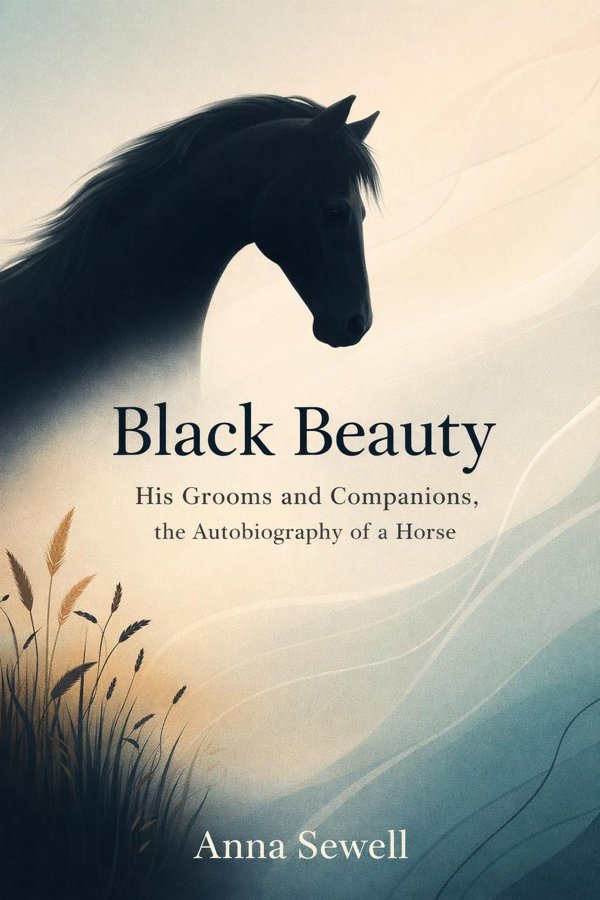
Black Beauty: His Grooms and Companions, the Autobiography of a Horse: Summary & Key Insights
by Anna Sewell
 10 min5 chaptersAudio available
What Is Black Beauty: His Grooms and Companions, the Autobiography of a Horse About?
Black Beauty: His Grooms and Companions, the Autobiography of a Horse by Anna Sewell is a classics book spanning 5 pages. Black Beauty is a novel written by Anna Sewell and first published in 1877. Told from the perspective of a horse, the story follows Black Beauty’s life from his youth in a peaceful meadow through years of hard work and mistreatment. Through his experiences, Sewell exposes cruelty toward animals and advocates empathy and humane treatment. The novel became a classic of children’s literature and a cornerstone in the movement for animal welfare.
This FizzRead summary covers all 5 key chapters of Black Beauty: His Grooms and Companions, the Autobiography of a Horse in approximately 10 minutes, distilling the most important ideas, arguments, and takeaways from Anna Sewell's work. Also available as an audio summary and Key Quotes Podcast.
Black Beauty: His Grooms and Companions, the Autobiography of a Horse
Black Beauty is a novel written by Anna Sewell and first published in 1877. Told from the perspective of a horse, the story follows Black Beauty’s life from his youth in a peaceful meadow through years of hard work and mistreatment. Through his experiences, Sewell exposes cruelty toward animals and advocates empathy and humane treatment. The novel became a classic of children’s literature and a cornerstone in the movement for animal welfare.
Who Should Read Black Beauty: His Grooms and Companions, the Autobiography of a Horse?
This book is perfect for anyone interested in classics and looking to gain actionable insights in a short read. Whether you're a student, professional, or lifelong learner, the key ideas from Black Beauty: His Grooms and Companions, the Autobiography of a Horse by Anna Sewell will help you think differently.
- ✓Readers who enjoy classics and want practical takeaways
- ✓Professionals looking to apply new ideas to their work and life
- ✓Anyone who wants the core insights of Black Beauty: His Grooms and Companions, the Autobiography of a Horse in just 10 minutes
Want the full summary?
Get instant access to this book summary and 100K+ more with Fizz Moment.
Get Free SummaryAvailable on App Store • Free to download
Key Chapters
I remember my earliest days as warm sunlight, soft grass, and the steady voice of Farmer Grey teaching me what it means to be gentle and to obey willingly. Those were the days of youth when the world seemed boundless and full of good will. Grey was a man who understood horses—how patience and fairness drew out our best, while fear and pain destroyed trust. Everything I learned in that peaceful meadow shaped the rest of my life: that a look or soft word could guide better than a lash, and that good character in a human being is felt long before it is understood. Sewell, through my young memories, wanted to show that training rooted in kindness shapes strength, not weakness. The meadow is not merely a setting; it is her ideal image of harmony between man and beast. The animals there live as nature intended, guided but not dominated, respected and not objectified.
When Farmer Grey sells me to Squire Gordon, I carry with me the comfort of those teachings. They become my measure of all that comes after. It is in this contrast between early virtue and later neglect that the reader learns what moral sight looks like: once you know the feel of compassion, you recognize its absence everywhere. My youth, therefore, is both memory and prophecy—showing what every horse could be, if only treated with understanding.
Under Squire Gordon and his wife at Birtwick Hall, I lived what one might call a blessed period of good service. John Manly, our coachman, cared for us as friends, not machines. Each day was orderly and fair. He never struck from impatience, never shouted from pride. In that household, kindness was law—not weakness. It was there I met Ginger, fiery and proud, her temper born of past cruelty. And Merrylegs, who brought laughter to the stable with his cheerful trust. Sewell drew these companions to show that every creature bears the mark of its past: some carry scars, some hope, and some faith unbroken. Through our conversations—yes, horses do talk privately in their own way—I came to understand how human fashion can breed barbarity. Ginger’s tales of rough grooms and cutting bits made me feel shame for my own luck. But Sewell meant it so: to awaken her readers’ empathy, not pity. By hearing animals reason about justice and kindness, humans were invited to ask why they, with minds and souls, show less.
Birtwick was a moral vision of what the world might be if gentleness directed labor. But even there, shadows appeared—the practice of the bearing rein, demanded by society’s vanity. I learned early that sometimes cruelty hides beneath civility, when people value appearances above comfort and fashion above life. The Gordons refused to use it; they cared more for our health than their pride. Those choices defined real nobility and became the book’s lasting creed: that moral worth, not social rank, determines goodness. In Birtwick Hall’s peace, Sewell built her mirror, letting readers see that compassion is civilization at its best.
+ 3 more chapters — available in the FizzRead app
All Chapters in Black Beauty: His Grooms and Companions, the Autobiography of a Horse
About the Author
Anna Sewell (1820–1878) was an English writer of the Victorian era. Due to health issues, she spent much of her life with limited mobility and dictated most of her only novel, Black Beauty, to her mother. A member of the Quaker community, Sewell’s compassion for suffering animals is reflected in her work, which had a lasting impact on public awareness of horse and animal welfare.
Get This Summary in Your Preferred Format
Read or listen to the Black Beauty: His Grooms and Companions, the Autobiography of a Horse summary by Anna Sewell anytime, anywhere. FizzRead offers multiple formats so you can learn on your terms — all free.
Available formats: App · Audio · PDF · EPUB — All included free with FizzRead
Download Black Beauty: His Grooms and Companions, the Autobiography of a Horse PDF and EPUB Summary
Key Quotes from Black Beauty: His Grooms and Companions, the Autobiography of a Horse
“I remember my earliest days as warm sunlight, soft grass, and the steady voice of Farmer Grey teaching me what it means to be gentle and to obey willingly.”
“Under Squire Gordon and his wife at Birtwick Hall, I lived what one might call a blessed period of good service.”
Frequently Asked Questions about Black Beauty: His Grooms and Companions, the Autobiography of a Horse
Black Beauty: His Grooms and Companions, the Autobiography of a Horse by Anna Sewell is a classics book that explores key ideas across 5 chapters. Black Beauty is a novel written by Anna Sewell and first published in 1877. Told from the perspective of a horse, the story follows Black Beauty’s life from his youth in a peaceful meadow through years of hard work and mistreatment. Through his experiences, Sewell exposes cruelty toward animals and advocates empathy and humane treatment. The novel became a classic of children’s literature and a cornerstone in the movement for animal welfare.
You Might Also Like


Browse by Category
Ready to read Black Beauty: His Grooms and Companions, the Autobiography of a Horse?
Get the full summary and 100K+ more books with Fizz Moment.