
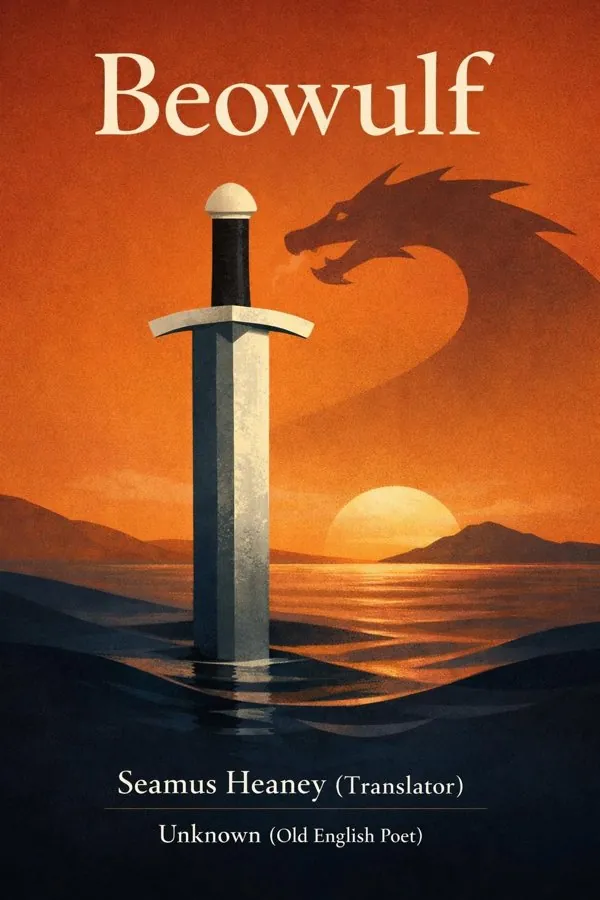
Beowulf: Summary & Key Insights
by Seamus Heaney (Translator), Unknown (Old English Poet)
 10 min4 chaptersAudio available
What Is Beowulf About?
Beowulf by Seamus Heaney (Translator), Unknown (Old English Poet) is a classics book spanning 4 pages. Beowulf is an Old English epic poem of over 3,000 lines that recounts the heroic deeds of Beowulf, a warrior who aids King Hrothgar of the Danes by defeating the monster Grendel and later Grendel’s mother. In his later years, Beowulf becomes king of the Geats and faces a dragon in his final act of heroism. The poem explores themes of bravery, loyalty, fate, and mortality, and stands as one of the most important works in early English literature.
This FizzRead summary covers all 4 key chapters of Beowulf in approximately 10 minutes, distilling the most important ideas, arguments, and takeaways from Seamus Heaney (Translator), Unknown (Old English Poet)'s work. Also available as an audio summary and Key Quotes Podcast.
Beowulf
Beowulf is an Old English epic poem of over 3,000 lines that recounts the heroic deeds of Beowulf, a warrior who aids King Hrothgar of the Danes by defeating the monster Grendel and later Grendel’s mother. In his later years, Beowulf becomes king of the Geats and faces a dragon in his final act of heroism. The poem explores themes of bravery, loyalty, fate, and mortality, and stands as one of the most important works in early English literature.
Who Should Read Beowulf?
This book is perfect for anyone interested in classics and looking to gain actionable insights in a short read. Whether you're a student, professional, or lifelong learner, the key ideas from Beowulf by Seamus Heaney (Translator), Unknown (Old English Poet) will help you think differently.
- ✓Readers who enjoy classics and want practical takeaways
- ✓Professionals looking to apply new ideas to their work and life
- ✓Anyone who wants the core insights of Beowulf in just 10 minutes
Want the full summary?
Get instant access to this book summary and 100K+ more with Fizz Moment.
Get Free SummaryAvailable on App Store • Free to download
Key Chapters
The poem begins with memory and song—the story of Scyld Scefing, who arrived mysteriously among the Danes, an orphan set adrift on the sea, only to rise by courage into kingship. His life marks the rhythm of every noble lineage: rising from hardship, bringing peace through strength, and departing into legend. Scyld’s funeral echoes that journey: laid in a ship laden with treasure, returned to the waters from which he came. In honoring him, the Danes affirm a world where honor and memory sustain meaning.
From Scyld’s line descends Hrothgar, a wise and prosperous ruler. To celebrate his reign, he constructs Heorot, a mead hall so vast and radiant that it becomes a symbol of communal joy—a place where warriors feast, poets sing, and the bonds of kinship are renewed. Yet in the midst of their joy lurks envy and alienation, embodied in Grendel, a creature of the marshes, descended from Cain. The light of Heorot, to him, is unbearable—it mocks the exile born of his own curse. Thus, even in the heart of civilization, darkness waits. The hall, radiant and fragile, represents all human achievement: glorious, but ever tempting to ruin.
These early scenes establish the moral order of the poem. Power rooted in generosity brings glory; power twisted by isolation breeds destruction. Hrothgar’s greatness lies not merely in strength but in his ability to give and bind his people together. Yet the poet warns: every hall can fall, every triumph is temporary, and joy invites its opposite. The stage is set for the test of those who would defend that fragile light.
From across the sea, Beowulf, a warrior of the Geats, hears of Hrothgar’s plight. Bound by both courage and lineage—his father once sought refuge among the Danes—he gathers a band of chosen men and sails into danger. His decision to cross the sea is the poem’s first great act of free will: a young man seeking not only glory, but the proving of himself before fate. For in his world, destiny is fixed, but the manner of one’s meeting it defines one’s worth.
Upon landing in Denmark, Beowulf is challenged, introduced, and welcomed through the rituals of speech that govern heroic society. Words matter as much as swords: every boast, every recollection contributes to the ordering of honor. In this pattern, storytelling itself becomes action—reputation forged through memory. When Beowulf pledges to defeat Grendel without weapons, trusting in his own strength, he places his faith in divine fairness and human valor alike.
That night, as the warriors sleep in Heorot, Grendel bursts in. The monster devours one warrior before Beowulf seizes him. They clash, hall shaking, foundation timbers groaning as the two embodiments of courage and chaos wrestle for dominance. At last Beowulf rips the creature’s arm from its socket, and Grendel flees to the fens to die. The hall stands once more in peace. What follows is celebration—gifts, songs, and feasting. But beneath the joyful surface lies awareness that the world’s order survives only by continual acts of bravery.
+ 2 more chapters — available in the FizzRead app
All Chapters in Beowulf
About the Authors
The author of Beowulf is unknown, often referred to as the Beowulf Poet. The poem was composed in Old English between the 8th and early 11th centuries. Seamus Heaney (1939–2013), an Irish poet and Nobel laureate, translated the poem into modern English for Penguin Classics in 2000, producing one of the most acclaimed contemporary versions.
Get This Summary in Your Preferred Format
Read or listen to the Beowulf summary by Seamus Heaney (Translator), Unknown (Old English Poet) anytime, anywhere. FizzRead offers multiple formats so you can learn on your terms — all free.
Available formats: App · Audio · PDF · EPUB — All included free with FizzRead
Download Beowulf PDF and EPUB Summary
Key Quotes from Beowulf
“The poem begins with memory and song—the story of Scyld Scefing, who arrived mysteriously among the Danes, an orphan set adrift on the sea, only to rise by courage into kingship.”
“From across the sea, Beowulf, a warrior of the Geats, hears of Hrothgar’s plight.”
Frequently Asked Questions about Beowulf
Beowulf by Seamus Heaney (Translator), Unknown (Old English Poet) is a classics book that explores key ideas across 4 chapters. Beowulf is an Old English epic poem of over 3,000 lines that recounts the heroic deeds of Beowulf, a warrior who aids King Hrothgar of the Danes by defeating the monster Grendel and later Grendel’s mother. In his later years, Beowulf becomes king of the Geats and faces a dragon in his final act of heroism. The poem explores themes of bravery, loyalty, fate, and mortality, and stands as one of the most important works in early English literature.
You Might Also Like


Browse by Category
Ready to read Beowulf?
Get the full summary and 100K+ more books with Fizz Moment.