
James Madison Books
James Madison (1751–1836) served as the fourth President of the United States and is known as the 'Father of the Constitution.
Known for: The Federalist Papers
Books by James Madison
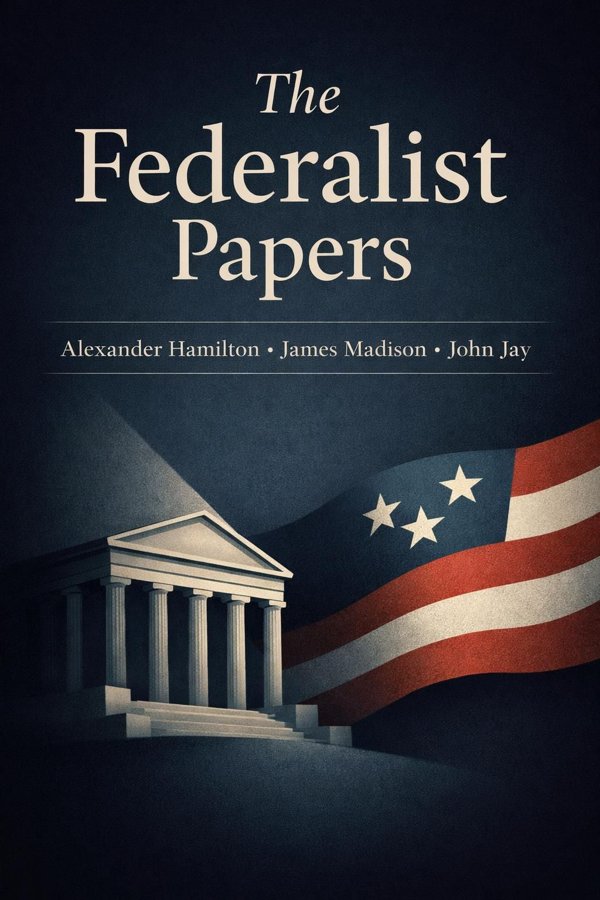
The Federalist Papers
The Federalist Papers is one of the most important works of political thought ever written. Composed of 85 essays by Alexander Hamilton, James Madison, and John Jay between 1787 and 1788, it was published under the pen name “Publius” to persuade Americans to ratify the newly drafted United States Constitution. But these essays do far more than argue for a political document. They explain how free government can survive conflict, ambition, division, and the constant temptations of power. At the time, the young republic was unstable. The Articles of Confederation had produced a weak central government unable to tax effectively, regulate commerce, or respond decisively to domestic unrest and foreign threats. Hamilton, Madison, and Jay wrote with unusual urgency because they believed the American experiment might fail without structural reform. Their authority came not only from intellect, but from direct involvement in nation-building: Hamilton was a leading statesman, Madison a chief architect of the Constitution, and Jay a diplomat and jurist of the highest rank. Today, The Federalist Papers still matters because it offers a clear guide to federalism, separation of powers, constitutional design, and the enduring challenge of balancing liberty with effective government.
Read SummaryKey Insights from James Madison
The Articles Could Not Hold
A nation can win its independence and still lose its future if it cannot govern itself effectively. That is the central anxiety behind many of the opening essays in The Federalist Papers. Under the Articles of Confederation, the United States had a Congress but no real national strength. The central...
From The Federalist Papers
Union Is Safer Than Separation
People often imagine that smaller, separate communities will naturally live in peace, but The Federalist Papers insists that political fragmentation usually creates rivalry, not harmony. In essays such as Federalist Nos. 6 through 9, Hamilton argues that if the states broke apart into independent co...
From The Federalist Papers
Energy in Government Protects Liberty
Weak government may sound safe, but one of The Federalist Papers’ boldest claims is that weakness can be just as dangerous as tyranny. Hamilton repeatedly argues that government must possess “energy” if it is to secure the public good. By energy, he means the capacity to act decisively, enforce laws...
From The Federalist Papers
Structure Shapes Political Behavior
The Federalist Papers is built on a sober insight: good government cannot rely on good intentions alone. Because people are ambitious, self-interested, and imperfect, political systems must be designed to guide behavior rather than hope to purify it. This is why Hamilton and Madison focus so intense...
From The Federalist Papers
The Legislature Needs Internal Limits
Many people fear executive overreach, but The Federalist Papers warns that in republics, the legislature can be the most dangerous branch. Because it speaks in the name of the people and controls lawmaking, the legislative body can gradually absorb too much authority. Madison was especially alert to...
From The Federalist Papers
A Single Executive Can Be Accountable
Power shared by many people can seem safer than power held by one, yet Hamilton argues in Federalist Nos. 67 through 77 that a single executive is often more responsible and more effective than a plural one. His case is subtle. Unity in the executive does not mean unlimited authority; it means clari...
From The Federalist Papers
About James Madison
James Madison (1751–1836) served as the fourth President of the United States and is known as the 'Father of the Constitution.


Frequently Asked Questions
James Madison (1751–1836) served as the fourth President of the United States and is known as the 'Father of the Constitution.
Read James Madison's books in 15 minutes
Get AI-powered summaries with key insights from 1 book by James Madison.