
Colin Ware Books
Colin Ware is a researcher and professor specializing in visual perception, cognitive science, and information visualization. He directs the Data Visualization Research Lab at the University of New Hampshire and has authored several influential works on visual design and human-computer interaction.
Known for: Visual Thinking for Design
Books by Colin Ware
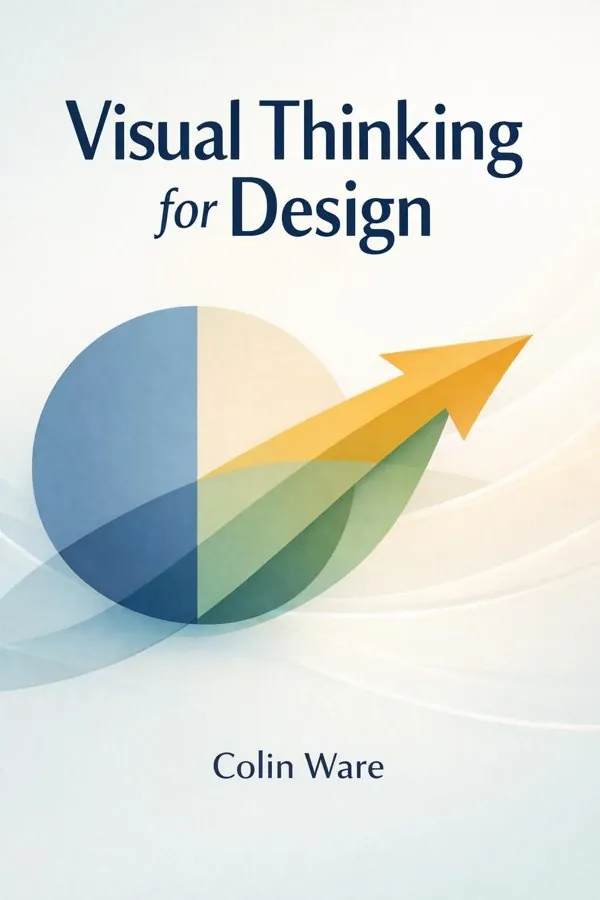
Visual Thinking for Design
Visual Thinking for Design shows that good design is not mainly about decoration, taste, or trend. It is about aligning what people see with how their minds actually work. Colin Ware draws on research in perception, attention, memory, and cognition to explain why some visuals feel instantly clear while others confuse, overwhelm, or mislead. The book connects scientific understanding of the human visual system with practical design decisions, helping readers create graphics, interfaces, and information displays that are easier to interpret and remember. What makes this book especially valuable is its bridge between theory and application. Ware does not treat cognitive science as abstract background knowledge. He turns it into a toolkit for making better choices about layout, hierarchy, color, motion, grouping, and visual emphasis. Designers, product teams, data visualization professionals, and anyone responsible for communicating visually can use these ideas immediately. Ware writes with unusual authority. As a leading researcher in visual perception and information visualization, he brings decades of academic insight and real-world relevance to the subject. The result is a book that helps readers see design differently: not as surface styling, but as a disciplined way of shaping attention, understanding, and thought.
Read SummaryKey Insights from Colin Ware
Perception Is the Foundation of Design
Every design succeeds or fails first at the level of perception. Before users interpret meaning, make decisions, or complete tasks, they must visually register what is in front of them. Ware argues that designers often act as if seeing were passive and automatic, when in fact vision is an active con...
From Visual Thinking for Design
Attention Is Design’s Scarcest Resource
What people notice determines what they can understand. Ware emphasizes that attention is severely limited, and design always takes place in a competitive environment. Screens, pages, interfaces, ads, notifications, and surrounding objects all fight for a user’s focus. Because attention cannot be ev...
From Visual Thinking for Design
Memory Shapes What Visuals Can Do
A design is only useful if people can hold and connect what they see. Ware explores how visual thinking depends not just on perception in the moment, but also on memory. Working memory is limited, which means users cannot juggle many unrelated visual elements at once. Long-term memory, meanwhile, he...
From Visual Thinking for Design
Spatial Reasoning Builds Strong Mental Models
People understand complexity better when they can place it in space. Ware shows that visual thinking is deeply tied to spatial reasoning: our ability to judge location, direction, containment, proximity, sequence, and structure. Designers can use this natural strength to help people form mental mode...
From Visual Thinking for Design
Pattern Recognition Drives Visual Intuition
Much of human intelligence begins with noticing patterns quickly. Ware explains that the visual system is remarkably good at detecting regularities, anomalies, repetition, symmetry, and trends, often before conscious analysis begins. Designers can harness this capability to create visuals that feel ...
From Visual Thinking for Design
Color and Gestalt Organize Meaning
Visual order emerges when the brain groups elements into meaningful wholes. Ware draws heavily on Gestalt principles to show that people do not perceive every object separately. They naturally group by proximity, similarity, continuity, enclosure, connectedness, and common fate. Color strengthens th...
From Visual Thinking for Design
About Colin Ware
Colin Ware is a researcher and professor specializing in visual perception, cognitive science, and information visualization. He directs the Data Visualization Research Lab at the University of New Hampshire and has authored several influential works on visual design and human-computer interaction.

Frequently Asked Questions
Colin Ware is a researcher and professor specializing in visual perception, cognitive science, and information visualization. He directs the Data Visualization Research Lab at the University of New Hampshire and has authored several influential works on visual design and human-computer interaction.
Read Colin Ware's books in 15 minutes
Get AI-powered summaries with key insights from 1 book by Colin Ware.