
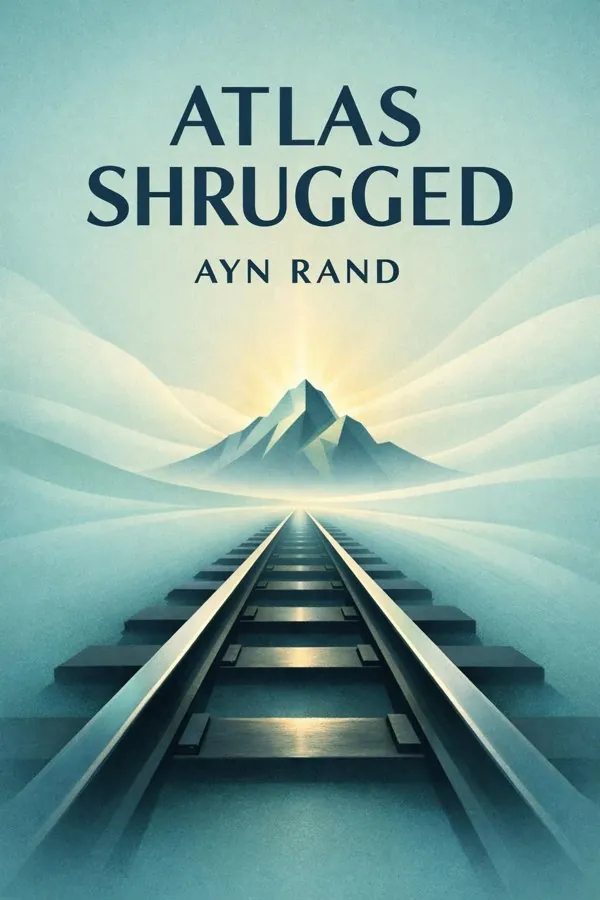
Atlas Shrugged: Summary & Key Insights
by Ayn Rand
 10 min5 chaptersAudio available
What Is Atlas Shrugged About?
Atlas Shrugged by Ayn Rand is a classics book spanning 5 pages. Atlas Shrugged is a philosophical novel by Ayn Rand that dramatizes her Objectivist philosophy through a dystopian story of a society collapsing under the weight of collectivism and government control. The narrative follows Dagny Taggart, a railroad executive, and other industrialists who struggle to keep their enterprises alive as the most productive members of society begin to mysteriously disappear.
This FizzRead summary covers all 5 key chapters of Atlas Shrugged in approximately 10 minutes, distilling the most important ideas, arguments, and takeaways from Ayn Rand's work. Also available as an audio summary and Key Quotes Podcast.
Atlas Shrugged
Atlas Shrugged is a philosophical novel by Ayn Rand that dramatizes her Objectivist philosophy through a dystopian story of a society collapsing under the weight of collectivism and government control. The narrative follows Dagny Taggart, a railroad executive, and other industrialists who struggle to keep their enterprises alive as the most productive members of society begin to mysteriously disappear.
Who Should Read Atlas Shrugged?
This book is perfect for anyone interested in classics and looking to gain actionable insights in a short read. Whether you're a student, professional, or lifelong learner, the key ideas from Atlas Shrugged by Ayn Rand will help you think differently.
- ✓Readers who enjoy classics and want practical takeaways
- ✓Professionals looking to apply new ideas to their work and life
- ✓Anyone who wants the core insights of Atlas Shrugged in just 10 minutes
Want the full summary?
Get instant access to this book summary and 100K+ more with Fizz Moment.
Get Free SummaryAvailable on App Store • Free to download
Key Chapters
The novel begins with an America that no longer believes in itself. Factories close under the weight of regulation, the railroads — the arteries of commerce — bleed inefficiency, and the phrase "Who is John Galt?" hangs over everything like a sigh of futility. I wanted the reader to see the consequences of moral inversion: when effort is punished and need is rewarded. In such a world, heroes are not conquerors but producers — the people who think and work and create. Dagny Taggart is one of them.
Dagny runs her family’s railroad as vice president of operations, and every mile of steel is her responsibility. Her brother James is a moral coward, a bureaucrat mouthing platitudes about social justice while exploiting the productive to shield his own incompetence. Through Dagny’s eyes we see the agony of a world collapsing, not because of lack of resources, but because of lack of moral clarity. Every act of government intervention replaces judgment with decree, effort with entitlement. The trains stop running not from rust or sabotage, but because the spirit that makes them run has been declared immoral.
The motif of deterioration reflects a principle: the mind is mankind’s motor. Without the free exercise of reason, civilization stalls. When men no longer act by rational choice but by fear or guilt, the world grinds to a halt. The story begins on that precipice. My purpose was to let readers feel the contradiction of living in a system that denounces selfishness while surviving only through individual initiative. Dagny stands against this contradiction, clinging to her belief that "the rails must run" — that effort still matters even as the world loses faith in it.
Enter Hank Rearden, a man who pours his soul into the creation of a new metal stronger and lighter than anything ever produced — Rearden Metal. He is the embodiment of the rational producer: proud of his achievement, indifferent to social scorn, guided only by the facts of his trade and the integrity of his mind. Yet he lives in a culture that condemns him for success. The politicians demand that he share his invention; his family reproaches him for ambition. Hank’s story illustrates the moral conflict that drives *Atlas Shrugged*: a world divided between creators who live by reason and looters who live off coercion.
Dagny and Hank join forces to rebuild a vital rail line using his metal. Their partnership is more than industrial — it’s philosophical. Dagny sees in Rearden the same spirit that drives her own struggle: the conviction that value must be earned, not granted. As they labor against bureaucratic sabotage and public hostility, their success exposes society’s hypocrisy. The very culture that vilifies them depends on their competence. This is my dramatization of moral inversion—the idea that the producers sustain the parasites who condemn production itself.
Rearden faces his crisis in the courtroom, accused of violating economic regulations designed to cripple innovation. He refuses to plead for mercy, declaring that his guilt lies only in pursuing his happiness through productive work. That moment marks the philosophical turning point: he rejects all moral codes not rooted in reason. Through Rearden’s defiance, I wanted readers to feel the integrity of an independent mind—a man refusing to exist as a sacrificial animal.
+ 3 more chapters — available in the FizzRead app
All Chapters in Atlas Shrugged
About the Author
Get This Summary in Your Preferred Format
Read or listen to the Atlas Shrugged summary by Ayn Rand anytime, anywhere. FizzRead offers multiple formats so you can learn on your terms — all free.
Available formats: App · Audio · PDF · EPUB — All included free with FizzRead
Download Atlas Shrugged PDF and EPUB Summary
Key Quotes from Atlas Shrugged
“The novel begins with an America that no longer believes in itself.”
“Enter Hank Rearden, a man who pours his soul into the creation of a new metal stronger and lighter than anything ever produced — Rearden Metal.”
Frequently Asked Questions about Atlas Shrugged
Atlas Shrugged by Ayn Rand is a classics book that explores key ideas across 5 chapters. Atlas Shrugged is a philosophical novel by Ayn Rand that dramatizes her Objectivist philosophy through a dystopian story of a society collapsing under the weight of collectivism and government control. The narrative follows Dagny Taggart, a railroad executive, and other industrialists who struggle to keep their enterprises alive as the most productive members of society begin to mysteriously disappear.
More by Ayn Rand
You Might Also Like






Browse by Category
Ready to read Atlas Shrugged?
Get the full summary and 100K+ more books with Fizz Moment.