
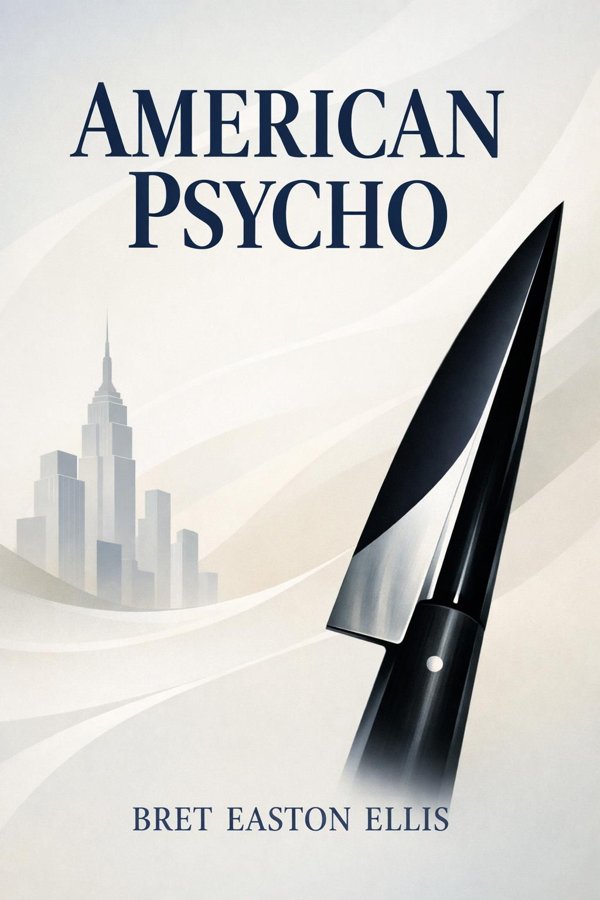
American Psycho: Summary & Key Insights
 10 min9 chaptersAudio available
Key Takeaways from American Psycho
The most frightening monsters often look perfectly ordinary.
A culture can become absurd when everyone is performing and no one is truly seeing anyone else.
When people no longer know who they are, they often start buying identities.
Extreme violence in the novel is not random shock; it is the logical endpoint of treating people as objects.
One of the novel’s most incisive themes is that Bateman is not simply insane; he is also performing a culturally approved version of manhood pushed to a grotesque extreme.
What Is American Psycho About?
American Psycho by Bret Easton Ellis is a classics book spanning 6 pages. American Psycho is a disturbing, brilliant, and darkly comic novel by Bret Easton Ellis that turns the glittering world of 1980s Manhattan into a nightmare. On the surface, it follows Patrick Bateman, a wealthy young Wall Street banker with perfect suits, expensive tastes, and an obsessive grooming routine. Beneath that polished exterior, however, lies a deeply fractured mind and a capacity for shocking violence. The novel moves between luxury restaurants, exclusive clubs, office conversations, and scenes of brutality, exposing a culture so consumed by image, status, and material success that human feeling seems to have disappeared. What makes American Psycho endure is not only its notoriety, but its precision. Ellis uses Bateman’s cold voice to satirize consumerism, masculinity, corporate emptiness, and the collapse of identity in modern life. The book is unsettling because it refuses easy moral comfort: it asks whether Bateman is a singular monster or merely the purest expression of a society built on greed, vanity, and indifference. Ellis, one of the defining American novelists of his generation, wrote a work that remains provocative because its targets—surface obsession, performative success, and emotional numbness—still feel painfully familiar.
This FizzRead summary covers all 9 key chapters of American Psycho in approximately 10 minutes, distilling the most important ideas, arguments, and takeaways from Bret Easton Ellis's work. Also available as an audio summary and Key Quotes Podcast.
American Psycho
American Psycho is a disturbing, brilliant, and darkly comic novel by Bret Easton Ellis that turns the glittering world of 1980s Manhattan into a nightmare. On the surface, it follows Patrick Bateman, a wealthy young Wall Street banker with perfect suits, expensive tastes, and an obsessive grooming routine. Beneath that polished exterior, however, lies a deeply fractured mind and a capacity for shocking violence. The novel moves between luxury restaurants, exclusive clubs, office conversations, and scenes of brutality, exposing a culture so consumed by image, status, and material success that human feeling seems to have disappeared.
What makes American Psycho endure is not only its notoriety, but its precision. Ellis uses Bateman’s cold voice to satirize consumerism, masculinity, corporate emptiness, and the collapse of identity in modern life. The book is unsettling because it refuses easy moral comfort: it asks whether Bateman is a singular monster or merely the purest expression of a society built on greed, vanity, and indifference. Ellis, one of the defining American novelists of his generation, wrote a work that remains provocative because its targets—surface obsession, performative success, and emotional numbness—still feel painfully familiar.
Who Should Read American Psycho?
This book is perfect for anyone interested in classics and looking to gain actionable insights in a short read. Whether you're a student, professional, or lifelong learner, the key ideas from American Psycho by Bret Easton Ellis will help you think differently.
- ✓Readers who enjoy classics and want practical takeaways
- ✓Professionals looking to apply new ideas to their work and life
- ✓Anyone who wants the core insights of American Psycho in just 10 minutes
Want the full summary?
Get instant access to this book summary and 100K+ more with Fizz Moment.
Get Free SummaryAvailable on App Store • Free to download
Key Chapters
The most frightening monsters often look perfectly ordinary. Patrick Bateman presents himself with immaculate precision: young, handsome, rich, disciplined, and effortlessly stylish. He knows which suit to wear, which restaurant to reserve, which skincare products to use, and which names to mention in order to secure status. His life appears controlled down to the smallest detail. Yet that polished surface is not a sign of wholeness. It is a mask designed to conceal an inner void.
Bateman’s routine matters because it reveals how identity in his world is built from external signals rather than inner substance. He is not defined by values, compassion, or meaningful commitments. He is defined by labels, habits, possessions, and the ability to perform success. Ellis shows us a man who has mistaken image for selfhood. Bateman’s obsessive self-presentation becomes a kind of armor, protecting him from vulnerability while also erasing whatever authentic self may once have existed.
This idea extends beyond fiction. Many people build versions of themselves through career titles, curated social media images, fashion, or consumer choices. There is nothing wrong with caring about presentation, but trouble begins when appearance becomes a replacement for character. A person can seem impressive while feeling internally vacant.
Bateman reminds us to ask difficult questions: Who are we when no one is watching? What remains if the symbols of status disappear? The novel’s horror starts there, in the gap between outer polish and inner emptiness.
Actionable takeaway: Examine one area where you rely on image to define yourself, and replace that signal of status with one concrete act that reflects genuine values or human connection.
A culture can become absurd when everyone is performing and no one is truly seeing anyone else. Around Bateman moves a circle of colleagues, friends, lovers, and acquaintances who all inhabit the same expensive, sterile world. They dine in fashionable restaurants, discuss brands and reservations with desperate intensity, and constantly confuse one person for another. These are people with wealth, access, and influence, yet their conversations feel empty and repetitive, as if language itself has been hollowed out.
Ellis uses this social environment to show how privilege can produce not freedom, but sameness. Bateman’s circle believes it is elite, but it is also interchangeable. Their clothes, tastes, opinions, and ambitions all conform to a narrow model of success. Even individuality becomes standardized. In such a world, people are no longer encountered as full human beings; they are treated as surfaces, accessories, or competitors.
This is one of the novel’s sharpest satirical moves. The men in Bateman’s world work in finance, but they often seem incapable of meaningful thought or feeling. Their social rituals are so scripted that even shocking truths can disappear into background noise. The inability to recognize one another becomes symbolic: if everyone is reduced to status markers, then identity itself starts to blur.
The modern application is clear. Any environment driven by prestige, exclusivity, and relentless comparison can become emotionally flattening. Whether in corporate culture, social media circles, or high-pressure professional networks, people can begin treating relationships as transactions and attention as a scarce asset.
Actionable takeaway: In your next conversation, resist performing status. Ask one sincere question, listen closely, and try to relate to the person in front of you as an individual rather than a role.
When people no longer know who they are, they often start buying identities. In American Psycho, consumption is never just background detail. Bateman catalogs brands, menus, products, furniture, music, business cards, and clothing with obsessive intensity. These lists are not decorative excess; they are the structure of his consciousness. He experiences the world through commodities, as though objects can stabilize a self that otherwise feels dangerously empty.
Ellis shows that consumer culture offers a seductive promise: buy the right things and you will become the right person. Bateman believes, at least implicitly, that his possessions certify his worth. Taste becomes morality. Price becomes personality. The novel exposes the spiritual weakness of this logic. Consumption can decorate identity, but it cannot create one. The more Bateman consumes, the less substantial he seems.
This idea remains deeply relevant. Modern life constantly encourages people to express themselves through purchases, subscriptions, aesthetic choices, and lifestyle branding. Again, consumption is not inherently bad. The problem arises when buying replaces becoming. If every emotional need is translated into a purchase, then self-development stalls. We stop asking what we believe, what we love, and what responsibilities we owe to others.
In Bateman’s world, objects are easier than relationships because objects demand nothing. They can be collected, compared, and controlled. Human beings, by contrast, require empathy, patience, and moral attention. That is exactly what his world cannot provide.
Actionable takeaway: Notice one thing you habitually buy to signal identity or soothe discomfort, and replace that purchase with an action that builds real selfhood—learning a skill, having an honest conversation, or creating something of your own.
Extreme violence in the novel is not random shock; it is the logical endpoint of treating people as objects. Bateman’s brutality is horrifying, but Ellis frames it within a social system already built on dehumanization. In his world, women are reduced to bodies, coworkers to rivals, service workers to invisible functionaries, and the vulnerable to disposable background figures. The murders are an intensified expression of a mindset that is already present in everyday interactions.
This is why the violence feels so unsettling. Bateman does not suddenly become monstrous only in isolated moments. The novel suggests that his cruelty grows out of habits of perception that his culture rewards: narcissism, domination, entitlement, and emotional detachment. Violence is what happens when another person is no longer experienced as fully real.
Ellis also uses these scenes to confront the reader with moral numbness. Because Bateman narrates with the same flat tone when discussing music, skincare, and murder, the novel collapses distinctions that should matter. That stylistic choice forces us to recognize how easily language can normalize horror when empathy is absent.
In practical terms, few readers will identify with Bateman’s extremity, but many will recognize subtler versions of dehumanization: objectifying others, dismissing workers, consuming suffering as entertainment, or reducing people to stereotypes. Social cruelty often begins in abstraction, long before it becomes openly violent.
Actionable takeaway: Practice rehumanization in everyday life. Learn names, make eye contact, refuse contemptuous language, and challenge any habit that turns people into categories rather than persons.
One of the novel’s most incisive themes is that Bateman is not simply insane; he is also performing a culturally approved version of manhood pushed to a grotesque extreme. He is expected to be dominant, competitive, sexually successful, physically disciplined, emotionally unreadable, and financially superior. These traits define status in his world, and Bateman clings to them with fanatic precision. His body, wardrobe, job title, and social access all become props in an ongoing performance of masculine power.
Ellis exposes how brittle this version of masculinity is. Bateman is terrified of weakness, insignificance, and loss of control. His violence can be read as an exaggerated attempt to prove mastery in a world where he feels internally unstable and easily replaced. The more he performs power, the more fragile he appears. His cruelty is not strength; it is panic disguised as dominance.
This matters because the novel reveals how destructive social scripts can become when men are taught to seek worth through status, conquest, and emotional suppression. A person who cannot tolerate vulnerability may turn to aggression, self-display, or control of others. Bateman’s world rewards these impulses while disguising their pathology as success.
Today, this insight still resonates. Competitive workplace cultures, online posturing, and image-driven ideals of male achievement can encourage men to confuse performance with character. Healthy strength includes restraint, emotional literacy, and responsibility—not just visible power.
Actionable takeaway: Redefine one standard of strength in your own life. Choose an act of maturity—apologizing, expressing uncertainty, setting a boundary, or showing care—instead of relying on dominance or performance.
One of the novel’s deepest anxieties is that identity may be less stable than we assume. As the story progresses, the boundaries between Bateman’s inner life and outer reality become increasingly uncertain. People mistake one another constantly. Bateman himself feels interchangeable with the men around him. His crimes seem both hyper-specific and strangely unreal, as if the world is too distracted or too hollow to register what is happening. The result is a chilling collapse of certainty.
Ellis uses this instability to ask whether Bateman has a coherent self at all. He imitates the language, tastes, and attitudes of his peers so completely that he becomes a collection of borrowed surfaces. Even his confessions fail to restore reality. If no one listens, believes, or notices, then truth loses its force. In such a setting, the distinction between performance and authenticity begins to dissolve.
This theme speaks to modern anxieties about fragmentation. Many people shift identities across professional, digital, and social spaces. We present edited versions of ourselves depending on context, and over time those performances can become difficult to reconcile. The danger is not flexibility itself, but disconnection from any moral center that ties those roles together.
In American Psycho, the collapse of identity is terrifying because Bateman cannot anchor himself in memory, empathy, or responsibility. He is all surface and therefore vulnerable to disintegration. The novel suggests that without inner coherence, even reality becomes unstable.
Actionable takeaway: Write down three values that remain true across your roles—work, family, friendship, private life—and use them as a test of whether your public behavior matches your actual self.
A confession only matters if someone is capable of hearing it. Near the end of the novel, Bateman attempts to confess, but the act changes nothing. His words do not lead to justice, redemption, or even recognition. They dissolve into the noise of a society too self-absorbed to take moral reality seriously. This is one of the bleakest and most important ideas in the book: evil can persist not only because it is hidden, but because people are too distracted, cynical, or superficial to respond.
Ellis turns confession into a test of cultural emptiness. In a morally awake world, truth should interrupt routine. It should force accountability. In Bateman’s environment, however, appearance matters more than substance, and social scripts overpower sincerity. Whether others do not believe him, do not care, or simply cannot distinguish truth from performance, the effect is the same: meaning collapses.
This gives the novel its haunting final mood. There is no cleansing revelation, no courtroom clarity, no redemptive ending. Instead, Ellis leaves us with a world in which speech has been drained of consequence. Bateman may be exposed, delusional, or both—but the social order remains untouched.
The lesson applies widely. Organizations, families, and communities often fail not because wrongdoing is impossible to detect, but because people normalize dysfunction, avoid discomfort, or protect appearances. Silence is not always the absence of information; sometimes it is the refusal to treat information as real.
Actionable takeaway: When someone tells an uncomfortable truth, resist the impulse to minimize it. Ask what response, accountability, or support is required instead of retreating into denial or indifference.
American Psycho is often remembered for its brutality, but its lasting power comes equally from its satire. Ellis exaggerates the manners, conversations, obsessions, and priorities of elite 1980s Manhattan to expose a culture hollowed out by money and image. The endless restaurant debates, business card competitions, and status anxieties are darkly funny because they reveal how trivial concerns can dominate lives that appear outwardly successful.
Satire matters here because it allows Ellis to criticize a system rather than merely describe an individual pathology. Bateman is a monster, but he is also a product and symbol of his environment. The novel asks readers to laugh uneasily at social rituals that are absurd on their own and terrifying when connected to moral emptiness. This blend of comedy and horror is precisely the point. A society does not become dangerous only through dramatic evil; it also decays through vanity, narcissism, and the worship of surfaces.
Readers can apply this lens beyond the novel. Satire helps us notice which social norms have become ridiculous but remain unquestioned. Which forms of prestige do people chase without thinking? Which public performances substitute for actual virtue? Which industries reward emptiness while packaging it as excellence?
By making excess visible, Ellis sharpens moral perception. The novel does not preach directly. Instead, it lets absurdity accumulate until readers see the underlying sickness for themselves.
Actionable takeaway: Identify one social ritual in your environment that everyone treats as important but that may actually be empty. Question it openly, or choose not to organize your self-worth around it.
A book set in the 1980s continues to disturb readers because the systems it critiques have not disappeared. The hairstyles, music, and finance culture may be specific to their era, but the deeper concerns of American Psycho remain strikingly current: curated identity, status competition, commodified relationships, emotional detachment, and the confusion of visibility with value. Bateman’s world was built from business cards and restaurant reservations; ours often runs on profiles, metrics, luxury aesthetics, and algorithmic performance.
What makes the novel contemporary is its insight into how people become brands to themselves. Bateman is obsessed with presentation, and modern culture often encourages the same habit. We are invited to manage impressions, optimize bodies, display taste, and turn every preference into a public signal. This can create pressure to appear coherent, successful, and desirable even when inner life is anxious or fragmented.
The novel also remains relevant because it asks how wealth and power can coexist with profound moral vacancy. Economic success does not guarantee emotional maturity or ethical seriousness. Institutions can reward competence, ambition, and style while failing to notice cruelty, emptiness, or psychological collapse.
Reading American Psycho today means recognizing not just a historical satire, but a continuing warning. The settings have changed; the underlying temptations have not. A culture built around surfaces will always struggle to protect what is human beneath them.
Actionable takeaway: Audit one part of your life that is shaped more by impression management than by meaning, and make a deliberate change that prioritizes substance over display.
All Chapters in American Psycho
About the Author
Bret Easton Ellis is an American novelist, essayist, and cultural commentator born in 1964 in Los Angeles, California. He emerged as a major literary voice in the 1980s with Less Than Zero, a novel that captured the emptiness and privilege of affluent youth. He followed it with works such as The Rules of Attraction, American Psycho, Glamorama, Lunar Park, and The Shards. Ellis is known for his cool, detached prose style and his sharp portrayals of wealth, alienation, media influence, violence, and emotional numbness in contemporary life. His books often blur satire, social critique, and psychological unease. Although frequently controversial, Ellis has remained an influential figure in modern American fiction, especially for readers interested in the darker undercurrents of consumer culture and identity.
Get This Summary in Your Preferred Format
Read or listen to the American Psycho summary by Bret Easton Ellis anytime, anywhere. FizzRead offers multiple formats so you can learn on your terms — all free.
Available formats: App · Audio · PDF · EPUB — All included free with FizzRead
Download American Psycho PDF and EPUB Summary
Key Quotes from American Psycho
“The most frightening monsters often look perfectly ordinary.”
“A culture can become absurd when everyone is performing and no one is truly seeing anyone else.”
“When people no longer know who they are, they often start buying identities.”
“Extreme violence in the novel is not random shock; it is the logical endpoint of treating people as objects.”
“One of the novel’s most incisive themes is that Bateman is not simply insane; he is also performing a culturally approved version of manhood pushed to a grotesque extreme.”
Frequently Asked Questions about American Psycho
American Psycho by Bret Easton Ellis is a classics book that explores key ideas across 9 chapters. American Psycho is a disturbing, brilliant, and darkly comic novel by Bret Easton Ellis that turns the glittering world of 1980s Manhattan into a nightmare. On the surface, it follows Patrick Bateman, a wealthy young Wall Street banker with perfect suits, expensive tastes, and an obsessive grooming routine. Beneath that polished exterior, however, lies a deeply fractured mind and a capacity for shocking violence. The novel moves between luxury restaurants, exclusive clubs, office conversations, and scenes of brutality, exposing a culture so consumed by image, status, and material success that human feeling seems to have disappeared. What makes American Psycho endure is not only its notoriety, but its precision. Ellis uses Bateman’s cold voice to satirize consumerism, masculinity, corporate emptiness, and the collapse of identity in modern life. The book is unsettling because it refuses easy moral comfort: it asks whether Bateman is a singular monster or merely the purest expression of a society built on greed, vanity, and indifference. Ellis, one of the defining American novelists of his generation, wrote a work that remains provocative because its targets—surface obsession, performative success, and emotional numbness—still feel painfully familiar.
You Might Also Like




Browse by Category
Ready to read American Psycho?
Get the full summary and 100K+ more books with Fizz Moment.