
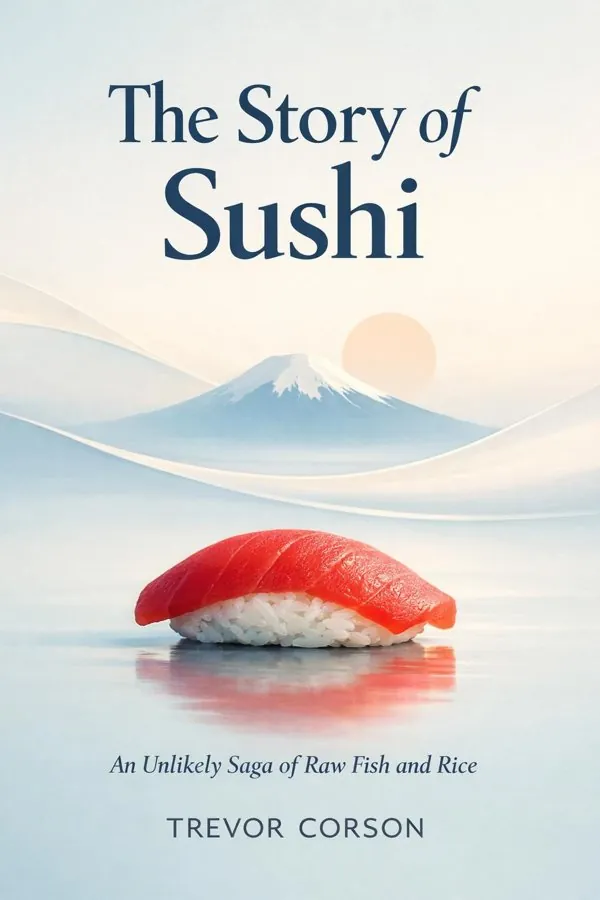
The Story of Sushi: An Unlikely Saga of Raw Fish and Rice: Summary & Key Insights
 10 min6 chaptersAudio available
What Is The Story of Sushi: An Unlikely Saga of Raw Fish and Rice About?
The Story of Sushi: An Unlikely Saga of Raw Fish and Rice by Trevor Corson is a food_culture book spanning 6 pages. A narrative nonfiction exploration of the history, culture, and science behind sushi, following the experiences of students at a sushi academy in Los Angeles while tracing the dish’s origins from ancient Japan to its global popularity.
This FizzRead summary covers all 6 key chapters of The Story of Sushi: An Unlikely Saga of Raw Fish and Rice in approximately 10 minutes, distilling the most important ideas, arguments, and takeaways from Trevor Corson's work. Also available as an audio summary and Key Quotes Podcast.
The Story of Sushi: An Unlikely Saga of Raw Fish and Rice
A narrative nonfiction exploration of the history, culture, and science behind sushi, following the experiences of students at a sushi academy in Los Angeles while tracing the dish’s origins from ancient Japan to its global popularity.
Who Should Read The Story of Sushi: An Unlikely Saga of Raw Fish and Rice?
This book is perfect for anyone interested in food_culture and looking to gain actionable insights in a short read. Whether you're a student, professional, or lifelong learner, the key ideas from The Story of Sushi: An Unlikely Saga of Raw Fish and Rice by Trevor Corson will help you think differently.
- ✓Readers who enjoy food_culture and want practical takeaways
- ✓Professionals looking to apply new ideas to their work and life
- ✓Anyone who wants the core insights of The Story of Sushi: An Unlikely Saga of Raw Fish and Rice in just 10 minutes
Want the full summary?
Get instant access to this book summary and 100K+ more with Fizz Moment.
Get Free SummaryAvailable on App Store • Free to download
Key Chapters
My story begins in a modest sushi academy in Los Angeles — a place buzzing with ambition and uncertainty. Here, men and women, many without Japanese heritage, wrestle with centuries of tradition in an intensive program where even the simplest motion carries meaning. I sought to show this rigorous environment as a living symbol of globalization: sushi, once a local craft rooted in Edo streets, now flourishing amid California sunlight and diverse faces.
In the classroom, students confront the foundations — rice cooking, knife technique, and the subtle rituals of courtesy and presentation. Their instructor embodies stern precision and deep respect for ingredients, reminding them constantly that mastery demands more than skill; it requires an inner stillness. Through them, we glimpse sushi’s ancient lineage. Long before the sleek counters of modern Tokyo, sushi was born in Southeast Asia as a functional way to preserve fish with fermented rice. The process, called *nare-zushi*, allowed people to store protein in humid climates when refrigeration was unimaginable.
From that beginning, Japan adopted and refined the technique, eventually casting off fermentation itself and keeping the rice fresh, blending acid and sweetness into balance. The transformation from *nare-zushi* to modern *edomae* sushi marked not only a change in taste but a cultural shift — sushi became pleasure, not preservation. I wanted readers to see that what happens at the Los Angeles sushi academy is not merely education; it’s an echo of centuries of culinary evolution.
The transition of sushi into the modern era occurred during the Edo period (1603–1868), a time when Tokyo, then called Edo, was flourishing, bustling with merchants, and open to innovation. I traced this evolution carefully, because it demonstrates how a society turns necessity into art. Edo’s working-class population demanded fast, fresh food, and ingenious street vendors responded by crafting hand-pressed morsels of seafood atop vinegar-seasoned rice — early *nigiri-zushi*. This was a revelation: food that celebrated immediacy and purity.
What fascinates me about the Edo sushi masters is their dual role — artisans and philosophers. They appreciated the beauty of the moment, insisting that each piece should disappear as soon as it’s made, embodying an impermanent perfection much like a fleeting season. This ideal resonates still within the sushi academy, where students are taught to notice the temperature of the fish, the breath of the rice, and the curve of the fingers. Sushi, I realized, is less about recipes than about mindfulness. Each detail reflects an intuitive harmony between human and ingredient.
As sushi evolved from preservation to celebration, its aesthetic language grew: from the gleam of a knife blade to the precise angle of presentation. In this evolution lies the heart of Japanese culinary philosophy — a reverence for balance, restraint, and nature’s simplicity. By guiding readers through Edo’s crowded alleys and vibrant markets, I wanted to show how sushi became a distillation of Japanese identity and how that spirit quietly persists, even in a Californian classroom thousands of miles away.
+ 4 more chapters — available in the FizzRead app
All Chapters in The Story of Sushi: An Unlikely Saga of Raw Fish and Rice
About the Author
Trevor Corson is an American author and journalist known for his works on food culture and marine life. He has written for major publications and taught writing at several universities.
Get This Summary in Your Preferred Format
Read or listen to the The Story of Sushi: An Unlikely Saga of Raw Fish and Rice summary by Trevor Corson anytime, anywhere. FizzRead offers multiple formats so you can learn on your terms — all free.
Available formats: App · Audio · PDF · EPUB — All included free with FizzRead
Download The Story of Sushi: An Unlikely Saga of Raw Fish and Rice PDF and EPUB Summary
Key Quotes from The Story of Sushi: An Unlikely Saga of Raw Fish and Rice
“My story begins in a modest sushi academy in Los Angeles — a place buzzing with ambition and uncertainty.”
“The transition of sushi into the modern era occurred during the Edo period (1603–1868), a time when Tokyo, then called Edo, was flourishing, bustling with merchants, and open to innovation.”
Frequently Asked Questions about The Story of Sushi: An Unlikely Saga of Raw Fish and Rice
The Story of Sushi: An Unlikely Saga of Raw Fish and Rice by Trevor Corson is a food_culture book that explores key ideas across 6 chapters. A narrative nonfiction exploration of the history, culture, and science behind sushi, following the experiences of students at a sushi academy in Los Angeles while tracing the dish’s origins from ancient Japan to its global popularity.
Browse by Category
Ready to read The Story of Sushi: An Unlikely Saga of Raw Fish and Rice?
Get the full summary and 100K+ more books with Fizz Moment.