
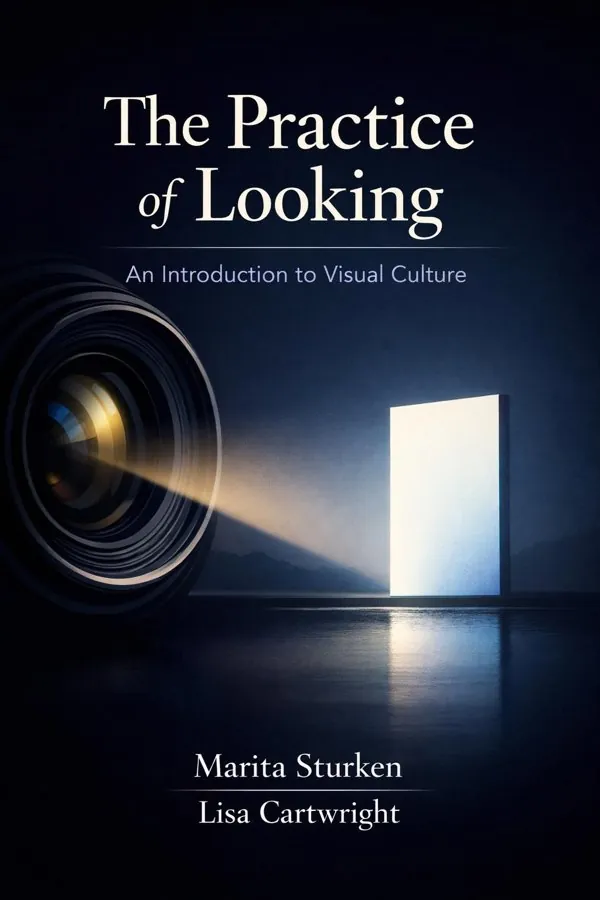
The Practice of Looking: An Introduction to Visual Culture: Summary & Key Insights
by Marita Sturken, Lisa Cartwright
 10 min9 chaptersAudio available
Key Takeaways from The Practice of Looking: An Introduction to Visual Culture
We do not simply look at the world; we look through tools, systems, and habits that teach us what seeing means.
Images do not merely mirror reality; they actively construct it.
Few visual forms feel as trustworthy as photographs, yet few are as culturally complicated.
Moving images do more than entertain us; they teach us how to feel, desire, fear, and understand the social world.
Advertisements rarely just sell products; they sell lifestyles, identities, fantasies, and emotional solutions.
What Is The Practice of Looking: An Introduction to Visual Culture About?
The Practice of Looking: An Introduction to Visual Culture by Marita Sturken, Lisa Cartwright is a visual_arts book spanning 9 pages. The Practice of Looking is a foundational guide to understanding how images shape modern life. Rather than treating pictures as neutral reflections of reality, Marita Sturken and Lisa Cartwright show that seeing is a cultural practice: what we notice, how we interpret it, and what we believe about it are all influenced by history, politics, technology, and power. The book moves across photography, film, television, advertising, museums, medical imaging, surveillance, and digital media to explain how visual culture organizes everyday experience. What makes this book especially valuable is its ability to combine theory with familiar examples. Sturken and Cartwright draw from semiotics, feminism, postcolonial studies, psychoanalysis, and media theory, but they do so in a way that helps readers apply these ideas to the images they encounter every day. A family photograph, a news broadcast, a fashion ad, or a social media post all become sites of cultural meaning. As respected scholars of media, memory, visuality, and representation, the authors offer both intellectual rigor and practical insight. The result is an essential introduction for anyone who wants to become a more critical, informed, and ethically aware viewer.
This FizzRead summary covers all 9 key chapters of The Practice of Looking: An Introduction to Visual Culture in approximately 10 minutes, distilling the most important ideas, arguments, and takeaways from Marita Sturken, Lisa Cartwright's work. Also available as an audio summary and Key Quotes Podcast.
The Practice of Looking: An Introduction to Visual Culture
The Practice of Looking is a foundational guide to understanding how images shape modern life. Rather than treating pictures as neutral reflections of reality, Marita Sturken and Lisa Cartwright show that seeing is a cultural practice: what we notice, how we interpret it, and what we believe about it are all influenced by history, politics, technology, and power. The book moves across photography, film, television, advertising, museums, medical imaging, surveillance, and digital media to explain how visual culture organizes everyday experience.
What makes this book especially valuable is its ability to combine theory with familiar examples. Sturken and Cartwright draw from semiotics, feminism, postcolonial studies, psychoanalysis, and media theory, but they do so in a way that helps readers apply these ideas to the images they encounter every day. A family photograph, a news broadcast, a fashion ad, or a social media post all become sites of cultural meaning. As respected scholars of media, memory, visuality, and representation, the authors offer both intellectual rigor and practical insight. The result is an essential introduction for anyone who wants to become a more critical, informed, and ethically aware viewer.
Who Should Read The Practice of Looking: An Introduction to Visual Culture?
This book is perfect for anyone interested in visual_arts and looking to gain actionable insights in a short read. Whether you're a student, professional, or lifelong learner, the key ideas from The Practice of Looking: An Introduction to Visual Culture by Marita Sturken, Lisa Cartwright will help you think differently.
- ✓Readers who enjoy visual_arts and want practical takeaways
- ✓Professionals looking to apply new ideas to their work and life
- ✓Anyone who wants the core insights of The Practice of Looking: An Introduction to Visual Culture in just 10 minutes
Want the full summary?
Get instant access to this book summary and 100K+ more with Fizz Moment.
Get Free SummaryAvailable on App Store • Free to download
Key Chapters
We do not simply look at the world; we look through tools, systems, and habits that teach us what seeing means. One of the book’s most important insights is that visual technologies are not passive instruments. From Renaissance perspective to photography, cinema, television, and digital screens, each technology organizes vision in particular ways. Perspective painting trained viewers to imagine space from a single stable point of view. Photography introduced the idea that machines could capture reality objectively. Film added movement and narrative, while television brought constant visual flow into domestic life. Today, smartphones, algorithms, and platforms shape not only what we see but how often, how fast, and in what context we see it.
Sturken and Cartwright argue that technologies of vision carry assumptions about truth, authority, and human experience. A medical scan appears scientific and reliable, yet it still requires interpretation. A satellite image seems detached and comprehensive, yet it reflects military, political, or institutional priorities. Even a phone camera, which feels personal and spontaneous, is built into systems of storage, sharing, surveillance, and commercial design.
This historical view matters because it prevents us from treating current media as natural or inevitable. It helps us see that every visual regime has conventions, limits, and embedded values. In practical terms, this means questioning not only what an image shows but also how a device or platform frames it. The next time you encounter an image, ask: what technology made this visible, what viewpoint does it privilege, and what does it leave out?
Images do not merely mirror reality; they actively construct it. At the center of visual culture studies is the idea of representation: the process through which signs, symbols, and images produce meaning. Drawing on semiotics, the book explains that visual meaning is never fixed inside an image itself. Instead, meaning emerges through cultural codes, social context, and shared systems of interpretation. A flag, a portrait, a brand logo, or a news image works because viewers have learned how to read it.
But representation is never innocent. The meanings images circulate often support larger ideologies: assumptions about nation, class, gender, race, beauty, normality, and power. For example, a magazine spread that repeatedly associates luxury with thinness, whiteness, and youth is doing more than selling products. It is reinforcing a worldview about desirability and status. A political photograph may present a leader as heroic through angle, lighting, and composition, turning visual form into ideological persuasion.
The authors encourage readers to see interpretation as an active process. Different audiences may read the same image differently depending on their identities and experiences. Yet not all readings have equal power; institutions such as media industries, schools, governments, and museums shape dominant meanings.
A practical application is to slow down your viewing. Ask what signs are being used, what values they suggest, and whose interests they serve. Rather than asking only, “What does this picture show?” ask, “What idea of the world does this image promote?” That shift turns everyday looking into critical analysis.
Few visual forms feel as trustworthy as photographs, yet few are as culturally complicated. The book treats photography as a central example of how visual media combine truth claims with emotion, memory, and power. Because a photograph is produced by light hitting a recording surface, it has long been associated with evidence. We trust photos in journalism, family albums, police files, passports, and archives because they appear to capture “what was there.”
Sturken and Cartwright show, however, that photographs are never pure facts. Framing, timing, selection, circulation, and captioning all shape meaning. A war image may become iconic not because it tells the whole story, but because it condenses a complex event into a single emotionally compelling scene. A family snapshot may preserve memory while also editing it, leaving out conflict and hardship in favor of belonging and celebration. Identity photographs, meanwhile, can function as tools of administration and surveillance, linking visual representation to state power.
The emotional force of photography is part of its social power. Photos can create intimacy across time, mobilize political movements, and generate public empathy. But they can also exploit suffering, freeze stereotypes, or create false certainty. In the digital era, manipulation and circulation have made photographic credibility even more unstable, yet the authority of the photographic image remains strong.
A useful habit is to treat photographs as both evidence and argument. Ask who made the image, for what purpose, how it has been framed, and what emotional response it seeks. Looking at photography critically does not mean rejecting it; it means understanding the conditions under which it persuades us.
Advertisements rarely just sell products; they sell lifestyles, identities, fantasies, and emotional solutions. One of the book’s strongest contributions is its analysis of advertising as a major force in visual culture. Ads teach viewers to connect objects with desire, self-worth, belonging, and aspiration. A perfume ad may promise seduction, a car commercial may imply freedom and control, and a tech campaign may frame consumption as innovation or personal empowerment. In each case, the product matters less than the visual story wrapped around it.
Advertising works by condensing social values into instantly recognizable images. It often borrows from art, fashion, celebrity culture, and political symbolism to create associations that feel natural. The body is especially central: ideals of beauty, health, masculinity, femininity, youth, and sexual attractiveness are repeatedly staged to support consumer messages. As a result, ads do not merely reflect cultural norms; they help produce them.
Sturken and Cartwright show that advertising is also deeply tied to global capitalism. Images circulate across borders, adapting to local markets while spreading broad commercial logics. Even when people know ads are manipulative, repeated exposure shapes habits of comparison, dissatisfaction, and desire. We begin to look at ourselves through commercial categories.
A practical way to resist this is to “decode” ads before absorbing them. Ask what insecurity or longing the ad is activating, what social ideal it is attaching to the product, and who is absent from the frame. By naming the fantasy being sold, you weaken its invisible hold. Consumer literacy begins when you stop seeing ads as simple information and start seeing them as cultural training.
What a culture repeatedly shows determines, in part, who gets recognized as fully human. The book carefully explores how gender, race, sexuality, and other identities are constructed and contested through representation. Images do not simply portray difference; they often organize hierarchies. When certain groups are stereotyped, exoticized, hypersexualized, infantilized, criminalized, or made invisible, visual culture helps sustain unequal social relations.
Feminist and postcolonial theories are central here. The authors examine how women have often been positioned as objects of display rather than subjects of action, and how racialized groups have been framed through colonial and nationalist fantasies. These patterns do not remain on the level of images alone. They influence expectations in everyday life, from beauty standards and workplace norms to policing, education, and public belonging.
At the same time, representation is also a field of struggle. Artists, filmmakers, activists, and communities have used visual media to challenge dominant images and create alternative forms of visibility. Self-representation, documentary projects, queer archives, and independent media can expose stereotypes while offering richer, more complex accounts of lived experience. The point is not that visibility automatically solves inequality, but that who controls images matters.
In everyday practice, this means paying attention to patterns rather than isolated examples. If you notice a film, campaign, or news outlet, ask: who is centered, who is simplified, who is missing, and who is allowed complexity? Then widen what you consume. Seeking out more diverse creators and perspectives is not just a matter of taste; it is a way of retraining perception and expanding the social imagination.
To look is never a neutral act. One of the book’s most influential ideas is the politics of the gaze: who gets to look, who is looked at, and under what conditions. The gaze is not just eyesight; it is a social relation structured by power. Feminist theory, psychoanalysis, and film studies have shown that many visual systems position viewers in ways that privilege certain subjects while objectifying others. A camera can invite identification with the active observer and render another person a spectacle, target, or object of desire.
This concept extends beyond cinema into everyday life. Museums, advertisements, fashion photography, social media, policing, and public space all involve forms of gazing. Surveillance is a crucial part of this discussion. Security cameras, biometric systems, facial recognition, and data-driven monitoring transform people into visible objects of management. Unlike traditional viewing, surveillance often works without reciprocity: those being watched may not know when, how, or by whom they are seen.
The authors show that visibility can be both empowering and dangerous. Marginalized groups may fight for recognition, yet increased visibility can also invite control, scrutiny, and commodification. This tension is central to contemporary visual culture, especially online, where self-display and monitoring often overlap.
A practical takeaway is to examine moments of looking from both sides. When you encounter an image or platform, ask: who controls the frame, who benefits from this visibility, and what kind of subject position am I being asked to occupy? Developing this reflex makes you more alert to hidden structures of power behind ordinary acts of seeing.
Digital media have not simply added new images to the world; they have changed the speed, scale, and logic of visual culture itself. Sturken and Cartwright show that digital images are more mobile, editable, searchable, and networked than earlier visual forms. A photograph taken on a phone can be filtered, captioned, reposted, memed, archived, monetized, and surveilled within minutes. Images now move through platforms that rank attention, encourage participation, and convert visibility into data.
This shift has major cultural consequences. First, the boundary between producer and viewer has weakened. Ordinary users create and circulate visual content constantly. Second, the credibility of images has become more unstable. Editing tools, AI systems, and viral misinformation challenge older assumptions about photographic truth. Third, global circulation means that local events can become international visual spectacles almost instantly, generating solidarity, outrage, or misunderstanding across borders.
Yet digital culture is not automatically democratic. Platform design, corporate ownership, and algorithmic amplification shape which images rise and which disappear. Some voices gain visibility while others are buried, harassed, or decontextualized. The global flow of images can also flatten cultural differences, turning complex realities into consumable trends or emotional flashes.
To navigate this environment, practice platform awareness. Before sharing an image, consider its source, context, and likely effects. Notice how interfaces steer attention through likes, autoplay, recommendation feeds, and metrics. The key lesson is that digital seeing is always structured. If you want more agency online, do not just evaluate content; evaluate the system through which the content reaches you.
Some images do not just inform us; they become part of how societies remember pain. The book highlights the powerful role of visual culture in memory and trauma, especially around war, disaster, atrocity, illness, and collective loss. Public memory is not formed only through official histories or written records. It is built through photographs, memorials, news footage, documentaries, museum displays, and repeated iconic images that stand in for larger events.
These images can create shared remembrance and public accountability. A single photograph may crystallize an injustice and motivate political action. Memorial architecture and museum exhibitions can give form to grief and historical consciousness. At the same time, the visual representation of suffering raises urgent ethical questions. When does looking become witnessing, and when does it become consumption? Can repeated exposure to trauma images build empathy, or does it produce numbness? Who has the right to display and circulate scenes of pain?
Sturken and Cartwright do not offer simple rules, but they push readers to consider context, intention, and audience responsibility. Ethical looking means recognizing that images of suffering involve real people, unequal power relations, and afterlives beyond the moment of viewing. It also means understanding that absence can matter as much as visibility; some histories are forgotten not because they lacked images, but because their images were ignored or suppressed.
An actionable takeaway is to pause before consuming or sharing traumatic imagery. Ask whether the image deepens understanding, honors those represented, or merely delivers shock. Ethical visual literacy requires not just attention, but care.
All Chapters in The Practice of Looking: An Introduction to Visual Culture
About the Authors
Marita Sturken and Lisa Cartwright are leading scholars in visual culture and media studies whose work has shaped how students and researchers think about images, power, and representation. Marita Sturken is a professor of Media, Culture, and Communication at New York University and is widely known for her research on cultural memory, consumer culture, tourism, and visual media. Lisa Cartwright, a professor of Communication and Science Studies at the University of California, San Diego, has made major contributions to feminist theory, visual studies, disability studies, and the analysis of scientific and medical imaging. Together, they bring an interdisciplinary perspective that bridges theory and everyday life. Their collaboration on The Practice of Looking has made the book one of the most widely used introductions to visual culture, valued for both its intellectual depth and practical relevance.
Get This Summary in Your Preferred Format
Read or listen to the The Practice of Looking: An Introduction to Visual Culture summary by Marita Sturken, Lisa Cartwright anytime, anywhere. FizzRead offers multiple formats so you can learn on your terms — all free.
Available formats: App · Audio · PDF · EPUB — All included free with FizzRead
Download The Practice of Looking: An Introduction to Visual Culture PDF and EPUB Summary
Key Quotes from The Practice of Looking: An Introduction to Visual Culture
“We do not simply look at the world; we look through tools, systems, and habits that teach us what seeing means.”
“Images do not merely mirror reality; they actively construct it.”
“Few visual forms feel as trustworthy as photographs, yet few are as culturally complicated.”
“Moving images do more than entertain us; they teach us how to feel, desire, fear, and understand the social world.”
“Advertisements rarely just sell products; they sell lifestyles, identities, fantasies, and emotional solutions.”
Frequently Asked Questions about The Practice of Looking: An Introduction to Visual Culture
The Practice of Looking: An Introduction to Visual Culture by Marita Sturken, Lisa Cartwright is a visual_arts book that explores key ideas across 9 chapters. The Practice of Looking is a foundational guide to understanding how images shape modern life. Rather than treating pictures as neutral reflections of reality, Marita Sturken and Lisa Cartwright show that seeing is a cultural practice: what we notice, how we interpret it, and what we believe about it are all influenced by history, politics, technology, and power. The book moves across photography, film, television, advertising, museums, medical imaging, surveillance, and digital media to explain how visual culture organizes everyday experience. What makes this book especially valuable is its ability to combine theory with familiar examples. Sturken and Cartwright draw from semiotics, feminism, postcolonial studies, psychoanalysis, and media theory, but they do so in a way that helps readers apply these ideas to the images they encounter every day. A family photograph, a news broadcast, a fashion ad, or a social media post all become sites of cultural meaning. As respected scholars of media, memory, visuality, and representation, the authors offer both intellectual rigor and practical insight. The result is an essential introduction for anyone who wants to become a more critical, informed, and ethically aware viewer.
Browse by Category
Ready to read The Practice of Looking: An Introduction to Visual Culture?
Get the full summary and 100K+ more books with Fizz Moment.