
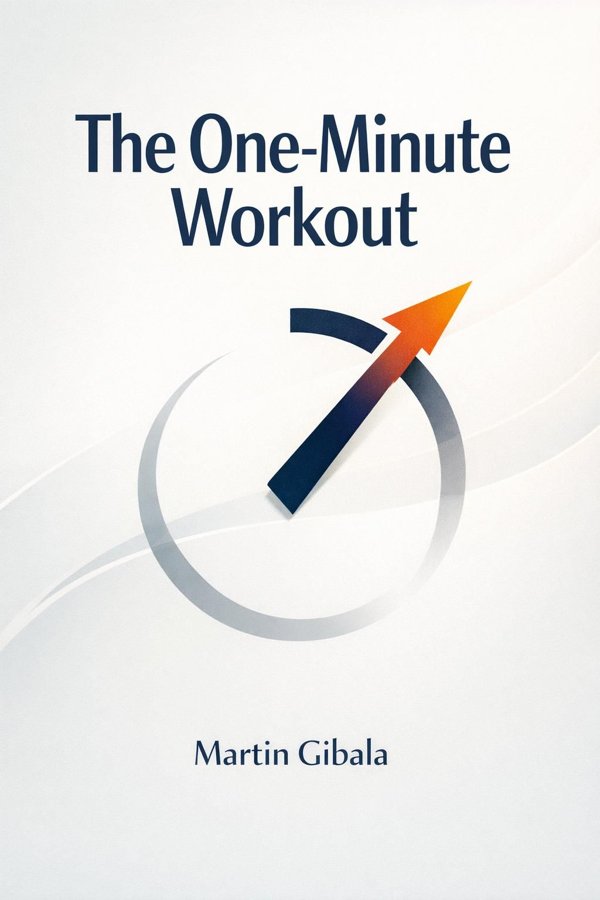
The One-Minute Workout: Science Shows a Way to Get Fit That's Smarter, Faster, Shorter: Summary & Key Insights
 10 min10 chaptersAudio available
What Is The One-Minute Workout: Science Shows a Way to Get Fit That's Smarter, Faster, Shorter About?
The One-Minute Workout: Science Shows a Way to Get Fit That's Smarter, Faster, Shorter by Martin Gibala is a fitness book spanning 10 pages. In this groundbreaking book, exercise physiologist Martin Gibala reveals how short bursts of high-intensity interval training (HIIT) can deliver the same health and fitness benefits as traditional endurance workouts. Drawing on years of scientific research, Gibala explains how just a few minutes of intense effort can improve cardiovascular health, increase strength, and boost metabolism. The book provides practical workout plans and guidance for people of all fitness levels who want to maximize results in minimal time.
This FizzRead summary covers all 10 key chapters of The One-Minute Workout: Science Shows a Way to Get Fit That's Smarter, Faster, Shorter in approximately 10 minutes, distilling the most important ideas, arguments, and takeaways from Martin Gibala's work. Also available as an audio summary and Key Quotes Podcast.
The One-Minute Workout: Science Shows a Way to Get Fit That's Smarter, Faster, Shorter
In this groundbreaking book, exercise physiologist Martin Gibala reveals how short bursts of high-intensity interval training (HIIT) can deliver the same health and fitness benefits as traditional endurance workouts. Drawing on years of scientific research, Gibala explains how just a few minutes of intense effort can improve cardiovascular health, increase strength, and boost metabolism. The book provides practical workout plans and guidance for people of all fitness levels who want to maximize results in minimal time.
Who Should Read The One-Minute Workout: Science Shows a Way to Get Fit That's Smarter, Faster, Shorter?
This book is perfect for anyone interested in fitness and looking to gain actionable insights in a short read. Whether you're a student, professional, or lifelong learner, the key ideas from The One-Minute Workout: Science Shows a Way to Get Fit That's Smarter, Faster, Shorter by Martin Gibala will help you think differently.
- ✓Readers who enjoy fitness and want practical takeaways
- ✓Professionals looking to apply new ideas to their work and life
- ✓Anyone who wants the core insights of The One-Minute Workout: Science Shows a Way to Get Fit That's Smarter, Faster, Shorter in just 10 minutes
Want the full summary?
Get instant access to this book summary and 100K+ more with Fizz Moment.
Get Free SummaryAvailable on App Store • Free to download
Key Chapters
For decades, the dogma of endurance training dominated exercise science: to improve cardiovascular fitness, one had to log long, steady hours of work. The logic seemed solid — endurance builds endurance. But around the mid‑2000s, my research group began to notice cracks in that assumption. Laboratory data hinted that brief periods of very high effort could mimic many of the same physiological changes typically seen after prolonged training, especially in mitochondria — the energy factories inside muscle cells.
Time efficiency became the central question driving my work. If most people cite lack of time as their primary barrier to exercise, what if we could compress the benefits of long workouts into much shorter sessions? The key was intensity. By challenging the body with brief episodes of near‑maximal exertion, we could activate many of the same molecular pathways responsible for endurance adaptation. It turned out that intensity, when properly structured, amplifies the body’s internal machinery far beyond what steady exercise achieves in the same span.
Our studies revealed that after just six weeks of brief high‑intensity sessions, participants doubled their endurance and showed improvements in muscle oxidative capacity comparable to those training with much longer sessions. The implications were profound: the road to fitness does not have to be paved with endless miles but with purposeful bursts of effort. Time efficiency, then, isn’t just a convenience — it’s a paradigm shift in how we think about improving health.
The origin of the One‑Minute Workout lies in a set of early McMaster experiments that surprised even us. We designed a protocol that asked participants to perform three bouts of twenty‑second all‑out cycling sprints on a specialized stationary bike known as a Wingate ergometer. Between each sprint, they rested for two minutes. The entire active portion of the workout — the time spent pushing the pedals — added up to just one minute. Including warm‑up and recovery, the total time commitment was about ten minutes.
This simple idea, born out of curiosity, challenged decades of endurance thinking. To test its effectiveness, we compared it head‑to‑head with a traditional endurance training group who cycled for forty‑five minutes at a moderate intensity. To our amazement, after only a few weeks, both groups showed nearly identical improvements in aerobic capacity, muscle enzyme activity, and insulin sensitivity. One group had spent about three minutes per week of true effort; the other had spent over four and a half hours. The physiological equality between these extremes became the cornerstone of my later work.
That early success was humbling. It taught me that the body’s potential for adaptation is far greater than our standard routines imagine. What mattered most was not the time you spent exercising but how you spent that time. The One‑Minute Workout wasn’t a gimmick. It was a revelation about human biology’s extraordinary efficiency.
+ 8 more chapters — available in the FizzRead app
All Chapters in The One-Minute Workout: Science Shows a Way to Get Fit That's Smarter, Faster, Shorter
About the Author
Martin Gibala is a professor of kinesiology at McMaster University in Canada, known for his pioneering research on high-intensity interval training (HIIT). His work has been featured in major media outlets and has influenced modern exercise science. He co-authored this book to make his research accessible to the general public.
Get This Summary in Your Preferred Format
Read or listen to the The One-Minute Workout: Science Shows a Way to Get Fit That's Smarter, Faster, Shorter summary by Martin Gibala anytime, anywhere. FizzRead offers multiple formats so you can learn on your terms — all free.
Available formats: App · Audio · PDF · EPUB — All included free with FizzRead
Download The One-Minute Workout: Science Shows a Way to Get Fit That's Smarter, Faster, Shorter PDF and EPUB Summary
Key Quotes from The One-Minute Workout: Science Shows a Way to Get Fit That's Smarter, Faster, Shorter
“For decades, the dogma of endurance training dominated exercise science: to improve cardiovascular fitness, one had to log long, steady hours of work.”
“The origin of the One‑Minute Workout lies in a set of early McMaster experiments that surprised even us.”
Frequently Asked Questions about The One-Minute Workout: Science Shows a Way to Get Fit That's Smarter, Faster, Shorter
The One-Minute Workout: Science Shows a Way to Get Fit That's Smarter, Faster, Shorter by Martin Gibala is a fitness book that explores key ideas across 10 chapters. In this groundbreaking book, exercise physiologist Martin Gibala reveals how short bursts of high-intensity interval training (HIIT) can deliver the same health and fitness benefits as traditional endurance workouts. Drawing on years of scientific research, Gibala explains how just a few minutes of intense effort can improve cardiovascular health, increase strength, and boost metabolism. The book provides practical workout plans and guidance for people of all fitness levels who want to maximize results in minimal time.
You Might Also Like
The Men's Health Handbook: Practical Fitness, Nutrition, and Wellbeing for Men
Men's Health Editors
10 min
30 Ways to Reboot Your Body: A Complete User Manual for Getting the Most Out of the Human Body
Ben Greenfield
10 min
Active Aging: Exercise Plans for Older Adults: Safe Training for Seniors and Aging Populations
Patricia A. Brill
10 min
Becoming a Supple Leopard: The Ultimate Guide to Resolving Pain, Preventing Injury, and Optimizing Athletic Performance
Kelly Starrett
10 min
Bigger Leaner Stronger: The Simple Science of Building the Ultimate Male Body
Michael Matthews
10 min
Body by Science: A Research-Based Program for Strength Training, Bodybuilding, and Complete Fitness in 12 Minutes a Week
Doug McGuff, John Little
10 minBrowse by Category
Ready to read The One-Minute Workout: Science Shows a Way to Get Fit That's Smarter, Faster, Shorter?
Get the full summary and 100K+ more books with Fizz Moment.