
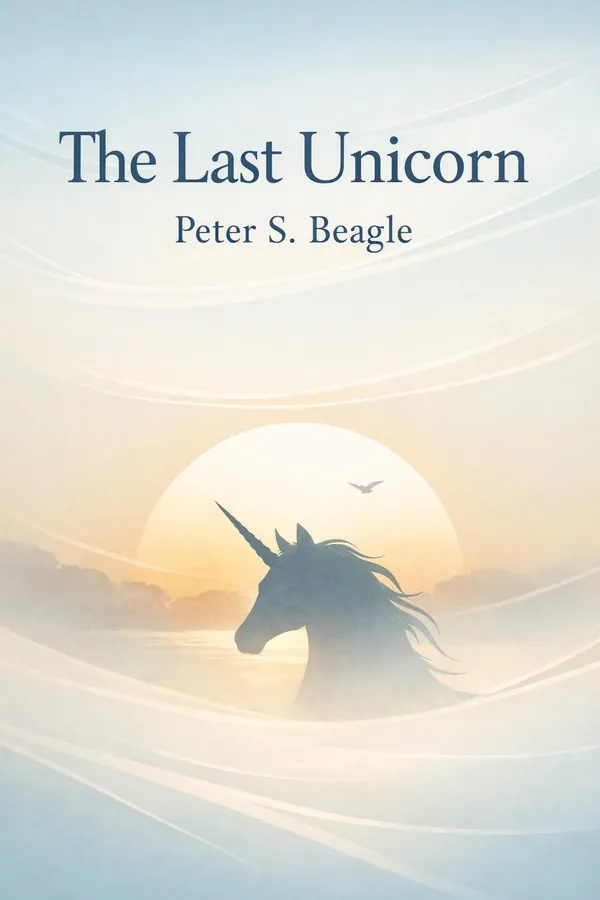
The Last Unicorn: Summary & Key Insights
 10 min9 chaptersAudio available
Key Takeaways from The Last Unicorn
Real transformation often starts with a disturbing question, not a heroic certainty.
Wonder does not disappear all at once; it erodes when people lose the ability to recognize it.
To become more human is to become more vulnerable, and that vulnerability is both terrifying and valuable.
No meaningful quest is completed by purity alone; it requires flawed companions who bring courage, humor, and hard-won loyalty.
People often choose comforting illusion over difficult truth, even when illusion slowly deforms their lives.
What Is The Last Unicorn About?
The Last Unicorn by Peter S. Beagle is a general book. What happens when a creature of pure myth discovers that myth may be dying? Peter S. Beagle’s The Last Unicorn begins with a haunting premise: a unicorn overhears hunters saying that she may be the last of her kind, and she sets out to discover what happened to the others. From that deceptively simple beginning, Beagle creates a fantasy novel that is lyrical, melancholy, funny, and unexpectedly wise. It is a story about enchantment, but also about loss, memory, mortality, and the painful beauty of becoming fully alive. First published in 1968, The Last Unicorn endures because it speaks to both children and adults at once. On one level, it is an unforgettable quest featuring a magician, a bandit-turned-heroine, a cursed king, and the terrifying Red Bull. On another, it is a profound meditation on innocence meeting experience, and on what is gained and lost when idealized beings enter the human world. Beagle, one of the most celebrated voices in modern fantasy, writes with rare elegance and emotional precision. His novel matters not just as a classic fantasy adventure, but as a timeless reflection on what it means to love, suffer, remember, and change.
This FizzRead summary covers all 9 key chapters of The Last Unicorn in approximately 10 minutes, distilling the most important ideas, arguments, and takeaways from Peter S. Beagle's work. Also available as an audio summary and Key Quotes Podcast.
The Last Unicorn
What happens when a creature of pure myth discovers that myth may be dying? Peter S. Beagle’s The Last Unicorn begins with a haunting premise: a unicorn overhears hunters saying that she may be the last of her kind, and she sets out to discover what happened to the others. From that deceptively simple beginning, Beagle creates a fantasy novel that is lyrical, melancholy, funny, and unexpectedly wise. It is a story about enchantment, but also about loss, memory, mortality, and the painful beauty of becoming fully alive.
First published in 1968, The Last Unicorn endures because it speaks to both children and adults at once. On one level, it is an unforgettable quest featuring a magician, a bandit-turned-heroine, a cursed king, and the terrifying Red Bull. On another, it is a profound meditation on innocence meeting experience, and on what is gained and lost when idealized beings enter the human world. Beagle, one of the most celebrated voices in modern fantasy, writes with rare elegance and emotional precision. His novel matters not just as a classic fantasy adventure, but as a timeless reflection on what it means to love, suffer, remember, and change.
Who Should Read The Last Unicorn?
This book is perfect for anyone interested in general and looking to gain actionable insights in a short read. Whether you're a student, professional, or lifelong learner, the key ideas from The Last Unicorn by Peter S. Beagle will help you think differently.
- ✓Readers who enjoy general and want practical takeaways
- ✓Professionals looking to apply new ideas to their work and life
- ✓Anyone who wants the core insights of The Last Unicorn in just 10 minutes
Want the full summary?
Get instant access to this book summary and 100K+ more with Fizz Moment.
Get Free SummaryAvailable on App Store • Free to download
Key Chapters
Real transformation often starts with a disturbing question, not a heroic certainty. In The Last Unicorn, the central journey begins when the unicorn hears ordinary humans speak as if unicorns belong to the past. For the first time, she confronts the possibility that she may truly be the last. That realization pushes her out of the safety of her forest and into a world where myth is fading, wonder is misunderstood, and truth must be pursued rather than assumed.
This idea gives the novel its emotional and philosophical depth. The unicorn does not begin her quest because she wants adventure. She begins because she can no longer live honestly without facing what she does not know. Beagle turns the classic fantasy quest into something more inward: a search for reality, identity, and responsibility. The unicorn’s innocence is not ignorance; it is a state of purity that must now encounter history, loss, and limitation.
In everyday life, this pattern feels familiar. Many important changes begin when we realize that a comforting assumption may no longer be true. A career may look secure until a shift in the industry forces us to rethink our path. A relationship may seem stable until one difficult conversation reveals hidden distance. Personal growth often begins when we stop avoiding unsettling evidence.
The unicorn’s decision also shows courage in a refined form. She does not rush forward with loud confidence. She moves because truth matters more than comfort. That is a useful model for anyone facing uncertainty. Growth does not always require certainty; it requires a willingness to investigate reality.
Actionable takeaway: Identify one assumption in your life you have not questioned lately, and spend time honestly examining whether it is still true.
Wonder does not disappear all at once; it erodes when people lose the ability to recognize it. One of the most memorable ideas in The Last Unicorn is that the world has not merely become less magical by accident. It has become spiritually dimmer because many people no longer perceive beauty, mystery, or truth even when they stand directly before it. The unicorn remains a unicorn, but most humans cannot see her clearly for what she is.
Beagle uses this selective blindness to explore modern spiritual exhaustion. The problem is not only that magic is hidden; it is that cynicism, distraction, and habit train people to overlook what is extraordinary. Mommy Fortuna, for example, runs a carnival of fake monsters because audiences are more comfortable with illusions than with the real thing. They prefer spectacle they can consume over wonder that might unsettle them.
This theme applies far beyond fantasy. In ordinary life, people often stop noticing what gives life depth: meaningful conversation, natural beauty, craftsmanship, loyalty, silence, art, and love expressed without performance. We become so accustomed to novelty and noise that genuine wonder feels too quiet to register. A masterpiece can be ignored while shallow entertainment gets immediate attention.
The book suggests that perception is moral as well as aesthetic. To truly see something precious, we must become more awake, more humble, and more receptive. This is why the novel still resonates: it asks readers whether the loss of enchantment in the world may reflect a loss of attentiveness in ourselves.
Actionable takeaway: Practice recovering your capacity for wonder by deliberately noticing one beautiful, unusual, or easily overlooked thing each day and giving it your full attention.
To become more human is to become more vulnerable, and that vulnerability is both terrifying and valuable. A defining turn in The Last Unicorn occurs when the unicorn is transformed into a human woman, Lady Amalthea. What first appears to be a disguise gradually becomes an existential test. As Amalthea, she experiences fear, time, longing, uncertainty, and love in ways she never could as an immortal creature.
This transformation is central to the novel’s power. Beagle does not romanticize humanity as superior to innocence or immortality. Instead, he presents human experience as profound precisely because it is fragile. The unicorn as unicorn is beautiful, timeless, and self-contained. Amalthea is more confused, more endangered, and far less certain of who she is. Yet she also gains access to emotional complexity. She can feel loss before it happens. She can love knowing love may end. She can inhabit the aching temporality that defines human life.
This mirrors real life in important ways. Many people try to avoid vulnerability, imagining that emotional safety will preserve them. But a life protected from pain is often also protected from intimacy, courage, and growth. To commit to another person, to create something meaningful, to risk failure, or to care deeply about a cause all involve becoming more exposed.
The novel suggests that pain is not good in itself, but it can deepen consciousness. Amalthea’s humanity teaches her not only what suffering feels like, but why mortal beings cling so fiercely to joy, memory, and love. Her change enlarges her understanding of the world.
Actionable takeaway: Instead of treating vulnerability as weakness, choose one area where allowing yourself to care more deeply could lead to a fuller, more human life.
No meaningful quest is completed by purity alone; it requires flawed companions who bring courage, humor, and hard-won loyalty. The unicorn does not travel alone for long. She is joined by Schmendrick, an inept magician whose failures often seem more obvious than his gifts, and Molly Grue, whose practical strength and emotional honesty ground the story. Together, they show that heroism rarely looks polished.
Schmendrick is especially important because he disrupts conventional fantasy expectations. He is not the all-powerful wizard who controls events from above. He is uncertain, frequently ineffective, and still becoming who he is meant to be. Yet his imperfection makes his courage meaningful. He acts despite fear and confusion. Molly, meanwhile, brings realism to the quest. She understands disappointment, age, regret, and longing, but she has not surrendered her hunger for beauty.
Beagle’s insight is that imperfect companions often make great tasks possible. The unicorn represents transcendence, but she needs those who understand the human world from the inside. Schmendrick and Molly each provide what she cannot: practical judgment, emotional interpretation, and sacrificial loyalty. Their limitations do not weaken the journey; they make it livable.
This dynamic applies in work, family, and creative life. People often wait for ideal collaborators or imagine that only exceptional individuals can accomplish meaningful things. In reality, many of life’s best outcomes come through ordinary people who show up imperfectly but faithfully. Teams are strengthened not by flawless members, but by honest ones whose strengths compensate for one another.
Actionable takeaway: Value the imperfect allies in your life by identifying one person whose reliability or perspective matters more than polished competence, and let them know it.
People often choose comforting illusion over difficult truth, even when illusion slowly deforms their lives. Throughout The Last Unicorn, deception takes many forms: carnival trickery, self-delusion, false identities, enchanted appearances, and emotional fantasies. Yet Beagle’s treatment of illusion is nuanced. Illusion is not only something villains create; it is something people participate in because reality can be painful.
Mommy Fortuna’s carnival is the clearest early example. She cages magical beings and disguises ordinary animals as monsters because people crave the feeling of enchantment without wanting the disruptive force of the real. Her show offers controlled mystery. It lets audiences believe they have encountered wonder while remaining safely untouched by it.
King Haggard represents a darker version of the same impulse. He hoards unicorns not out of joy, but out of an inability to feel fully alive except through possession. He creates a private illusion of meaning by controlling beauty rather than entering into relationship with it. His castle becomes a place where longing has hardened into sterility.
In modern life, illusion appears as curated identities, shallow status symbols, emotional denial, and endless distraction. People may perform success while feeling empty, remain in unhealthy situations to preserve an image, or consume endless stimulation to avoid confronting sadness. Illusion feels easier in the short term because truth demands response.
The novel argues that liberation begins when illusion is stripped away. That process may be humiliating or painful, but it makes real encounter possible. Honest perception is the beginning of freedom.
Actionable takeaway: Notice one area where appearances are replacing reality in your life, and take a concrete step toward honesty, even if it feels uncomfortable.
Love is not simply an emotion in The Last Unicorn; it is a force that alters identity. The relationship between Lady Amalthea and Prince Lír reveals one of the novel’s deepest truths: love does not leave us as it found us. Amalthea, once detached from human frailty, becomes capable of longing and hesitation. Lír, initially shaped by fairy-tale expectations of knightly purpose, discovers devotion that is less theatrical and more real.
What makes this idea compelling is its cost. Love in the novel is not presented as a neat reward for good behavior. It brings confusion, delay, grief, and irreversible change. Amalthea begins to forget her original mission as human feeling grows stronger. Lír must face that love may require sacrifice without guarantee. Their bond matters precisely because it is not easy, safe, or complete.
This reflects ordinary experience. Real love often interrupts plans, revises self-understanding, and asks us to become more accountable. It may lead someone to rethink priorities, become more patient, or confront patterns of selfishness. It can also expose how little control we truly have. To care deeply for another person is to accept uncertainty.
Beagle does not treat this transformation cynically. Instead, he suggests that love’s value lies partly in the way it unsettles fixed identities. Through love, people become less sealed off and more fully alive. Even when it leads to sorrow, it enlarges the soul.
For readers, this is an important corrective to superficial ideas of romance. Love is not only about finding fulfillment; it is about becoming vulnerable to change. That is why it matters so deeply in the novel’s moral universe.
Actionable takeaway: Ask yourself how love has changed your character, not just your feelings, and choose one way to honor that growth in your daily actions.
Things become precious not despite their fragility, but often because of it. The Last Unicorn is filled with beauty, yet it is never a naïve or carefree beauty. Beagle consistently ties wonder to transience, memory, and sorrow. The result is a story where enchantment feels more powerful because it exists alongside loss.
This is especially clear in the contrast between the unicorn’s timeless nature and human mortality. Humans fear death, aging, regret, and missed chances. Yet these very conditions make their choices urgent. A mortal life cannot be endlessly postponed. Love must be spoken before time runs out. Courage matters because danger is real. Memory matters because moments do not return unchanged.
The novel suggests that sorrow is not merely an interruption of beauty, but one of the things that teaches us to value it. Molly Grue’s response to meeting the unicorn captures this poignantly. Her reaction is not simple happiness; it is grief, anger, longing, and awe all at once. She recognizes beauty, but also feels the pain of meeting it later than she had hoped. That mixture gives the encounter its depth.
In practical terms, this idea can reshape how people experience ordinary life. Instead of treating sadness as evidence that something meaningful has failed, we can sometimes see it as proof that something mattered. Graduations, farewells, aging parents, children growing up, endings of seasons, and shifting friendships all carry a bittersweet quality because they are valuable and passing.
Beagle’s wisdom lies in refusing false consolation. He does not erase grief. He shows that a life awake to beauty will also be vulnerable to sorrow.
Actionable takeaway: When you feel sadness around change or ending, ask what that sorrow reveals about what you truly value, and let it clarify your priorities.
Some forms of evil are driven less by rage than by emptiness. King Haggard, the novel’s central antagonist, is not a conventional tyrant motivated by conquest or glory. He is hollow, joyless, and incapable of sustaining delight. The unicorns momentarily stir something in him, so he seeks to possess them. His obsession is born from inner barrenness rather than abundance of desire.
This makes Haggard a remarkably modern villain. He is not grandly demonic; he is spiritually withered. He represents the kind of person who consumes beauty without reverence, who tries to own what should be encountered with gratitude. He cannot create wonder, receive it properly, or be transformed by it. He can only trap it.
That pattern appears in many forms outside fiction. People may try to possess status, relationships, art, or experiences as proof of significance rather than as sources of genuine connection. Institutions may reduce living traditions to commodities. Leaders may hoard control because they are internally insecure. In each case, emptiness seeks compensation through domination.
The book’s insight is that inner starvation can become destructive when left unexamined. Haggard’s castle is an image of what happens when life contracts around private dissatisfaction. Everything becomes colder, narrower, and less alive. The antidote is not more possession, but a recovered ability to participate in joy, gratitude, and relation.
Readers can take this as a warning against substituting ownership for meaning. Collecting achievements, followers, money, or admiration will not cure spiritual vacancy if one’s inner life remains untouched.
Actionable takeaway: Reflect on whether you are trying to possess something that cannot satisfy you, and replace one act of grasping with an act of gratitude or shared enjoyment.
The deepest journeys do not restore innocence; they transform it into wisdom. By the end of The Last Unicorn, the unicorn is not simply the same being who left her forest. She has completed the quest, but she has also passed through fear, love, humanity, grief, and moral complexity. The novel resists the comforting fantasy that one can see everything and remain untouched.
This is one of Beagle’s most mature insights. Many stories promise a return to order after disruption, as if the hero can recover the original state with only added triumph. Here, the ending is more powerful because it acknowledges irreversible change. The unicorn regains her true form, but she now carries memory in a new way. She knows regret. She knows love. She knows what mortality feels like from within. That knowledge sets her apart even from her own kind.
In real life, major experiences work the same way. Loss, parenthood, illness, devotion, artistic creation, failure, spiritual awakening, and deep love all alter a person permanently. We may recover stability, but not untouched innocence. The challenge is to let experience ripen us rather than harden us.
The novel ultimately suggests that this changed state is not a corruption of purity but an enlargement of being. Wisdom contains what innocence could not yet know. That does not mean every painful experience is automatically meaningful. It means that when we engage suffering and truth honestly, they can deepen our humanity.
This ending helps explain why the book lingers in memory. It honors the reality that meaningful life leaves marks.
Actionable takeaway: Instead of longing to be who you were before a major experience, ask what deeper wisdom that experience makes possible now.
All Chapters in The Last Unicorn
About the Author
Peter S. Beagle is an American author, screenwriter, and editor best known for his landmark fantasy novel The Last Unicorn. Born in 1939, Beagle emerged as a distinctive literary voice through his ability to combine mythic storytelling with wit, emotional insight, and lyrical prose. Over the course of his career, he has written novels, short stories, screenplays, and nonfiction, earning a reputation as one of the most respected figures in modern fantasy literature. His work often explores memory, longing, mortality, and the fragile boundary between the ordinary and the magical. Beagle’s influence extends far beyond a single book, but The Last Unicorn remains his signature achievement, cherished by generations of readers for its beauty, melancholy, and enduring wisdom.
Get This Summary in Your Preferred Format
Read or listen to the The Last Unicorn summary by Peter S. Beagle anytime, anywhere. FizzRead offers multiple formats so you can learn on your terms — all free.
Available formats: App · Audio · PDF · EPUB — All included free with FizzRead
Download The Last Unicorn PDF and EPUB Summary
Key Quotes from The Last Unicorn
“Real transformation often starts with a disturbing question, not a heroic certainty.”
“Wonder does not disappear all at once; it erodes when people lose the ability to recognize it.”
“To become more human is to become more vulnerable, and that vulnerability is both terrifying and valuable.”
“No meaningful quest is completed by purity alone; it requires flawed companions who bring courage, humor, and hard-won loyalty.”
“People often choose comforting illusion over difficult truth, even when illusion slowly deforms their lives.”
Frequently Asked Questions about The Last Unicorn
The Last Unicorn by Peter S. Beagle is a general book that explores key ideas across 9 chapters. What happens when a creature of pure myth discovers that myth may be dying? Peter S. Beagle’s The Last Unicorn begins with a haunting premise: a unicorn overhears hunters saying that she may be the last of her kind, and she sets out to discover what happened to the others. From that deceptively simple beginning, Beagle creates a fantasy novel that is lyrical, melancholy, funny, and unexpectedly wise. It is a story about enchantment, but also about loss, memory, mortality, and the painful beauty of becoming fully alive. First published in 1968, The Last Unicorn endures because it speaks to both children and adults at once. On one level, it is an unforgettable quest featuring a magician, a bandit-turned-heroine, a cursed king, and the terrifying Red Bull. On another, it is a profound meditation on innocence meeting experience, and on what is gained and lost when idealized beings enter the human world. Beagle, one of the most celebrated voices in modern fantasy, writes with rare elegance and emotional precision. His novel matters not just as a classic fantasy adventure, but as a timeless reflection on what it means to love, suffer, remember, and change.
You Might Also Like
Duct Tape Marketing: The World's Most Practical Small Business Marketing Guide
John Jantsch
10 minDusk, Night, Dawn: On Revival and Courage
Anne Lamott
10 minFinish Big: How Great Entrepreneurs Exit Their Companies on Top
Bo Burlingham
10 minFirst As Tragedy, Then As Farce
Slavoj Zizek
10 minFirst Principles: What America's Founders Learned from the Greeks and Romans and How That Shaped Our Country
Thomas E. Ricks
10 minGood Habits, Bad Habits: The Science of Making Positive Changes That Stick
Wendy Wood
10 minBrowse by Category
Ready to read The Last Unicorn?
Get the full summary and 100K+ more books with Fizz Moment.