
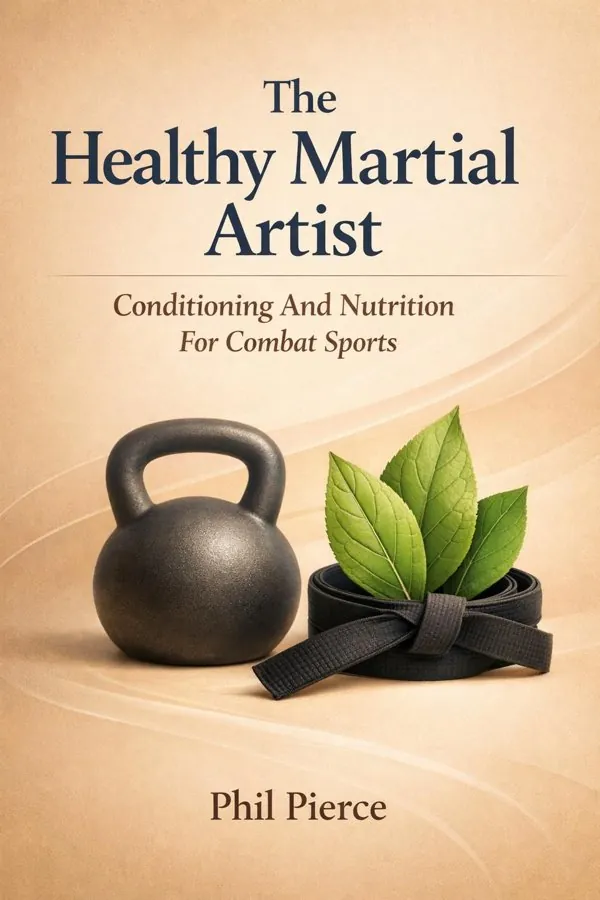
The Healthy Martial Artist: Conditioning And Nutrition For Combat Sports: Summary & Key Insights
by Phil Pierce
 10 min9 chaptersAudio available
Key Takeaways from The Healthy Martial Artist: Conditioning And Nutrition For Combat Sports
Many martial artists train as if hard work alone guarantees readiness, but combat sports punish vague preparation.
The fastest way to waste training time is to copy a program designed for someone whose body, goals, and sport differ from yours.
Strength matters in martial arts, but not all strength is equally useful.
Feeling exhausted in sparring is not always a sign that you need more toughness; often it means your conditioning does not match the way your sport actually drains energy.
Food is training, not just maintenance.
What Is The Healthy Martial Artist: Conditioning And Nutrition For Combat Sports About?
The Healthy Martial Artist: Conditioning And Nutrition For Combat Sports by Phil Pierce is a fitness book spanning 6 pages. Martial arts rewards skill, discipline, and courage, but performance in combat sports is never built on technique alone. In The Healthy Martial Artist, Phil Pierce argues that serious practitioners must treat conditioning, nutrition, recovery, and mindset as essential parts of their training rather than optional extras. Whether you practice boxing, Muay Thai, wrestling, judo, Brazilian jiu-jitsu, taekwondo, or mixed martial arts, your body is asked to generate explosive power, endure repeated rounds, recover quickly, and stay resilient under stress. This book shows how to support those demands in a practical, sustainable way. Pierce brings a martial artist’s perspective to sports science, translating broad fitness principles into advice that makes sense for fighters and traditional practitioners alike. Instead of promoting generic gym routines or extreme dieting, he focuses on training that matches the realities of combat: movement quality, energy system development, intelligent strength work, sound weight management, and long-term health. The result is a clear guide for athletes who want to perform better, avoid preventable injuries, and build a body that can keep training for years, not just for one short competitive peak.
This FizzRead summary covers all 9 key chapters of The Healthy Martial Artist: Conditioning And Nutrition For Combat Sports in approximately 10 minutes, distilling the most important ideas, arguments, and takeaways from Phil Pierce's work. Also available as an audio summary and Key Quotes Podcast.
The Healthy Martial Artist: Conditioning And Nutrition For Combat Sports
Martial arts rewards skill, discipline, and courage, but performance in combat sports is never built on technique alone. In The Healthy Martial Artist, Phil Pierce argues that serious practitioners must treat conditioning, nutrition, recovery, and mindset as essential parts of their training rather than optional extras. Whether you practice boxing, Muay Thai, wrestling, judo, Brazilian jiu-jitsu, taekwondo, or mixed martial arts, your body is asked to generate explosive power, endure repeated rounds, recover quickly, and stay resilient under stress. This book shows how to support those demands in a practical, sustainable way.
Pierce brings a martial artist’s perspective to sports science, translating broad fitness principles into advice that makes sense for fighters and traditional practitioners alike. Instead of promoting generic gym routines or extreme dieting, he focuses on training that matches the realities of combat: movement quality, energy system development, intelligent strength work, sound weight management, and long-term health. The result is a clear guide for athletes who want to perform better, avoid preventable injuries, and build a body that can keep training for years, not just for one short competitive peak.
Who Should Read The Healthy Martial Artist: Conditioning And Nutrition For Combat Sports?
This book is perfect for anyone interested in fitness and looking to gain actionable insights in a short read. Whether you're a student, professional, or lifelong learner, the key ideas from The Healthy Martial Artist: Conditioning And Nutrition For Combat Sports by Phil Pierce will help you think differently.
- ✓Readers who enjoy fitness and want practical takeaways
- ✓Professionals looking to apply new ideas to their work and life
- ✓Anyone who wants the core insights of The Healthy Martial Artist: Conditioning And Nutrition For Combat Sports in just 10 minutes
Want the full summary?
Get instant access to this book summary and 100K+ more with Fizz Moment.
Get Free SummaryAvailable on App Store • Free to download
Key Chapters
Many martial artists train as if hard work alone guarantees readiness, but combat sports punish vague preparation. A fighter may look fit in a general sense and still gas out, lose power, or break form under pressure because the body was not prepared for the specific demands of sparring and competition. Phil Pierce begins by grounding the reader in a simple truth: martial arts challenges every major physical quality at once. You need speed, power, balance, coordination, mobility, endurance, resilience, and the ability to make decisions while fatigued.
Different styles emphasize these qualities in different ways. A boxer may need repeated bursts of fast hand combinations and sharp footwork over multiple rounds. A grappler may need isometric strength, positional endurance, and the ability to explode during scrambles. A kickboxer needs rotational power, leg endurance, timing, and rapid recovery between exchanges. Traditional martial arts practitioners also face complex movement demands, especially if they train striking, forms, partner drills, and self-defense applications together.
Pierce encourages readers to stop thinking of conditioning as something separate from martial arts. Conditioning should reflect the rhythm of the sport: work-rest ratios, likely movement patterns, impact demands, and the mental stress of contact. If your training only improves one dimension, such as long-distance stamina or maximum lifting strength, it may leave dangerous gaps elsewhere.
A practical application is to analyze your own training week. What kinds of effort dominate your sessions: short explosions, continuous movement, gripping, clinching, repeated takedown entries, or footwork under fatigue? Once you identify the true demands of your art, you can build support around them.
Actionable takeaway: Write down the three most important physical demands of your martial art and evaluate whether your current conditioning actually trains those demands directly.
The fastest way to waste training time is to copy a program designed for someone whose body, goals, and sport differ from yours. Pierce stresses that martial artists need personalized conditioning rather than trendy routines. Two athletes can train in the same gym and still require different support work depending on age, injury history, competitive level, technical style, and recovery capacity.
A personalized plan begins with assessment. You need to know what limits your performance now. Is it poor aerobic recovery between rounds? Weak hip mobility affecting kicks and takedowns? Lack of pulling strength for clinch work? Do you fade mentally because your conditioning cannot support your pace? Without this diagnosis, athletes often do more of what they enjoy instead of what they need.
Pierce recommends designing training around priorities rather than trying to improve everything at once. A beginner may need general strength, movement quality, and basic cardiovascular fitness. An experienced competitor may need maintenance in some areas and targeted development in others. Personalization also means matching workload to life circumstances. A full-time student or worker who trains martial arts four nights a week cannot recover from the same strength and conditioning volume as a professional fighter.
For example, a jiu-jitsu athlete with recurring low-back fatigue might prioritize trunk stability, hip mobility, and aerobic base work instead of chasing heavy deadlift numbers. A striker preparing for competition might focus on interval conditioning, rotational power, and shoulder durability. The goal is not to build the most impressive gym performance, but the most useful body for your practice.
Actionable takeaway: Identify one primary weakness, one secondary weakness, and one strength in your athletic profile, then structure your next four weeks of conditioning to address them in that order.
Strength matters in martial arts, but not all strength is equally useful. Pierce challenges the common mistake of chasing weight-room achievements that do little to improve combat performance. The aim is not bodybuilding aesthetics or even raw maximal force by itself. The aim is applied strength: the kind that helps you strike harder, hold position, resist pressure, move an opponent, and maintain posture when tired.
Useful strength training for martial artists emphasizes movement patterns and structural balance. Lower-body work develops force through the hips and legs for shots, kicks, sprawls, and stable footwork. Upper-body pushing and pulling support punching mechanics, clinch exchanges, hand fighting, and grappling control. Core training should reinforce force transfer and anti-rotation, not just endless sit-ups. Grip and neck work may also be important depending on the sport.
Pierce favors moderation and purpose. Heavy lifting has value, but too much can reduce mobility, interfere with technical practice, or increase fatigue. Similarly, high-repetition circuits may feel athletic but can become sloppy conditioning that does not build meaningful strength. The best program balances foundational lifts, unilateral work, mobility, and explosive exercises such as medicine ball throws, jumps, or kettlebell movements.
A practical weekly setup might include two strength sessions: one focused on lower body and pulling strength, another on pressing, trunk stability, and explosive movement. The key is to keep volume appropriate so skill training remains the priority. Progress should be measured not only by numbers lifted but by how the athlete moves and performs in practice.
Actionable takeaway: Choose three foundational strength qualities your martial art needs most, such as hip power, pulling strength, or anti-rotation stability, and make them the center of your gym work instead of training everything equally.
Feeling exhausted in sparring is not always a sign that you need more toughness; often it means your conditioning does not match the way your sport actually drains energy. Pierce explains that combat sports rely on multiple energy systems, and effective cardio training should reflect how rounds unfold. Fighters need an aerobic base for recovery and sustained effort, anaerobic power for bursts of offense or defense, and the ability to repeat high-intensity efforts without collapsing.
Many martial artists make one of two errors: they do only slow endurance work, or they do only brutal intervals. Long steady sessions can improve general capacity and aid recovery, but by themselves they do not prepare you for flurries, scrambles, takedown chains, or explosive counters. On the other hand, constant all-out intervals can create fatigue without building the base needed to recover between bursts.
Pierce promotes a layered approach. Aerobic conditioning supports the whole system by improving recovery between rounds, sessions, and training days. Higher-intensity intervals are then used to mimic the stress of fighting. For example, a striker might perform pad or bag intervals that mirror round timing, while a grappler might use short positional circuits or repeated takedown entries. Sport-specific conditioning often works best when paired with lower-intensity base work such as roadwork, tempo efforts, or cyclical cardio.
The real measure of cardio readiness is not whether you can survive one hard workout. It is whether you can maintain skill, posture, timing, and decision-making when your heart rate rises. Good conditioning preserves technique under stress.
Actionable takeaway: Structure your weekly cardio into at least two categories: one aerobic session for base and recovery, and one sport-specific interval session that closely mirrors the pace and duration of your competition rounds.
Food is training, not just maintenance. Pierce makes the case that martial artists often undermine their own progress by treating nutrition as an afterthought until a weigh-in approaches. In reality, daily eating habits influence energy, body composition, recovery speed, focus, immune function, and the ability to train consistently.
The book emphasizes practical nutrition over rigid dogma. Martial artists need enough total calories to support training, adequate protein for repair and adaptation, carbohydrates to fuel intense sessions, and healthy fats for hormones and overall health. Timing matters too. Eating appropriately before training can improve output and concentration, while post-training meals help replenish energy and support recovery.
Pierce is especially attentive to the culture of combat sports, where athletes often swing between overeating and aggressive restriction. He warns that poor nutrition can show up as chronic fatigue, reduced power, irritability, poor sleep, frequent illness, and stalled progress. The goal is not simply to look lean, but to build a body that can perform repeatedly.
A useful application is to match meal structure to training demands. On heavy sparring or competition-prep days, an athlete may need more carbohydrate intake before and after sessions. On lighter technical days, intake can be more moderate while still keeping protein consistent. Hydration and electrolyte balance are also critical, especially for athletes training in hot environments or doing multiple sessions.
Actionable takeaway: For one week, track your meals alongside your training quality, energy, and recovery, then look for patterns between what you eat and how you perform rather than judging nutrition only by the scale.
In combat sports, making weight can become so normalized that athletes forget to ask a basic question: are these methods helping performance or destroying it? Pierce addresses weight management with a healthier and more strategic perspective than the extreme-cut culture often seen in fight sports. He argues that body composition should be developed gradually through consistent habits, not through panic-driven dehydration and starvation.
Weight classes can offer a competitive framework, but they also tempt athletes into chasing unrealistic numbers. Severe cutting may reduce short-term body weight, yet it often comes at the cost of reaction time, endurance, focus, mood, and resilience. Worse, repeated harsh cuts can damage long-term health and training quality. Pierce encourages athletes to compete closer to their natural, well-prepared body weight whenever possible.
Healthy weight management starts long before the event. That means maintaining reasonable nutrition year-round, monitoring body weight trends, and using small adjustments in food intake and training load rather than dramatic last-minute measures. If a cut is necessary, it should be planned, modest, and supervised intelligently. The athlete must still preserve muscle, hydration status, and the ability to perform on event day.
Practical examples include setting a realistic target class months in advance, reducing excess body fat slowly during off-season training, and avoiding reward-binge cycles after weigh-ins or hard sessions. Athletes should also distinguish cosmetic leanness from functional readiness. A slightly heavier but properly fueled fighter often performs better than a depleted one who barely made the scale.
Actionable takeaway: Choose a competition weight you can support with consistent daily habits, and if your current class requires extreme cuts, reassess whether it truly serves your performance or ego.
Improvement does not happen only when you push hard; it happens when your body absorbs that work and comes back stronger. Pierce treats recovery as a core discipline, not a luxury reserved for elite athletes. Martial artists frequently accept chronic soreness, fatigue, and nagging pain as part of the culture, but poor recovery eventually steals skill development, consistency, and longevity.
Recovery includes sleep, nutrition, hydration, active restoration, stress management, and sensible scheduling. Sleep is especially powerful because it supports hormone function, tissue repair, nervous system recovery, learning, and emotional regulation. An athlete who trains brilliantly but sleeps badly may see disappointing results because the system never fully resets. Hydration and post-training nutrition also shape how fast the body can repair itself.
Pierce encourages athletes to notice early warning signs of under-recovery: declining motivation, poor concentration, elevated resting fatigue, unusually heavy limbs, recurring illness, and reduced technical sharpness. Sometimes the answer is not another hard conditioning session but a lighter day, mobility work, easy aerobic movement, or simply more rest. Recovery strategies should fit the athlete’s life. A busy parent training in the evenings may need stricter sleep routines and lower extra gym volume than a younger athlete with more free time.
Practical methods include planning at least one lower-stress day each week, using light movement after intense sessions, keeping post-training meals ready in advance, and establishing a pre-sleep routine. The smartest athletes know when to push and when to absorb.
Actionable takeaway: Add one deliberate recovery habit this week, such as a fixed bedtime, post-training meal prep, or a scheduled low-intensity restoration session, and treat it as non-negotiable training.
Injury prevention is rarely about eliminating risk completely; it is about reducing avoidable breakdown so training can continue. Pierce argues that martial artists should stop viewing injuries as random bad luck and start seeing many of them as the result of accumulated stress, technical inefficiency, poor preparation, or neglected imbalances. Combat sports are demanding, but smart habits can dramatically improve durability.
The book highlights several pillars of resilience. First, movement quality matters. Stiff hips, unstable shoulders, weak posterior chain muscles, or poor trunk control can turn routine practice into repetitive strain. Second, progression matters. Jumping from low volume to intense sparring, hard roadwork, and heavy lifting all at once is a recipe for overload. Third, technique itself protects the body. Efficient punching, kicking, falling, grappling, and defensive movement reduce unnecessary stress.
Pierce also values warm-ups that actually prepare athletes for training. Instead of a few random stretches, a good warm-up raises temperature, mobilizes key joints, activates stabilizers, and rehearses sport-specific movement. Maintenance work, such as shoulder health drills, neck strengthening, ankle stability, and hip mobility, can be built into short daily sessions.
A practical example is the athlete with recurring knee pain from kicking and takedown practice. Rather than just resting until the pain fades, Pierce would encourage examining ankle mobility, hip control, landing mechanics, training volume, and strength balance. Prevention often comes from fixing the system rather than treating the symptom alone.
Actionable takeaway: Choose one area of your body that repeatedly feels vulnerable, then build a 10-minute pre-training routine that improves mobility, activation, and stability around that region.
A healthy martial artist is not just physically prepared but mentally organized. Pierce expands the idea of conditioning to include the habits of attention, discipline, patience, and emotional control that make training sustainable. Many athletes sabotage themselves not because they lack effort, but because they are inconsistent, impulsive, or locked into short-term thinking.
Mental conditioning begins with clarity of purpose. Why are you training: competition, self-defense, personal mastery, health, or community? Without that clarity, it is easy to chase extremes, compare yourself constantly, or burn out trying to prove something every session. Pierce encourages a mindset that values progress over ego. That means being coachable, accepting slow development, and understanding that health is part of mastery rather than separate from it.
He also recognizes the psychological stress of combat sports. Fear of sparring, pressure before competition, frustration with plateaus, and identity tied to performance can all affect training quality. Good mental preparation includes routines, realistic self-assessment, and the ability to stay composed under fatigue. Practices such as goal setting, journaling, breath control, and reflection after training can strengthen this dimension.
A practical example is the athlete who alternates between overtraining and quitting. Pierce would likely frame this as a mindset issue as much as a physical one: too much emotional reaction, not enough structured consistency. Sustainable progress comes from repeatable behavior, not motivational highs.
Actionable takeaway: Define one performance goal, one health goal, and one process goal for the next month so your martial arts practice stays balanced between ambition and sustainability.
All Chapters in The Healthy Martial Artist: Conditioning And Nutrition For Combat Sports
About the Author
Phil Pierce is a martial artist and author whose work focuses on helping practitioners improve both the physical and mental sides of training. He is known for writing accessible guides on conditioning, self-discipline, mindset, and martial development, with an emphasis on practical application rather than abstract theory. Pierce’s approach reflects an understanding that martial arts performance depends on far more than technique alone; athletes also need strength, endurance, recovery habits, and psychological steadiness. In his writing, he often connects traditional martial values such as discipline and consistency with modern training principles drawn from fitness and sports science. Through books like The Healthy Martial Artist, he has built a reputation as a clear, encouraging voice for readers who want to train harder, smarter, and more sustainably.
Get This Summary in Your Preferred Format
Read or listen to the The Healthy Martial Artist: Conditioning And Nutrition For Combat Sports summary by Phil Pierce anytime, anywhere. FizzRead offers multiple formats so you can learn on your terms — all free.
Available formats: App · Audio · PDF · EPUB — All included free with FizzRead
Download The Healthy Martial Artist: Conditioning And Nutrition For Combat Sports PDF and EPUB Summary
Key Quotes from The Healthy Martial Artist: Conditioning And Nutrition For Combat Sports
“Many martial artists train as if hard work alone guarantees readiness, but combat sports punish vague preparation.”
“The fastest way to waste training time is to copy a program designed for someone whose body, goals, and sport differ from yours.”
“Strength matters in martial arts, but not all strength is equally useful.”
“Feeling exhausted in sparring is not always a sign that you need more toughness; often it means your conditioning does not match the way your sport actually drains energy.”
“Pierce makes the case that martial artists often undermine their own progress by treating nutrition as an afterthought until a weigh-in approaches.”
Frequently Asked Questions about The Healthy Martial Artist: Conditioning And Nutrition For Combat Sports
The Healthy Martial Artist: Conditioning And Nutrition For Combat Sports by Phil Pierce is a fitness book that explores key ideas across 9 chapters. Martial arts rewards skill, discipline, and courage, but performance in combat sports is never built on technique alone. In The Healthy Martial Artist, Phil Pierce argues that serious practitioners must treat conditioning, nutrition, recovery, and mindset as essential parts of their training rather than optional extras. Whether you practice boxing, Muay Thai, wrestling, judo, Brazilian jiu-jitsu, taekwondo, or mixed martial arts, your body is asked to generate explosive power, endure repeated rounds, recover quickly, and stay resilient under stress. This book shows how to support those demands in a practical, sustainable way. Pierce brings a martial artist’s perspective to sports science, translating broad fitness principles into advice that makes sense for fighters and traditional practitioners alike. Instead of promoting generic gym routines or extreme dieting, he focuses on training that matches the realities of combat: movement quality, energy system development, intelligent strength work, sound weight management, and long-term health. The result is a clear guide for athletes who want to perform better, avoid preventable injuries, and build a body that can keep training for years, not just for one short competitive peak.
You Might Also Like
The Men's Health Handbook: Practical Fitness, Nutrition, and Wellbeing for Men
Men's Health Editors
10 min
30 Ways to Reboot Your Body: A Complete User Manual for Getting the Most Out of the Human Body
Ben Greenfield
10 min
Active Aging: Exercise Plans for Older Adults: Safe Training for Seniors and Aging Populations
Patricia A. Brill
10 min
Becoming a Supple Leopard: The Ultimate Guide to Resolving Pain, Preventing Injury, and Optimizing Athletic Performance
Kelly Starrett
10 min
Bigger Leaner Stronger: The Simple Science of Building the Ultimate Male Body
Michael Matthews
10 min
Body by Science: A Research-Based Program for Strength Training, Bodybuilding, and Complete Fitness in 12 Minutes a Week
Doug McGuff, John Little
10 minBrowse by Category
Ready to read The Healthy Martial Artist: Conditioning And Nutrition For Combat Sports?
Get the full summary and 100K+ more books with Fizz Moment.