
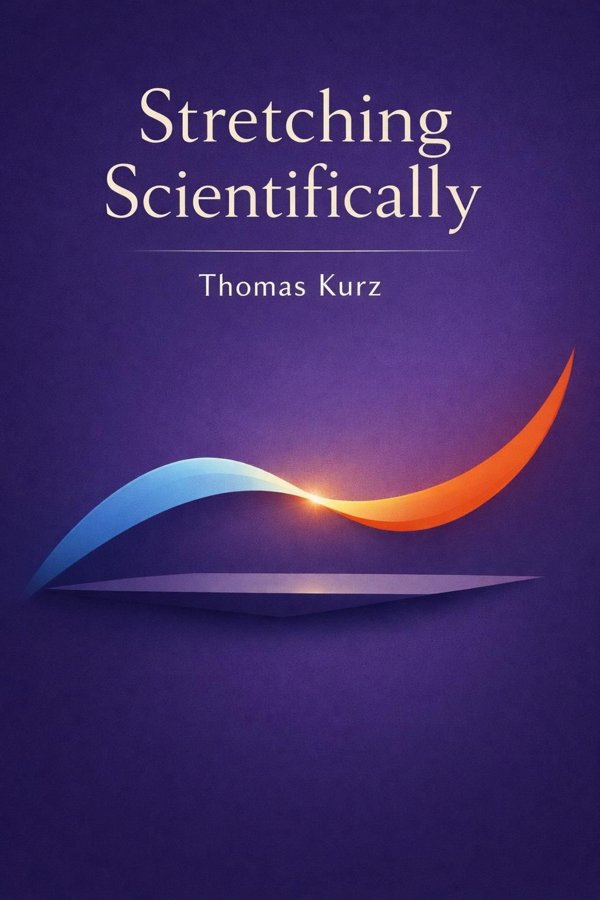
Stretching Scientifically: A Guide to Flexibility Training: Summary & Key Insights
by Thomas Kurz
 10 min5 chaptersAudio available
What Is Stretching Scientifically: A Guide to Flexibility Training About?
Stretching Scientifically: A Guide to Flexibility Training by Thomas Kurz is a fitness book spanning 5 pages. Stretching Scientifically is a comprehensive guide to flexibility training, presenting scientifically grounded methods for improving range of motion, strength, and athletic performance. Thomas Kurz explains the physiological principles behind stretching and provides practical routines for athletes, martial artists, and fitness enthusiasts seeking safe and effective flexibility gains.
This FizzRead summary covers all 5 key chapters of Stretching Scientifically: A Guide to Flexibility Training in approximately 10 minutes, distilling the most important ideas, arguments, and takeaways from Thomas Kurz's work. Also available as an audio summary and Key Quotes Podcast.
Stretching Scientifically: A Guide to Flexibility Training
Stretching Scientifically is a comprehensive guide to flexibility training, presenting scientifically grounded methods for improving range of motion, strength, and athletic performance. Thomas Kurz explains the physiological principles behind stretching and provides practical routines for athletes, martial artists, and fitness enthusiasts seeking safe and effective flexibility gains.
Who Should Read Stretching Scientifically: A Guide to Flexibility Training?
This book is perfect for anyone interested in fitness and looking to gain actionable insights in a short read. Whether you're a student, professional, or lifelong learner, the key ideas from Stretching Scientifically: A Guide to Flexibility Training by Thomas Kurz will help you think differently.
- ✓Readers who enjoy fitness and want practical takeaways
- ✓Professionals looking to apply new ideas to their work and life
- ✓Anyone who wants the core insights of Stretching Scientifically: A Guide to Flexibility Training in just 10 minutes
Want the full summary?
Get instant access to this book summary and 100K+ more with Fizz Moment.
Get Free SummaryAvailable on App Store • Free to download
Key Chapters
The foundation of scientific flexibility lies in understanding how our muscles and connective tissues respond to tension and movement. Muscles are not just elastic bands; they are complex organs made of thousands of fibers that contract under neural command and resist overstretching through protective reflexes. Tendons connect these fibers to bones, forming the transmission lines of force. When these structures are stressed beyond their accustomed range, the body instinctively contracts them to prevent tearing. This is the stretch reflex—a remarkable safety mechanism that guards against injury but also limits flexibility.
In flexibility training, our goal isn’t to fight this reflex but to retrain it. Through gradual, controlled exposure, we teach the nervous system to tolerate greater length without activating the protective contraction. That is why correct warm-up and progression are vital: when the muscle’s temperature rises, viscosity decreases, and the nervous system adapts more easily. Scientific stretching removes superstition and replaces it with physiology: every sensation of tightness you feel is a message about your muscle’s current habitual limit, not a permanent obstacle.
Understanding muscle fiber types deepens our strategy. Fast-twitch fibers, developed primarily in explosive athletes, resist lengthening more than slow-twitch fibers. This means that sprinters and martial artists often require more careful dynamic and isometric routines to maintain mobility while preserving power. Flexibility training, from this standpoint, becomes an act of calibration—balancing force and length, strength and suppleness.
In my research and coaching, I’ve seen how neglecting this balance leads to recurring injuries, poor movement economy, and unnecessary fatigue. Whether it’s a hamstring strain from rapid kick extension or shoulder stiffness from heavy bench pressing, the root cause is often the same: muscles conditioned for contraction but neglected in lengthening adaptation. Scientific stretching turns recovery into preparation—it transforms flexibility from a passive afterthought into an active power amplifier.
Through years of application and study, I’ve classified stretching methods into four primary categories: static, dynamic, isometric, and ballistic. Each serves a distinct physiological purpose and must be applied according to context, not preference.
Static stretching involves holding a pose at the edge of discomfort, relaxing into it, and allowing the muscle fibers to gradually lengthen under minimal tension. It is ideal for cool-down or flexibility assessment. Dynamic stretching, however, is movement-based—controlled swings, leg lifts, torso turns—executed with precision and increasing amplitude. This type prepares neuromuscular pathways for athletics, aligning flexibility with functional motion.
Isometric stretching is the true secret to rapid gains. Here, you contract a stretched muscle against resistance, often pushing gently against a fixed object or your own limbs. The contraction signals the nervous system to permit greater post-contraction length. In essence, you strengthen while lengthening—building flexibility that supports dynamic power rather than diminishing it. Ballistic stretching, characterized by uncontrolled bouncing, is often misunderstood. While it can stimulate adaptations in highly trained individuals, it carries high risk if used improperly. Thus, every type of stretch has its place and timing, and in this book I teach how to recognize it.
A critical insight from applied physiology is that flexibility depends not solely on muscle tissue but on the nervous system’s conditioning. Each stretch type communicates differently to your body’s neural regulators. Static stretches tell the nervous system to relax; dynamic stretches prime coordination; isometric stretches rewire strength limits. When integrated, these methods produce stable, functional flexibility perfectly suited to any demanding physical discipline.
+ 3 more chapters — available in the FizzRead app
All Chapters in Stretching Scientifically: A Guide to Flexibility Training
About the Author
Thomas Kurz is a sports scientist and coach known for his expertise in flexibility, strength, and conditioning. He has written extensively on athletic training and is recognized for integrating scientific research into practical training methods.
Get This Summary in Your Preferred Format
Read or listen to the Stretching Scientifically: A Guide to Flexibility Training summary by Thomas Kurz anytime, anywhere. FizzRead offers multiple formats so you can learn on your terms — all free.
Available formats: App · Audio · PDF · EPUB — All included free with FizzRead
Download Stretching Scientifically: A Guide to Flexibility Training PDF and EPUB Summary
Key Quotes from Stretching Scientifically: A Guide to Flexibility Training
“The foundation of scientific flexibility lies in understanding how our muscles and connective tissues respond to tension and movement.”
“Through years of application and study, I’ve classified stretching methods into four primary categories: static, dynamic, isometric, and ballistic.”
Frequently Asked Questions about Stretching Scientifically: A Guide to Flexibility Training
Stretching Scientifically: A Guide to Flexibility Training by Thomas Kurz is a fitness book that explores key ideas across 5 chapters. Stretching Scientifically is a comprehensive guide to flexibility training, presenting scientifically grounded methods for improving range of motion, strength, and athletic performance. Thomas Kurz explains the physiological principles behind stretching and provides practical routines for athletes, martial artists, and fitness enthusiasts seeking safe and effective flexibility gains.
You Might Also Like
The Men's Health Handbook: Practical Fitness, Nutrition, and Wellbeing for Men
Men's Health Editors
10 min
30 Ways to Reboot Your Body: A Complete User Manual for Getting the Most Out of the Human Body
Ben Greenfield
10 min
Active Aging: Exercise Plans for Older Adults: Safe Training for Seniors and Aging Populations
Patricia A. Brill
10 min
Becoming a Supple Leopard: The Ultimate Guide to Resolving Pain, Preventing Injury, and Optimizing Athletic Performance
Kelly Starrett
10 min
Bigger Leaner Stronger: The Simple Science of Building the Ultimate Male Body
Michael Matthews
10 min
Body by Science: A Research-Based Program for Strength Training, Bodybuilding, and Complete Fitness in 12 Minutes a Week
Doug McGuff, John Little
10 minBrowse by Category
Ready to read Stretching Scientifically: A Guide to Flexibility Training?
Get the full summary and 100K+ more books with Fizz Moment.