
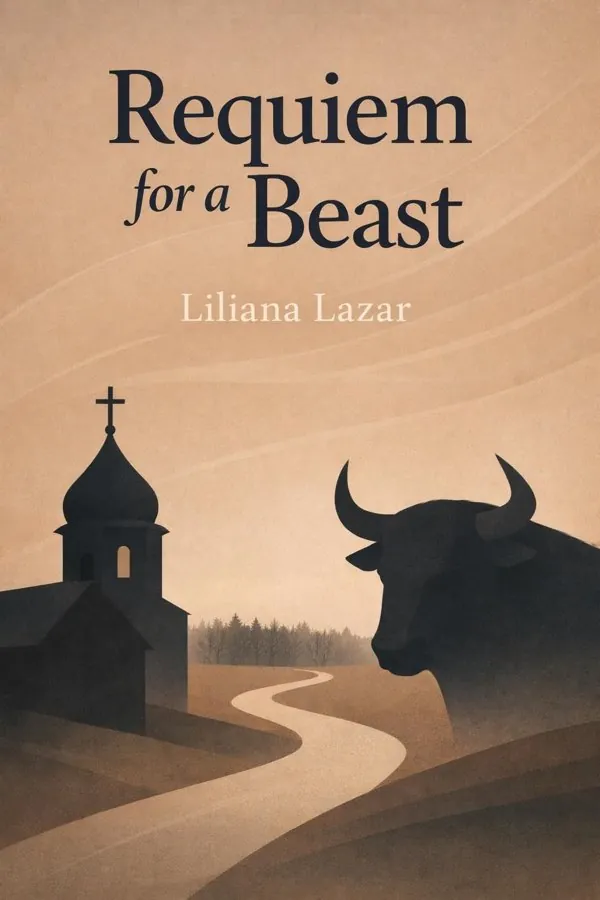
Requiem for a Beast: Summary & Key Insights
 10 min8 chaptersAudio available
Key Takeaways from Requiem for a Beast
One of the novel’s deepest insights is that inner guilt can punish more relentlessly than any prison or public sentence.
A violent act may seem sudden, but its consequences unfold across years, generations, and entire communities.
Sometimes myths tell the truth more clearly than official language.
It is easy to judge people in extreme circumstances from the comfort of freedom, but Lazar insists that political systems shape the very conditions under which morality is lived.
Faith in Requiem for a Beast is never simple consolation.
What Is Requiem for a Beast About?
Requiem for a Beast by Liliana Lazar is a general book. Set in a remote Romanian village under the suffocating pressure of communist rule, Requiem for a Beast by Liliana Lazar is a dark, lyrical novel about guilt, violence, memory, and the uneasy boundary between sin and redemption. The story centers on Victor, a boy marked by a terrible act and forced to grow up in a world where religion, folklore, fear, and state power all shape human behavior. What begins as a local tragedy gradually opens into a haunting portrait of a community trapped by secrets, superstition, and moral compromise. Lazar explores not only what people do when driven by shame and desperation, but also how entire societies learn to hide their wounds. The novel matters because it turns a deeply specific historical setting, 1970s communist Romania, into a timeless meditation on conscience. It asks whether evil is born inside a person, created by circumstance, or sustained by collective silence. Liliana Lazar, a Romanian-born writer known for blending history with mythic atmosphere, brings unusual authority to this terrain. Her prose captures both the brutality of political repression and the spiritual intensity of rural life, making this novel feel at once intimate, eerie, and profoundly human.
This FizzRead summary covers all 8 key chapters of Requiem for a Beast in approximately 10 minutes, distilling the most important ideas, arguments, and takeaways from Liliana Lazar's work. Also available as an audio summary and Key Quotes Podcast.
Requiem for a Beast
Set in a remote Romanian village under the suffocating pressure of communist rule, Requiem for a Beast by Liliana Lazar is a dark, lyrical novel about guilt, violence, memory, and the uneasy boundary between sin and redemption. The story centers on Victor, a boy marked by a terrible act and forced to grow up in a world where religion, folklore, fear, and state power all shape human behavior. What begins as a local tragedy gradually opens into a haunting portrait of a community trapped by secrets, superstition, and moral compromise. Lazar explores not only what people do when driven by shame and desperation, but also how entire societies learn to hide their wounds.
The novel matters because it turns a deeply specific historical setting, 1970s communist Romania, into a timeless meditation on conscience. It asks whether evil is born inside a person, created by circumstance, or sustained by collective silence. Liliana Lazar, a Romanian-born writer known for blending history with mythic atmosphere, brings unusual authority to this terrain. Her prose captures both the brutality of political repression and the spiritual intensity of rural life, making this novel feel at once intimate, eerie, and profoundly human.
Who Should Read Requiem for a Beast?
This book is perfect for anyone interested in general and looking to gain actionable insights in a short read. Whether you're a student, professional, or lifelong learner, the key ideas from Requiem for a Beast by Liliana Lazar will help you think differently.
- ✓Readers who enjoy general and want practical takeaways
- ✓Professionals looking to apply new ideas to their work and life
- ✓Anyone who wants the core insights of Requiem for a Beast in just 10 minutes
Want the full summary?
Get instant access to this book summary and 100K+ more with Fizz Moment.
Get Free SummaryAvailable on App Store • Free to download
Key Chapters
One of the novel’s deepest insights is that inner guilt can punish more relentlessly than any prison or public sentence. In Requiem for a Beast, wrongdoing does not end with the act itself. Instead, it continues to echo through memory, behavior, relationships, and self-image. Victor’s life is not defined only by what happened, but by the heavy psychological aftermath of living with it. The novel shows that a person can remain trapped long after the external event has passed.
This idea matters because the book refuses to treat guilt as a simple moral label. Guilt in Lazar’s world is unstable. It can be deserved, inherited, exaggerated, denied, or transformed into violence. It can make someone seek repentance, but it can also lead to concealment and emotional paralysis. Communities participate in this process too. When neighbors whisper, religious symbols loom, and no one speaks honestly, guilt becomes part of the atmosphere. The result is a world in which the conscience is never private.
In practical terms, the novel offers a lens for thinking about how people cope with harmful actions in real life. Some try to bury the past and become harsher. Others turn toward ritual, work, or isolation. Still others project blame onto outsiders. These patterns are familiar in families, institutions, and even nations dealing with historical trauma. The book suggests that suppressing guilt rarely frees anyone; it usually distorts the future.
A useful application is to distinguish between accountability and concealment. Whether in personal conflict or organizational leadership, refusing to name harm often deepens it. Honest reckoning, while painful, creates the possibility of change. Actionable takeaway: when facing a damaging truth, address it directly and early, because unspoken guilt tends to grow into a force that shapes everything around it.
A violent act may seem sudden, but its consequences unfold across years, generations, and entire communities. Requiem for a Beast treats violence not as a shocking incident inserted into a story, but as a living presence that keeps reproducing itself. A crime affects not only victim and perpetrator, but also families, bystanders, institutions, and shared memory. Lazar’s great achievement is to show how brutality leaks into ordinary life, changing the emotional climate of a village.
The novel’s setting helps intensify this idea. In a closed rural world under communist surveillance, people have limited freedom and little space for open truth. This means violence is rarely processed openly. Instead, it becomes rumor, superstition, fear, and ritualized silence. When a society cannot confront what happened, the damage migrates into its customs and relationships. The community learns to live around the wound rather than heal it.
This insight extends beyond the novel. In contemporary life, violence can be physical, psychological, social, or political. A family secret, an abusive workplace, corrupt policing, or authoritarian governance all leave traces that persist long after the visible event is over. The story teaches readers to ask not only “What happened?” but also “How does it keep happening in new forms?” That is an especially valuable question in discussions of trauma and social harm.
Practical examples include the way communities respond to scandal, injustice, or unresolved conflict. If the response is denial, the next generation often inherits anxiety and mistrust. If the response includes truth-telling, support, and responsibility, the cycle is more likely to weaken. Actionable takeaway: when confronting harm, focus on the long afterlife of the event, not just the event itself, because cycles of violence are broken only when their hidden continuations are recognized.
Sometimes myths tell the truth more clearly than official language. In Requiem for a Beast, folklore, superstition, and religious imagination are not decorative background; they are essential tools for understanding fear, desire, and moral confusion. Lazar uses local beliefs, ominous symbols, and village lore to express what characters cannot articulate openly under repression. The result is a world where legends feel emotionally truer than political slogans.
This is especially important in the context of communist Romania, where official narratives sought order, control, and ideological certainty. Folklore resists that neatness. It keeps alive ambiguity, dread, and metaphysical questions. In rural life, people often interpret suffering through saints, curses, signs, and inherited stories because those frameworks help explain what institutions ignore. If the state denies complexity, myth restores it.
Readers can apply this insight by paying attention to the stories people use when direct speech feels dangerous. In any society, people may rely on jokes, rumors, symbolic language, or cultural myths to express what they cannot say plainly. In organizations, families, and political communities, the informal narrative often reveals more than the official statement. What people fear becomes encoded in story.
For example, when a workplace constantly describes a leader as a "storm" or a family speaks of one room as if it were haunted, the metaphor may be carrying real emotional information. In the novel, folklore works similarly: it translates moral reality into image and atmosphere. Actionable takeaway: listen closely to symbols, repeated stories, and local myths, because they often reveal the buried truths that formal language and public authority try to suppress.
Faith in Requiem for a Beast is never simple consolation. It offers hope, ritual, and a language for suffering, but it also intensifies awareness of sin, guilt, and judgment. Lazar portrays religion as both refuge and burden. In the village, spiritual life gives shape to grief and moral imagination, yet it can also deepen fear by making every act seem cosmically charged. The sacred does not erase darkness; it throws it into sharper relief.
This duality is one of the novel’s most compelling features. Religious symbols and practices provide continuity in a fractured world, especially under a political regime hostile to spiritual autonomy. But belief also raises difficult questions. Can repentance undo harm? Is forgiveness deserved or simply desired? Does ritual cleanse the conscience, or merely soothe it? The novel refuses easy answers. Instead, it shows characters struggling between the need for mercy and the terror of accountability.
In practical life, this idea applies to any moral framework people use to interpret suffering. Whether rooted in religion, philosophy, or personal ethics, such frameworks can steady us, but they can also produce harsh self-judgment if not accompanied by honesty and compassion. Communities may use moral language to heal, or to stigmatize and exclude.
For instance, rituals of apology can be meaningful when tied to repair, but hollow when used to avoid change. Likewise, spiritual reflection can encourage responsibility, yet become destructive if it turns into obsessive shame. Lazar captures this tension with rare subtlety. Actionable takeaway: use moral or spiritual reflection not as a substitute for responsibility, but as a guide toward truthful repair, because comfort without accountability leaves the deepest wounds untouched.
The novel reminds us that evil rarely survives by one person alone; it is often sustained by the compromises of many. Requiem for a Beast is not only about Victor’s fate, but about the village that surrounds him. Neighbors observe, suspect, gossip, fear, and remain silent. Their actions may appear small, yet together they create the moral environment in which secrecy hardens and suffering spreads. Lazar shows how ordinary people become entangled in wrongdoing without always naming themselves as participants.
This is not the same as saying everyone bears equal blame. The book is more nuanced than that. Some characters are more responsible than others, and some are trapped by limited power. Still, the community’s role matters because it reveals how social passivity enables moral catastrophe. Silence can protect the innocent, but it can also protect the guilty. Curiosity can seek truth, but gossip can deform it. Shared life becomes a network through which harm either circulates or is challenged.
This insight is highly practical. In any group, harmful patterns are sustained not only by those who initiate them, but by those who normalize them. Think of a school where bullying is dismissed, a company where abuse is an open secret, or a society where corruption is treated as inevitable. The issue is not merely individual character; it is collective tolerance.
The novel invites readers to consider what they permit through inaction. A community does not need to be openly cruel to become morally compromised. It only needs to learn to live with what should disturb it. Actionable takeaway: whenever you see recurring harm in a group, ask not just who caused it, but who is allowing it to remain unquestioned.
One of the book’s most haunting claims is that innocence is not a permanent state but a vulnerable condition shaped by environment, secrecy, and power. Victor’s youth does not protect him from darkness; instead, childhood becomes the stage on which violence, confusion, and moral burden first take root. Lazar presents childhood not as sentimental purity, but as a period of dangerous impressionability in which the world’s hidden forces are absorbed before they are understood.
This matters because the novel resists the comforting idea that children naturally remain outside adult corruption. In isolated or oppressive environments, children often become carriers of unprocessed fear. They witness things they cannot interpret, inherit stories they cannot verify, and form identities around events they did not choose. What looks like fate may actually be early moral injury. The book captures how quickly a young life can be redirected by one event, one silence, or one inherited shame.
In practical terms, the novel speaks to modern concerns about trauma, family systems, and social neglect. Children do not need full information to be shaped by an atmosphere. Tension, secrecy, humiliation, and violence all communicate powerful lessons. Adults often underestimate how much children notice and how deeply they internalize what remains unspoken.
Examples are everywhere: a child growing up around addiction, emotional volatility, political fear, or family taboo may carry those patterns into adulthood without understanding their origin. Lazar makes visible that hidden formation. Actionable takeaway: if you care for children, pay attention not only to what you tell them, but to the emotional climate you create around them, because silence and fear educate as powerfully as words.
Many stories offer redemption as relief, but Requiem for a Beast suggests that genuine redemption is neither quick nor comfortable. It cannot be achieved through denial, distance, or mere passage of time. If there is any path toward moral renewal in Lazar’s world, it begins with truth. Characters may long to bury the past, but the novel insists that forgetting is not the same as healing. What is hidden continues to act.
This makes the book emotionally demanding. It does not promise neat closure or sentimental absolution. Instead, it asks what redemption would actually require after irreversible harm. Naming the wrong. Acknowledging suffering. Refusing convenient lies. Accepting that some damage cannot be undone. In this vision, redemption is less a feeling of peace than a disciplined willingness to live honestly with what one has done or inherited.
This insight applies powerfully beyond fiction. Individuals, families, and institutions often seek shortcuts to reconciliation. They want to move on without disclosure, apology without repair, memory without discomfort. The novel warns that such shortcuts are unstable. They preserve appearances while leaving the underlying wound active. Whether dealing with personal betrayal or historical injustice, truth is the minimum condition for meaningful restoration.
A practical example can be seen in conflict resolution: a relationship rarely heals because one side says, "Let’s not talk about it anymore." It heals, if at all, because reality is faced and responsibility is accepted. Lazar’s moral world is severe, but clarifying. Actionable takeaway: if you want repair rather than repression, start with honest acknowledgment, because redemption built on forgetting eventually collapses under the weight of what was denied.
All Chapters in Requiem for a Beast
About the Author
Liliana Lazar is a Romanian-born novelist whose work is known for its dark lyricism, psychological depth, and evocative use of folklore and history. Raised in Romania, she later moved to France and began writing in French, bringing an outsider-insider perspective to the landscapes and memories of her homeland. Her fiction often explores moral transgression, spiritual unease, and the ways political systems shape private lives. Lazar has drawn praise for her ability to merge realism with a haunting, almost mythical atmosphere, especially in stories rooted in rural Eastern Europe. In Requiem for a Beast, she demonstrates her distinctive talent for portraying guilt, violence, and communal silence within the historical reality of communist Romania, making her an important contemporary voice in literary fiction.
Get This Summary in Your Preferred Format
Read or listen to the Requiem for a Beast summary by Liliana Lazar anytime, anywhere. FizzRead offers multiple formats so you can learn on your terms — all free.
Available formats: App · Audio · PDF · EPUB — All included free with FizzRead
Download Requiem for a Beast PDF and EPUB Summary
Key Quotes from Requiem for a Beast
“One of the novel’s deepest insights is that inner guilt can punish more relentlessly than any prison or public sentence.”
“A violent act may seem sudden, but its consequences unfold across years, generations, and entire communities.”
“Sometimes myths tell the truth more clearly than official language.”
“It is easy to judge people in extreme circumstances from the comfort of freedom, but Lazar insists that political systems shape the very conditions under which morality is lived.”
“Faith in Requiem for a Beast is never simple consolation.”
Frequently Asked Questions about Requiem for a Beast
Requiem for a Beast by Liliana Lazar is a general book that explores key ideas across 8 chapters. Set in a remote Romanian village under the suffocating pressure of communist rule, Requiem for a Beast by Liliana Lazar is a dark, lyrical novel about guilt, violence, memory, and the uneasy boundary between sin and redemption. The story centers on Victor, a boy marked by a terrible act and forced to grow up in a world where religion, folklore, fear, and state power all shape human behavior. What begins as a local tragedy gradually opens into a haunting portrait of a community trapped by secrets, superstition, and moral compromise. Lazar explores not only what people do when driven by shame and desperation, but also how entire societies learn to hide their wounds. The novel matters because it turns a deeply specific historical setting, 1970s communist Romania, into a timeless meditation on conscience. It asks whether evil is born inside a person, created by circumstance, or sustained by collective silence. Liliana Lazar, a Romanian-born writer known for blending history with mythic atmosphere, brings unusual authority to this terrain. Her prose captures both the brutality of political repression and the spiritual intensity of rural life, making this novel feel at once intimate, eerie, and profoundly human.
You Might Also Like
Duct Tape Marketing: The World's Most Practical Small Business Marketing Guide
John Jantsch
10 minDusk, Night, Dawn: On Revival and Courage
Anne Lamott
10 minFinish Big: How Great Entrepreneurs Exit Their Companies on Top
Bo Burlingham
10 minFirst As Tragedy, Then As Farce
Slavoj Zizek
10 minFirst Principles: What America's Founders Learned from the Greeks and Romans and How That Shaped Our Country
Thomas E. Ricks
10 minGood Habits, Bad Habits: The Science of Making Positive Changes That Stick
Wendy Wood
10 minBrowse by Category
Ready to read Requiem for a Beast?
Get the full summary and 100K+ more books with Fizz Moment.