
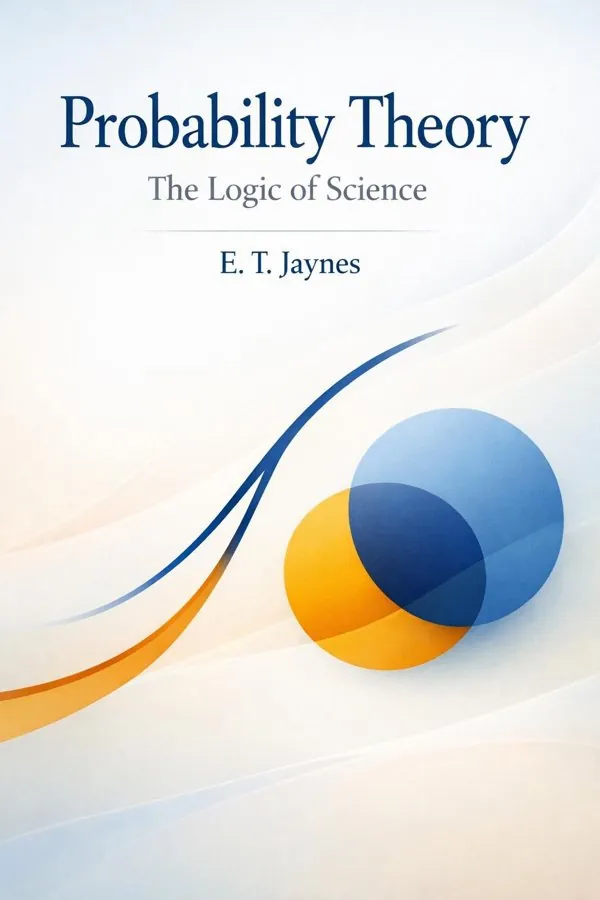
Probability Theory: The Logic of Science: Summary & Key Insights
by E. T. Jaynes
 10 min13 chaptersAudio available
What Is Probability Theory: The Logic of Science About?
Probability Theory: The Logic of Science by E. T. Jaynes is a mathematics book spanning 13 pages. This book presents a comprehensive and rigorous exposition of probability theory as an extension of logic. E. T. Jaynes develops the Bayesian interpretation of probability, showing how it provides a consistent framework for reasoning under uncertainty. The text covers fundamental principles, inference methods, and applications across science and engineering, emphasizing the logical foundations of statistical reasoning.
This FizzRead summary covers all 13 key chapters of Probability Theory: The Logic of Science in approximately 10 minutes, distilling the most important ideas, arguments, and takeaways from E. T. Jaynes's work. Also available as an audio summary and Key Quotes Podcast.
Probability Theory: The Logic of Science
This book presents a comprehensive and rigorous exposition of probability theory as an extension of logic. E. T. Jaynes develops the Bayesian interpretation of probability, showing how it provides a consistent framework for reasoning under uncertainty. The text covers fundamental principles, inference methods, and applications across science and engineering, emphasizing the logical foundations of statistical reasoning.
Who Should Read Probability Theory: The Logic of Science?
This book is perfect for anyone interested in mathematics and looking to gain actionable insights in a short read. Whether you're a student, professional, or lifelong learner, the key ideas from Probability Theory: The Logic of Science by E. T. Jaynes will help you think differently.
- ✓Readers who enjoy mathematics and want practical takeaways
- ✓Professionals looking to apply new ideas to their work and life
- ✓Anyone who wants the core insights of Probability Theory: The Logic of Science in just 10 minutes
Want the full summary?
Get instant access to this book summary and 100K+ more with Fizz Moment.
Get Free SummaryAvailable on App Store • Free to download
Key Chapters
To understand probability as logic, we must begin by defining what it means to reason consistently. Logic deals with propositions—statements that may be true or false. When information is incomplete, logical reasoning must extend to degrees of plausibility. The postulates of probability theory are rooted in this consistency. If we accept that any sound rule for plausible reasoning must obey the same standards of internal coherence as ordinary logic, then the sum and product rules follow unavoidably.
I derive these rules by insisting that any two inferences about propositions A and B must yield the same result, regardless of the order or method of reasoning, provided that our premises are identical. This requirement alone—logical consistency—implies relationships among probabilities that correspond exactly to the familiar operations: multiplication for conjunctions and addition for alternatives.
In this light, probabilities are not arbitrary quantities assigned by convenience; they are expressions of logical relations constrained by the necessity of avoiding contradictions. The product rule expresses how we reason about dependent propositions: P(AB) = P(A|B)P(B). The sum rule expresses how mutually exclusive propositions combine: P(A + B) = P(A) + P(B) − P(AB). These are not assumptions; they are the only possible forms consistent with logical reasoning under uncertainty.
This foundation liberates probability from its textbook mystique. It is not separate from logic—it *is* logic, continuously extended. The axioms you find here are not inventions of mathematicians, but deductions from the principle that rational thought must remain self-consistent no matter how limited our knowledge.
In everyday conversation, we speak of something being ‘likely’ or ‘doubtful.’ These intuitive judgments are what probability theory formalizes. A degree of plausibility represents our rational belief in the truth of a proposition given incomplete knowledge. To quantify plausibility, we assign numerical values subject to logical constraints. This numerical assignment does not introduce subjectivity in the pejorative sense—it gives our reasoning precision.
Every plausible statement is conditioned on information. Thus, probability statements must always specify what is known: P(A|X), the probability of A given X. Without X, probabilities are undefined. This conditional framework captures the essence of reasoning itself, for no rational inference exists in isolation from context.
In developing the theory, I stress the invariance of these plausibility assignments under logical transformations. When two different representations of the same information lead to the same conclusions, consistency demands identical numerical results. This principle prevents arbitrary manipulation of probability; it keeps reasoning objective and reproducible.
Plausibility, as quantitatively defined, bridges intuitive belief and formal reasoning. It allows us to manipulate uncertain propositions as rigorously as we would manipulate algebraic equations. Once we grasp that probabilities express degrees of logical support rather than frequencies of outcomes, we enter the realm of inference—a domain where probability becomes genuinely meaningful.
+ 11 more chapters — available in the FizzRead app
All Chapters in Probability Theory: The Logic of Science
About the Author
Edwin Thompson Jaynes (1922–1998) was an American physicist known for his work on statistical mechanics and Bayesian probability theory. He was a professor at Washington University in St. Louis and a leading advocate for the interpretation of probability as extended logic.
Get This Summary in Your Preferred Format
Read or listen to the Probability Theory: The Logic of Science summary by E. T. Jaynes anytime, anywhere. FizzRead offers multiple formats so you can learn on your terms — all free.
Available formats: App · Audio · PDF · EPUB — All included free with FizzRead
Download Probability Theory: The Logic of Science PDF and EPUB Summary
Key Quotes from Probability Theory: The Logic of Science
“To understand probability as logic, we must begin by defining what it means to reason consistently.”
“In everyday conversation, we speak of something being ‘likely’ or ‘doubtful.”
Frequently Asked Questions about Probability Theory: The Logic of Science
Probability Theory: The Logic of Science by E. T. Jaynes is a mathematics book that explores key ideas across 13 chapters. This book presents a comprehensive and rigorous exposition of probability theory as an extension of logic. E. T. Jaynes develops the Bayesian interpretation of probability, showing how it provides a consistent framework for reasoning under uncertainty. The text covers fundamental principles, inference methods, and applications across science and engineering, emphasizing the logical foundations of statistical reasoning.
Browse by Category
Ready to read Probability Theory: The Logic of Science?
Get the full summary and 100K+ more books with Fizz Moment.