
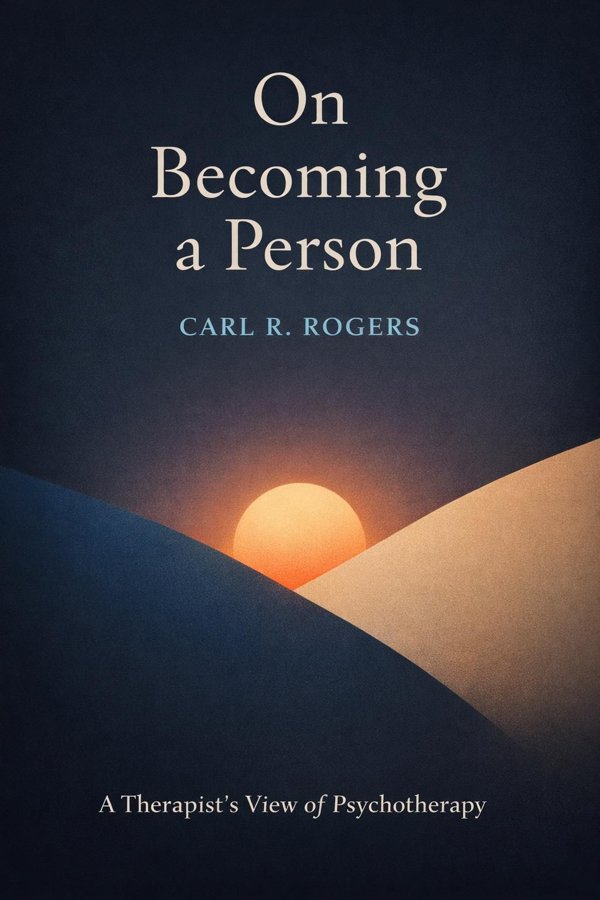
On Becoming a Person: A Therapist's View of Psychotherapy: Summary & Key Insights
 10 min9 chaptersAudio available
What Is On Becoming a Person: A Therapist's View of Psychotherapy About?
On Becoming a Person: A Therapist's View of Psychotherapy by Carl R. Rogers is a psychotherapy book spanning 9 pages. This influential work by Carl R. Rogers presents his humanistic approach to psychotherapy, emphasizing the importance of authenticity, empathy, and unconditional positive regard in the therapeutic relationship. Rogers explores how individuals can achieve personal growth and self-actualization through genuine human connection and acceptance.
This FizzRead summary covers all 9 key chapters of On Becoming a Person: A Therapist's View of Psychotherapy in approximately 10 minutes, distilling the most important ideas, arguments, and takeaways from Carl R. Rogers's work. Also available as an audio summary and Key Quotes Podcast.
On Becoming a Person: A Therapist's View of Psychotherapy
This influential work by Carl R. Rogers presents his humanistic approach to psychotherapy, emphasizing the importance of authenticity, empathy, and unconditional positive regard in the therapeutic relationship. Rogers explores how individuals can achieve personal growth and self-actualization through genuine human connection and acceptance.
Who Should Read On Becoming a Person: A Therapist's View of Psychotherapy?
This book is perfect for anyone interested in psychotherapy and looking to gain actionable insights in a short read. Whether you're a student, professional, or lifelong learner, the key ideas from On Becoming a Person: A Therapist's View of Psychotherapy by Carl R. Rogers will help you think differently.
- ✓Readers who enjoy psychotherapy and want practical takeaways
- ✓Professionals looking to apply new ideas to their work and life
- ✓Anyone who wants the core insights of On Becoming a Person: A Therapist's View of Psychotherapy in just 10 minutes
Want the full summary?
Get instant access to this book summary and 100K+ more with Fizz Moment.
Get Free SummaryAvailable on App Store • Free to download
Key Chapters
Early in my professional life, I believed that being a good therapist meant being an expert — knowing what was wrong with the client, identifying their symptoms, and prescribing methods to fix them. I was trained to analyze and direct, to tell people what they should do. And for a time, I tried to fit that mold. Yet I slowly came to see that the more I imposed my interpretations on clients, the more they withdrew. They seemed to feel diminished and unseen, as though my expertise had silenced their own capacity for understanding.
The turning point came when I began to listen — not to analyze, but simply to be present. When I allowed myself to encounter the client as another human being, without pretense or authority, something remarkable happened. People began to change. They spoke more freely. They discovered meanings and feelings that had been long buried. I realized then that the healing power lay not in my knowledge but in their inner wisdom, waiting to be heard.
Thus I shifted from being an expert to being a facilitator. Instead of guiding with techniques, I learned to trust the client’s ability to direct their own growth. My task became to provide a climate in which that natural tendency toward self-actualization could unfold. This transformation, for me, was not only professional but personal. It required that I relinquish control, that I risk uncertainty, and that I accept that genuine relationship is more powerful than any method. This shift continues to define how I see human development: people flourish when they are trusted to explore their own experience.
Through years of observation and reflection, I came to envision what I call the "fully functioning person" — not an idealized figure or a perfect being, but someone living openly and fluidly in the stream of experience. Such a person is not defensive or overly controlled by shoulds and musts imposed from outside. They are open to experience — meaning that they can receive the full range of feelings, sensations, and meanings life offers, without denial or distortion.
To live as a fully functioning person is to live existentially, to meet each moment freshly, without clinging to predetermined conclusions. When one trusts the organismic processes within — those deep, intuitive signals that guide us toward vitality — behavior becomes more congruent, decisions more authentic. This is not a recipe for selfishness; it is a path toward integration, where thoughts, feelings, and actions align naturally.
I have found that such individuals radiate freedom. They are creative, flexible, able to adapt to change without losing their center. They experience an inner sense of direction rather than following external standards. In therapy, helping someone approach this way of being means fostering openness — encouraging awareness without judgment. The fully functioning person is not an endpoint but a living process, continuous becoming.
+ 7 more chapters — available in the FizzRead app
All Chapters in On Becoming a Person: A Therapist's View of Psychotherapy
About the Author
Carl Ransom Rogers (1902–1987) was an American psychologist and one of the founders of the humanistic approach to psychology. He developed client-centered therapy, focusing on the individual's capacity for self-understanding and personal growth. His work profoundly influenced counseling, education, and interpersonal communication.
Get This Summary in Your Preferred Format
Read or listen to the On Becoming a Person: A Therapist's View of Psychotherapy summary by Carl R. Rogers anytime, anywhere. FizzRead offers multiple formats so you can learn on your terms — all free.
Available formats: App · Audio · PDF · EPUB — All included free with FizzRead
Download On Becoming a Person: A Therapist's View of Psychotherapy PDF and EPUB Summary
Key Quotes from On Becoming a Person: A Therapist's View of Psychotherapy
“Early in my professional life, I believed that being a good therapist meant being an expert — knowing what was wrong with the client, identifying their symptoms, and prescribing methods to fix them.”
“Such a person is not defensive or overly controlled by shoulds and musts imposed from outside.”
Frequently Asked Questions about On Becoming a Person: A Therapist's View of Psychotherapy
On Becoming a Person: A Therapist's View of Psychotherapy by Carl R. Rogers is a psychotherapy book that explores key ideas across 9 chapters. This influential work by Carl R. Rogers presents his humanistic approach to psychotherapy, emphasizing the importance of authenticity, empathy, and unconditional positive regard in the therapeutic relationship. Rogers explores how individuals can achieve personal growth and self-actualization through genuine human connection and acceptance.
Browse by Category
Ready to read On Becoming a Person: A Therapist's View of Psychotherapy?
Get the full summary and 100K+ more books with Fizz Moment.