
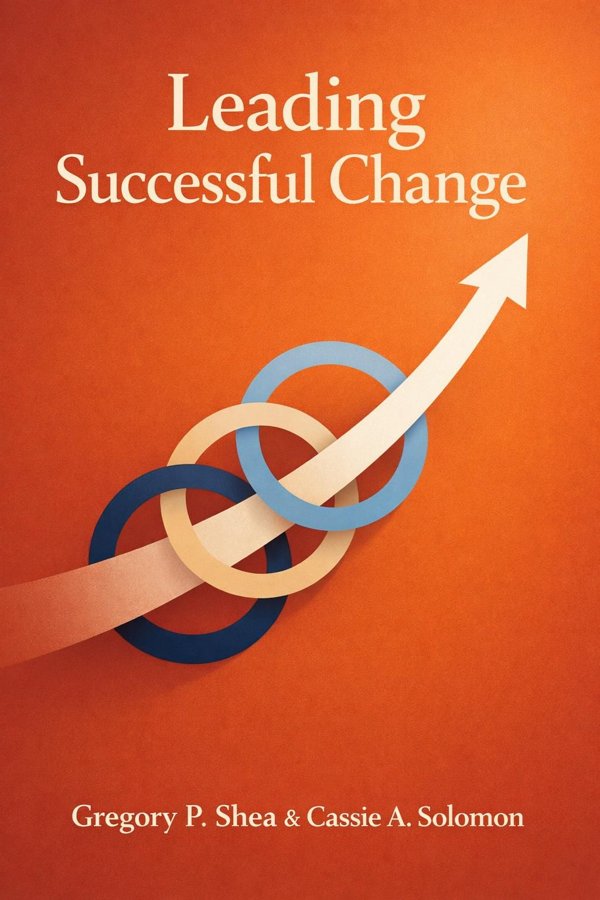
Leading Successful Change: 8 Keys to Making Change Work: Summary & Key Insights
by Gregory P. Shea, Cassie A. Solomon
 10 min8 chaptersAudio available
Key Takeaways from Leading Successful Change: 8 Keys to Making Change Work
A powerful truth sits at the center of this book: people usually do not resist change nearly as much as systems resist change.
Many change efforts collapse because they begin at the level of abstraction rather than action.
One of the book’s biggest contributions is its structured framework for diagnosing change.
A stirring speech can launch change, but only alignment can sustain it.
One of the most costly habits in organizations is the rush to solutions.
What Is Leading Successful Change: 8 Keys to Making Change Work About?
Leading Successful Change: 8 Keys to Making Change Work by Gregory P. Shea & Cassie A. Solomon is a general book. Leading Successful Change: 8 Keys to Making Change Work is a practical guide to one of the hardest tasks in management: turning ambitious plans into real, lasting organizational change. Gregory P. Shea and Cassie A. Solomon argue that most change efforts do not fail because people are lazy, resistant, or incapable. They fail because leaders misunderstand how organizations actually work. Instead of relying on slogans, inspiration, or top-down mandates alone, the authors show that successful change depends on aligning the concrete elements that shape daily behavior: priorities, roles, processes, relationships, and rewards. What makes this book especially valuable is its realism. It does not present change as a dramatic moment of vision, but as a disciplined leadership practice grounded in structure and execution. Shea, a Wharton professor and organizational consultant, and Solomon, an experienced advisor on leadership and change, bring decades of field-tested insight to the subject. Their framework helps leaders diagnose why change stalls, identify the leverage points that matter most, and build conditions where people can actually succeed. For managers, executives, team leaders, and anyone responsible for transformation, this book offers a clear roadmap for making change stick.
This FizzRead summary covers all 8 key chapters of Leading Successful Change: 8 Keys to Making Change Work in approximately 10 minutes, distilling the most important ideas, arguments, and takeaways from Gregory P. Shea & Cassie A. Solomon's work. Also available as an audio summary and Key Quotes Podcast.
Leading Successful Change: 8 Keys to Making Change Work
Leading Successful Change: 8 Keys to Making Change Work is a practical guide to one of the hardest tasks in management: turning ambitious plans into real, lasting organizational change. Gregory P. Shea and Cassie A. Solomon argue that most change efforts do not fail because people are lazy, resistant, or incapable. They fail because leaders misunderstand how organizations actually work. Instead of relying on slogans, inspiration, or top-down mandates alone, the authors show that successful change depends on aligning the concrete elements that shape daily behavior: priorities, roles, processes, relationships, and rewards. What makes this book especially valuable is its realism. It does not present change as a dramatic moment of vision, but as a disciplined leadership practice grounded in structure and execution. Shea, a Wharton professor and organizational consultant, and Solomon, an experienced advisor on leadership and change, bring decades of field-tested insight to the subject. Their framework helps leaders diagnose why change stalls, identify the leverage points that matter most, and build conditions where people can actually succeed. For managers, executives, team leaders, and anyone responsible for transformation, this book offers a clear roadmap for making change stick.
Who Should Read Leading Successful Change: 8 Keys to Making Change Work?
This book is perfect for anyone interested in general and looking to gain actionable insights in a short read. Whether you're a student, professional, or lifelong learner, the key ideas from Leading Successful Change: 8 Keys to Making Change Work by Gregory P. Shea & Cassie A. Solomon will help you think differently.
- ✓Readers who enjoy general and want practical takeaways
- ✓Professionals looking to apply new ideas to their work and life
- ✓Anyone who wants the core insights of Leading Successful Change: 8 Keys to Making Change Work in just 10 minutes
Want the full summary?
Get instant access to this book summary and 100K+ more with Fizz Moment.
Get Free SummaryAvailable on App Store • Free to download
Key Chapters
A powerful truth sits at the center of this book: people usually do not resist change nearly as much as systems resist change. Leaders often blame employees when transformation stalls, assuming the workforce lacks commitment, courage, or adaptability. Shea and Solomon challenge that instinct. They argue that most organizations are perfectly designed to produce the behaviors they are currently getting. If meetings reward caution, if incentives favor short-term output, if authority is unclear, and if legacy processes remain untouched, then even highly motivated people will revert to old habits. In other words, failure is often structural, not personal.
This idea matters because it shifts the leader’s job from persuasion alone to design. Instead of asking, “Why won’t people change?” effective leaders ask, “What in our environment makes the old behavior easier than the new one?” A company that wants cross-functional collaboration, for example, cannot keep evaluating employees strictly within siloed departmental metrics. A hospital seeking better patient outcomes cannot expect coordination if handoff processes are ambiguous. A sales organization that talks about long-term relationships cannot reward only quarterly volume.
The authors encourage leaders to examine the organizational architecture that shapes action every day. This means looking beyond vision statements and change announcements to the operating logic of the business. What gets discussed? What gets measured? Who has influence? What tradeoffs are people being forced to make? Once leaders identify these signals, they can redesign the environment to support the desired future.
Actionable takeaway: Stop interpreting stalled change as a motivation problem first. Audit the structures, incentives, routines, and decision rights around the behavior you want, and remove the barriers that make old habits the rational choice.
Many change efforts collapse because they begin at the level of abstraction rather than action. Leaders announce a bold future, define broad values, and communicate urgency, yet fail to specify what actual work must be done differently on Monday morning. Shea and Solomon insist that successful change starts by identifying the critical work that drives performance. If leaders cannot describe the handful of behaviors, decisions, and interactions that must change, then the initiative remains too vague to execute.
This principle forces clarity. A company may say it wants to become more innovative, more customer-centric, or more agile, but those phrases are not operational until they are tied to specific activities. Does innovation mean faster product experiments, new budgeting rules for pilots, or greater tolerance for early-stage failure? Does customer-centricity mean redesigned service recovery processes, more authority at the frontline, or new feedback loops between support and product teams? Until leaders define the work, employees are left to interpret the message individually, which creates inconsistency and confusion.
The authors recommend beginning with a disciplined diagnosis of where value is created and where current behavior undermines results. For example, if customer retention is falling, leaders should examine the moments where customers experience friction, then identify which team behaviors, handoffs, or escalation processes are causing the problem. In a manufacturing setting, if quality issues persist, leaders should map the routines of supervision, maintenance, and communication rather than simply urging people to “care more.”
By grounding change in critical tasks, leaders make it concrete, measurable, and teachable. Employees can then understand not just the aspiration, but the performance expectations tied to it.
Actionable takeaway: Define your change effort in terms of three to five specific work behaviors or decisions that must change, not just in terms of broad cultural aspirations.
One of the book’s biggest contributions is its structured framework for diagnosing change. Shea and Solomon show that behavior is influenced by a set of organizational levers that leaders can intentionally align. Although leaders often overemphasize communication and underuse design, the authors explain that effective change comes from orchestrating multiple factors together. These include direction, people, measurement, rewards, processes, structure, information flow, and decision-making realities. When these levers reinforce one another, change gains traction. When they conflict, the old system wins.
The brilliance of this framework is that it helps leaders stop guessing. Rather than launching another motivation campaign, they can ask sharper questions. Is the desired direction clear? Do the right people occupy key roles? Are metrics encouraging the new behavior or the old one? Do formal reporting lines support collaboration or hinder it? Are decision rights placed where speed and accountability are needed? Are meetings, routines, and workflows consistent with the change message?
Imagine a company trying to improve innovation. If it says experimentation matters but requires five approval layers for every test, innovation will stall. If it promotes collaboration but leaves budget ownership fully siloed, turf protection will continue. If it wants faster execution but decision rights remain at the top, teams will wait instead of acting. The framework reveals these contradictions and helps leaders redesign the environment around the desired outcome.
This systems view also reduces the temptation to search for one magic fix. Most change efforts fail not because one thing is broken, but because several small misalignments add up to powerful resistance.
Actionable takeaway: Evaluate your change initiative across all major organizational levers, and identify where your systems are sending mixed signals that undermine the behavior you say you want.
A stirring speech can launch change, but only alignment can sustain it. Shea and Solomon do not dismiss the importance of vision, leadership energy, or emotional commitment. What they reject is the belief that inspiration alone can overcome structural contradiction. When leaders ask people to behave in new ways while leaving old incentives, roles, and routines intact, they are effectively asking for heroic effort against the grain of the organization. Heroics are rare; alignment is scalable.
Alignment means that the essential elements of the organization point in the same direction. If leaders want accountability, expectations must be clear, authority must match responsibility, and outcomes must be reviewed consistently. If they want collaboration, goals, information, and rewards must cross boundaries rather than reinforce silos. If they want innovation, they must create room for experimentation, shorten approval cycles, and protect learning from punishment.
Consider a professional services firm that says it values coaching and talent development, yet promotes partners based almost entirely on billable revenue. In that environment, development becomes optional, no matter how often leaders praise mentorship. Or think of a nonprofit that emphasizes community responsiveness but centralizes every operational decision. Staff members quickly learn that rhetoric and reality diverge.
The authors show that employees always read the true strategy through what the organization rewards, tolerates, and prioritizes in practice. That is why symbolic communication must be matched by operational redesign. Leaders who align systems reduce confusion, build trust, and make desired behavior the path of least resistance.
Actionable takeaway: After communicating a change, ask whether your measures, meeting agendas, reporting lines, and incentives all reinforce it. If they do not, fix the contradiction before expecting commitment.
One of the most costly habits in organizations is the rush to solutions. Faced with pressure, leaders often respond with new programs, restructuring announcements, or culture campaigns before they understand the real problem. Shea and Solomon emphasize that leading change requires disciplined diagnosis. Without it, organizations treat symptoms, misidentify causes, and waste energy on interventions that feel active but produce little lasting improvement.
Diagnosis means looking carefully at current performance and the system producing it. Leaders need to identify what outcomes matter, where the breakdowns occur, and what patterns keep repeating. They must separate anecdote from evidence and avoid simplistic explanations such as “people are resistant” or “communication was poor.” Instead, they should examine how goals, roles, handoffs, information, power, and incentives interact.
For example, if a company struggles with execution speed, the issue may not be weak urgency. It may be duplicated approvals, unclear ownership, overloaded managers, or poor cross-functional coordination. If a retailer sees uneven customer experience, the problem may not be employee attitude. It may stem from staffing models, training gaps, conflicting KPIs, or fragmented escalation channels. Good diagnosis looks beneath visible friction to the design choices causing it.
This mindset also improves credibility. Employees become skeptical when leaders repeatedly introduce initiatives that do not address lived reality. By contrast, leaders who take time to understand the work earn trust because their actions feel relevant and grounded. Diagnosis slows the beginning of change, but accelerates the eventual results because the intervention is more precise.
Actionable takeaway: Before launching any major change, map the current workflow, decision points, incentives, and pain points around the problem. Solve the system you actually have, not the one you assume exists.
A striking reality of organizational change is that the middle layer often determines whether strategy becomes behavior. Senior leaders can set direction, and frontline employees can execute tasks, but middle managers translate goals into day-to-day priorities, coaching, tradeoffs, and coordination. Shea and Solomon make clear that ignoring this group is one of the surest ways to sabotage change.
Middle managers live where change becomes practical. They decide what gets attention in team meetings, what gets escalated, how performance is interpreted, and whether people feel safe trying new approaches. If they are confused, overloaded, unconvinced, or structurally constrained, the initiative stalls. Even worse, they may unintentionally preserve the old system by protecting short-term output, defaulting to familiar routines, or filtering new messages through outdated assumptions.
Organizations often burden middle managers with contradictory expectations. They are told to drive transformation, but receive no reduction in operational load. They are asked to empower teams, but retain little real authority themselves. They are measured on old targets while being told to support new behaviors. Under those conditions, they naturally prioritize what is most visible and punishable, which is usually the status quo.
The authors suggest that leaders treat middle managers not as mere messengers but as central actors in redesign. They need clarity about the change, support in translating it, authority to act, and forums to share obstacles upward. In a merger, for instance, department heads may need explicit decision rights and integration metrics. In a digital transformation, team managers may need training, revised dashboards, and staffing flexibility.
Actionable takeaway: Identify the middle managers critical to your change, clarify what must be different in their teams, remove conflicting expectations, and equip them to lead rather than merely relay the message.
Nothing exposes an organization’s true priorities more clearly than what it measures and rewards. Shea and Solomon emphasize that employees pay close attention to performance indicators, recognition patterns, promotion criteria, and informal praise. These signals tell people what really matters, often more loudly than strategy decks or town hall speeches. If change efforts do not alter measurement and rewards, they usually remain aspirational.
This matters because behavior follows consequences. When people are evaluated on speed alone, they will cut corners even if leaders talk about quality. When managers are promoted for individual results, collaboration suffers despite messages about teamwork. When customer service agents are judged mainly by call volume, empathy and problem solving will decline. The system educates people through repetition: do more of what is rewarded, avoid what is ignored or punished.
A practical example is a company trying to build a customer-first culture. If its scorecards track only sales conversion and cost control, employees will naturally optimize those outcomes. But if leaders add retention, complaint resolution quality, and customer lifetime value, then the organization begins to direct attention toward long-term relationships. Similarly, if an engineering team wants better cross-functional coordination, promotion criteria should include partnership effectiveness, not just technical output.
The authors also imply that leaders must watch for informal rewards. Who gets visibility? Who gets the best assignments? Who is treated as a role model? These cues shape norms just as much as formal compensation systems.
Actionable takeaway: Review every major metric, recognition practice, and promotion standard tied to your change effort. If the desired behavior is not being measured or rewarded, do not expect it to spread.
Change is rarely won at the announcement stage. It is won in the weeks and months that follow, when enthusiasm fades and organizations decide, often unconsciously, whether the new way of working is temporary or real. Shea and Solomon stress that successful change requires reinforcement over time. Without follow-through, even well-designed initiatives lose momentum and people return to habits that feel familiar, efficient, and politically safe.
Reinforcement means more than repeating the message. It involves monitoring progress, correcting misalignment, recognizing desired behavior, and adapting the system as learning emerges. Leaders must stay close enough to the work to see where the change is sticking and where it is being absorbed by the old culture. That often requires regular review forums, visible sponsorship, and candid discussion of obstacles rather than premature declarations of success.
For example, if a company introduces a new operating model but never revisits workload, collaboration friction, or decision bottlenecks, teams will quietly invent workarounds that recreate the old model. If a hospital launches a patient-safety initiative but fails to review incident reporting quality, local leadership behavior, and cross-shift communication, early gains may disappear. Reinforcement turns change from an event into a management discipline.
The book’s broader lesson is that people watch what leaders keep paying attention to. When executives continue to ask for the old metrics, tolerate old routines, or move on too quickly, employees conclude that the change was symbolic. Sustained reinforcement signals seriousness and builds confidence that investment in new habits will be worthwhile.
Actionable takeaway: Build a reinforcement plan with recurring check-ins, clear indicators, visible recognition, and rapid problem-solving loops so the change remains active until new habits become the normal way of working.
All Chapters in Leading Successful Change: 8 Keys to Making Change Work
About the Authors
Gregory P. Shea and Cassie A. Solomon are respected voices in leadership, organizational effectiveness, and change management. Shea is a senior fellow and adjunct professor at the Wharton School of the University of Pennsylvania, where he has taught leadership and organizational behavior and advised companies on strategy execution and performance improvement. Solomon is a consultant, executive advisor, and writer with deep experience helping leaders navigate organizational complexity and transformation. Together, they bring a rare combination of academic insight and hands-on consulting practice. Their work focuses on the real mechanics of how organizations operate, why change efforts stall, and what leaders can do to create durable results. In Leading Successful Change, they translate years of field experience into a clear, practical framework for making change efforts more effective and sustainable.
Get This Summary in Your Preferred Format
Read or listen to the Leading Successful Change: 8 Keys to Making Change Work summary by Gregory P. Shea & Cassie A. Solomon anytime, anywhere. FizzRead offers multiple formats so you can learn on your terms — all free.
Available formats: App · Audio · PDF · EPUB — All included free with FizzRead
Download Leading Successful Change: 8 Keys to Making Change Work PDF and EPUB Summary
Key Quotes from Leading Successful Change: 8 Keys to Making Change Work
“A powerful truth sits at the center of this book: people usually do not resist change nearly as much as systems resist change.”
“Many change efforts collapse because they begin at the level of abstraction rather than action.”
“One of the book’s biggest contributions is its structured framework for diagnosing change.”
“A stirring speech can launch change, but only alignment can sustain it.”
“One of the most costly habits in organizations is the rush to solutions.”
Frequently Asked Questions about Leading Successful Change: 8 Keys to Making Change Work
Leading Successful Change: 8 Keys to Making Change Work by Gregory P. Shea & Cassie A. Solomon is a general book that explores key ideas across 8 chapters. Leading Successful Change: 8 Keys to Making Change Work is a practical guide to one of the hardest tasks in management: turning ambitious plans into real, lasting organizational change. Gregory P. Shea and Cassie A. Solomon argue that most change efforts do not fail because people are lazy, resistant, or incapable. They fail because leaders misunderstand how organizations actually work. Instead of relying on slogans, inspiration, or top-down mandates alone, the authors show that successful change depends on aligning the concrete elements that shape daily behavior: priorities, roles, processes, relationships, and rewards. What makes this book especially valuable is its realism. It does not present change as a dramatic moment of vision, but as a disciplined leadership practice grounded in structure and execution. Shea, a Wharton professor and organizational consultant, and Solomon, an experienced advisor on leadership and change, bring decades of field-tested insight to the subject. Their framework helps leaders diagnose why change stalls, identify the leverage points that matter most, and build conditions where people can actually succeed. For managers, executives, team leaders, and anyone responsible for transformation, this book offers a clear roadmap for making change stick.
You Might Also Like
Duct Tape Marketing: The World's Most Practical Small Business Marketing Guide
John Jantsch
10 minDusk, Night, Dawn: On Revival and Courage
Anne Lamott
10 minFinish Big: How Great Entrepreneurs Exit Their Companies on Top
Bo Burlingham
10 minFirst As Tragedy, Then As Farce
Slavoj Zizek
10 minFirst Principles: What America's Founders Learned from the Greeks and Romans and How That Shaped Our Country
Thomas E. Ricks
10 minGood Habits, Bad Habits: The Science of Making Positive Changes That Stick
Wendy Wood
10 minBrowse by Category
Ready to read Leading Successful Change: 8 Keys to Making Change Work?
Get the full summary and 100K+ more books with Fizz Moment.