
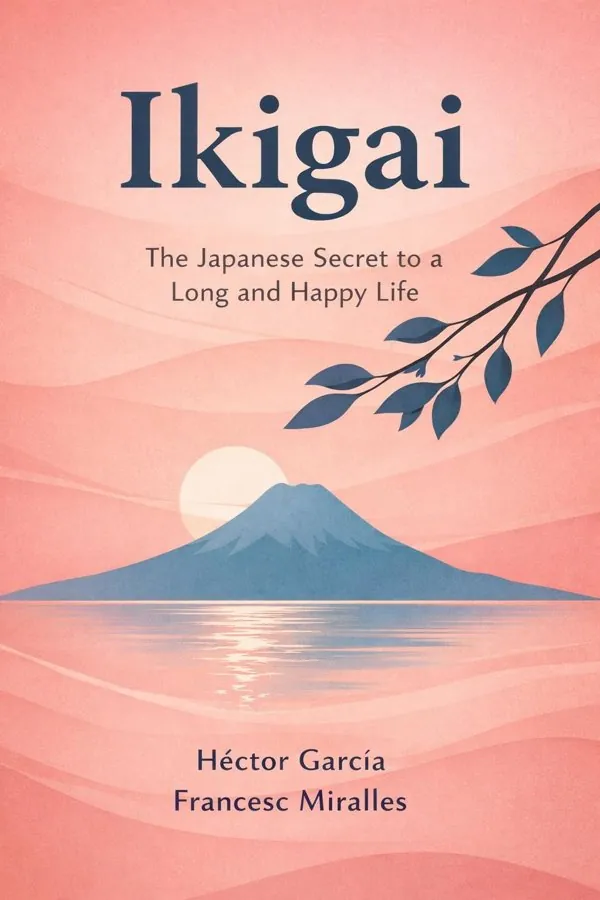
Ikigai: The Japanese Secret to a Long and Happy Life: Summary & Key Insights
by Héctor García, Francesc Miralles
 10 min9 chaptersAudio available
Key Takeaways from Ikigai: The Japanese Secret to a Long and Happy Life
A long life means little without a reason to live it fully.
Transformation is rarely dramatic; it is usually repetitive.
Many people assume aging means slowing down, withdrawing, and eventually becoming passive.
Happiness becomes fragile when it depends on individual achievement alone.
Health is often shaped more by everyday choices than by extreme interventions.
What Is Ikigai: The Japanese Secret to a Long and Happy Life About?
Ikigai: The Japanese Secret to a Long and Happy Life by Héctor García, Francesc Miralles is a general book. What keeps some people energetic, purposeful, and joyful well into old age? In Ikigai, Héctor García and Francesc Miralles explore this question through Japanese philosophy, psychology, and the daily habits of some of the world’s longest-living people. Drawing inspiration from Okinawa, especially the village of Ogimi, the authors examine how purpose, community, movement, diet, and resilience combine to create a life that feels both meaningful and sustainable. Rather than offering a rigid self-help formula, the book presents ikigai as a practical way of living: a reason to get up in the morning and engage fully with the day. The book matters because it shifts the conversation about success away from achievement alone and toward vitality, contribution, and inner alignment. García, a writer with deep experience living in Japan, and Miralles, an acclaimed author focused on personal growth, bring together interviews, cultural observation, and accessible research to make complex ideas easy to apply. Their message is simple but powerful: happiness is not found in dramatic transformation, but in consistent habits, meaningful relationships, and work that gives life direction.
This FizzRead summary covers all 9 key chapters of Ikigai: The Japanese Secret to a Long and Happy Life in approximately 10 minutes, distilling the most important ideas, arguments, and takeaways from Héctor García, Francesc Miralles's work. Also available as an audio summary and Key Quotes Podcast.
Ikigai: The Japanese Secret to a Long and Happy Life
What keeps some people energetic, purposeful, and joyful well into old age? In Ikigai, Héctor García and Francesc Miralles explore this question through Japanese philosophy, psychology, and the daily habits of some of the world’s longest-living people. Drawing inspiration from Okinawa, especially the village of Ogimi, the authors examine how purpose, community, movement, diet, and resilience combine to create a life that feels both meaningful and sustainable. Rather than offering a rigid self-help formula, the book presents ikigai as a practical way of living: a reason to get up in the morning and engage fully with the day.
The book matters because it shifts the conversation about success away from achievement alone and toward vitality, contribution, and inner alignment. García, a writer with deep experience living in Japan, and Miralles, an acclaimed author focused on personal growth, bring together interviews, cultural observation, and accessible research to make complex ideas easy to apply. Their message is simple but powerful: happiness is not found in dramatic transformation, but in consistent habits, meaningful relationships, and work that gives life direction.
Who Should Read Ikigai: The Japanese Secret to a Long and Happy Life?
This book is perfect for anyone interested in general and looking to gain actionable insights in a short read. Whether you're a student, professional, or lifelong learner, the key ideas from Ikigai: The Japanese Secret to a Long and Happy Life by Héctor García, Francesc Miralles will help you think differently.
- ✓Readers who enjoy general and want practical takeaways
- ✓Professionals looking to apply new ideas to their work and life
- ✓Anyone who wants the core insights of Ikigai: The Japanese Secret to a Long and Happy Life in just 10 minutes
Want the full summary?
Get instant access to this book summary and 100K+ more with Fizz Moment.
Get Free SummaryAvailable on App Store • Free to download
Key Chapters
A long life means little without a reason to live it fully. One of the book’s central insights is that ikigai is not a grand abstract ideal reserved for philosophers or artists. It is a personal sense of purpose that makes ordinary days feel worth inhabiting. The authors describe ikigai as the intersection of what you love, what you are good at, what the world needs, and, in some interpretations, what can sustain you. But beyond frameworks, the deeper point is emotional: people thrive when they feel useful, connected, and engaged.
In the book, many elderly residents of Okinawa do not "retire" from life. Even in advanced age, they tend gardens, teach crafts, cook for others, help neighbors, or participate in community rituals. Their activities may seem modest, yet they create continuity, identity, and motivation. This stands in contrast to modern lifestyles in which people often postpone meaning until after work, or lose direction once a career ends.
Purpose does not need to be singular or permanent. A teacher may find ikigai in mentoring students, but also in painting, parenting, or volunteering. A business professional may discover that their deepest motivation is solving problems, building teams, or creating stability for others. The practical lesson is to notice what consistently draws your attention and where your effort feels naturally worthwhile.
To apply this idea, ask yourself three questions: What activities make me forget time? Where do people genuinely benefit from my strengths? What kind of contribution would I still care about even without applause? Write down your answers and look for recurring patterns. Actionable takeaway: identify one small daily activity that makes you feel useful and alive, and commit to doing it every day for the next week.
Transformation is rarely dramatic; it is usually repetitive. A major strength of Ikigai is its rejection of the fantasy that fulfillment arrives through one huge breakthrough. Instead, the authors show that lasting happiness and health are built through small, repeatable behaviors practiced over time. The people they study do not appear to be chasing optimization in the modern sense. They live well because their routines quietly support body, mind, and relationships.
This idea matters because many people search for purpose while ignoring the structure of daily life. Yet purpose becomes real only when it is expressed through habit. Someone who values creativity but never creates will feel frustrated. Someone who values health but lives in constant exhaustion will struggle to feel engaged. Meaning needs a practical container.
The book points to routines such as rising with intention, moving regularly, eating moderately, staying socially connected, and keeping mentally active. These habits may seem simple, but they compound. A short walk each day improves mood and circulation. A regular mealtime creates stability. A hobby practiced consistently becomes a source of identity. A weekly gathering with friends protects against isolation.
Modern readers can apply this by shrinking their goals. Instead of "find my life purpose," begin with "spend 20 minutes daily on something that matters to me." Instead of trying to redesign your entire career overnight, schedule one conversation, one journal session, or one focused hour each week around your deeper interests.
The authors remind us that a satisfying life often looks ordinary from the outside. Its power lies in rhythm, not spectacle. Actionable takeaway: choose one tiny habit that supports your sense of purpose, such as ten minutes of writing, stretching, or learning, and attach it to an existing daily routine.
Many people assume aging means slowing down, withdrawing, and eventually becoming passive. Ikigai challenges this assumption by showing that continued activity is one of the foundations of a long and happy life. In Okinawan culture, the idea of complete retirement is less central than in many Western societies. People often remain involved in work, craft, social life, or service for as long as they are able. The result is not endless busyness, but sustained relevance.
The authors argue that useful activity keeps both mind and body engaged. Work in this sense does not only mean paid employment. It includes gardening, caregiving, cooking, community leadership, learning, and making things by hand. These forms of engagement preserve confidence and prevent the sense of emptiness that can arise when people no longer feel needed.
This insight has broad relevance in a world where many define themselves narrowly by job title. When a career ends or changes, identity can collapse. Ikigai suggests building a wider life architecture: multiple roles, ongoing interests, and ways to contribute beyond professional status. A retired accountant might mentor young entrepreneurs. A former nurse might volunteer in community care. A parent whose children have grown may rediscover music, language study, or local service.
Physical activity is also embedded in this idea. The healthiest elders are often not gym fanatics, but people who keep moving throughout the day. They walk, kneel, stand, carry, and stretch as part of living. Activity remains natural rather than forced.
The practical goal is not to stay busy for the sake of it, but to stay involved in life. Ask not, "When can I stop?" but, "How can I remain useful in ways I enjoy?" Actionable takeaway: create a personal list of three meaningful roles you can continue or begin at any age, so your identity never depends on just one form of work.
Happiness becomes fragile when it depends on individual achievement alone. One of the most memorable themes in Ikigai is the importance of social connection. The authors describe how Okinawan communities are held together by enduring social networks, including informal support groups known as moai. These groups offer companionship, emotional support, practical help, and a sense of belonging over a lifetime.
This matters because loneliness is not just emotionally painful; it is physically harmful. Modern life often celebrates independence while quietly producing isolation. People move frequently, work remotely, spend long hours online, and may lack close intergenerational ties. The book suggests that meaning is reinforced when life is shared. People are more likely to stay healthy, hopeful, and active when others know them, need them, and expect them to show up.
Community also protects against stress. A problem that feels overwhelming in isolation becomes manageable in relationship. Whether it is financial hardship, illness, grief, or simply a difficult week, support systems reduce emotional load. In the book’s examples, elders remain integrated into daily community life rather than separated from it. They are not seen as obsolete, but as participants with memory, skill, and value.
You do not need to live in Okinawa to apply this principle. A modern moai might be a weekly dinner with friends, a walking group, a volunteer team, a mastermind circle, a neighborhood network, or a faith community. The key is consistency and mutual care, not occasional socializing.
To build deeper connection, focus on contribution as much as belonging. Ask how you can become a reliable part of someone else’s support system. Actionable takeaway: start or strengthen one recurring group connection this month, such as a weekly meetup or check-in circle, and treat it as essential to your well-being rather than optional.
Health is often shaped more by everyday choices than by extreme interventions. Ikigai emphasizes the role of diet in long life, especially the Okinawan habit of moderation. One key principle the authors highlight is hara hachi bu, a practice of eating until one is about 80 percent full. This simple idea encourages awareness, restraint, and respect for the body’s signals.
Rather than promoting complicated nutritional dogma, the book points toward a generally balanced pattern: smaller portions, plant-rich foods, variety, and a lower reliance on heavily processed meals. Many of the long-lived people described eat vegetables, tofu, sweet potatoes, legumes, fish in moderation, and antioxidant-rich foods. Meals are often simpler and more intentional than the oversized, rushed eating common in many modern environments.
The deeper lesson is not merely what to eat, but how to eat. Slowing down during meals, eating in company, appreciating food, and avoiding excess all contribute to better digestion and healthier habits. Moderation creates sustainability. It allows food to remain a source of pleasure without turning into a source of constant strain.
For readers, the value of this idea lies in its practicality. You do not need a perfect diet to benefit. Start by reducing portion size slightly, adding one more whole food to each meal, and paying attention to satiety instead of external cues. For example, pause halfway through lunch and ask whether you are still hungry or simply continuing automatically. Over time, this restores trust in your own body.
Long-term health is usually not the result of heroic willpower but of repeated moderation. Actionable takeaway: for one week, practice eating more slowly and stopping before you feel completely full, while increasing the share of whole, minimally processed foods on your plate.
Some of the happiest moments in life occur when self-consciousness disappears. Ikigai connects purpose with the psychological state known as flow, a concept popularized by Mihaly Csikszentmihalyi. Flow occurs when you are so immersed in a meaningful challenge that time seems to vanish. In those moments, attention becomes focused, effort feels natural, and the activity itself becomes rewarding.
The authors suggest that people often discover their ikigai by noticing where flow appears. A ceramic artist feels it at the wheel. A coder feels it while solving a complex problem. A gardener feels it while tending plants. A grandparent may feel it while cooking for family or teaching a child a practical skill. Flow is a clue that your capacities are meeting an activity that matters to you.
This is important because many people pursue goals that look impressive but leave them mentally fragmented. They multitask, chase validation, and rarely experience deep engagement. The book invites a shift from external status to lived experience. A meaningful life is not only about outcomes, but about the quality of attention you bring to what you do.
Creating flow requires the right balance between challenge and skill. If a task is too easy, you become bored. If it is too difficult, you become anxious. So the practical strategy is to choose activities that stretch you slightly while remaining achievable. Reduce distractions, set a clear objective, and dedicate uninterrupted time. Even 30 focused minutes can reconnect you with a neglected source of joy.
Flow is not an escape from purpose; it is often one of its clearest expressions. Actionable takeaway: identify one activity in which you regularly lose track of time, then schedule protected time for it this week without phones, notifications, or unnecessary interruptions.
A meaningful life is not free from difficulty; it is strengthened by how difficulty is met. Ikigai does not present happiness as constant positivity. Instead, it highlights the role of emotional resilience, especially the ability to accept reality, adapt to change, and continue moving with intention. The authors draw on Japanese ideas and practices that value balance, mindfulness, and endurance without dramatization.
This perspective is refreshing because much self-help writing encourages control over everything: productivity, mood, success, even identity. But life inevitably includes loss, setbacks, aging, uncertainty, and disappointment. The people portrayed in the book seem durable not because they avoid hardship, but because they remain connected to purpose and community while facing it.
Acceptance does not mean passivity. It means seeing clearly what cannot be changed, so energy can be directed toward what still can be done. Someone facing career disruption may not control the economy, but can control learning, networking, and daily structure. Someone experiencing grief cannot erase pain, but can lean into relationships, ritual, and meaningful activity. Adaptation keeps suffering from becoming stagnation.
Practices such as mindfulness, simple routines, appreciation of small pleasures, and emotional steadiness all support resilience. Even tending a garden, preparing tea, walking, or writing each day can become anchors when life feels unstable. The message is that stability often comes from returning to simple, grounding acts.
Readers can apply this by asking, in any difficult moment: What is outside my control? What remains within my control today? This small mental shift reduces helplessness and restores agency. Actionable takeaway: the next time you feel overwhelmed, make two lists, one for what you cannot change and one for one small constructive response you can take immediately.
Modern life often confuses abundance with fulfillment. Ikigai offers a quieter idea: the more cluttered your life becomes, the harder it is to hear what genuinely matters. Throughout the book, there is a recurring admiration for simplicity in lifestyle, environment, food, routine, and attitude. This simplicity is not deprivation. It is the deliberate reduction of noise so that meaning becomes easier to feel.
Many long-lived, content people do not appear to be optimizing every moment or accumulating endless choices. Their lives contain familiar rhythms, useful tasks, and relationships that do not require constant reinvention. Simplicity reduces decision fatigue and frees attention for presence. When life is overpacked with obligations, consumption, and distraction, even important experiences can feel shallow.
This insight is especially relevant today. Many people want purpose while living in conditions that prevent reflection: constant notifications, overcrowded schedules, impulsive entertainment, and possessions that demand maintenance. Simplicity creates space for awareness. It allows you to notice what energizes you, what drains you, and what deserves your commitment.
Practical applications can be surprisingly modest. Declutter one workspace so it supports concentration. Reduce one recurring obligation that adds little value. Create a slower morning. Eat one undistracted meal each day. Replace some passive scrolling with a hands-on activity. None of these changes are dramatic, but each increases the signal-to-noise ratio of life.
The goal is not aesthetic perfection, but greater clarity. When less competes for your attention, your real priorities become more visible. Actionable takeaway: remove one source of daily clutter this week, whether physical, digital, or emotional, and use the reclaimed time or space for an activity that brings calm or meaning.
Many people postpone happiness, imagining it will begin after the next achievement, promotion, move, or milestone. Ikigai gently argues the opposite: a fulfilling life is built in the present, not deferred indefinitely into the future. The authors show that one of the secrets of long and happy living is the ability to find satisfaction in ordinary moments while still having reasons to keep going.
This is not a rejection of ambition. It is a warning against living exclusively in anticipation. If purpose exists only as a future target, life becomes an endless waiting room. The people celebrated in the book often take pleasure in small rituals: sharing tea, tending plants, walking, preparing food, talking with neighbors, practicing a craft. These moments are not interruptions to life; they are life.
The present-moment orientation also supports mental health. Anxiety often pulls attention into imagined futures, while regret traps it in the past. A grounded daily practice brings attention back to what can be experienced and shaped now. This might mean noticing the physical sensations of a walk, giving full attention to a conversation, or savoring a meal instead of rushing through it.
For modern readers, this idea can be transformative because productivity culture often trains people to treat every moment as instrumental. But not every valuable experience needs to lead somewhere else. Presence has its own worth. And paradoxically, those who are most present often work better, relate better, and enjoy more sustained motivation.
Purpose is not only your long-term direction; it is your way of inhabiting today. Actionable takeaway: choose one routine activity today, such as eating, walking, or speaking with someone, and do it with complete attention instead of dividing your focus.
All Chapters in Ikigai: The Japanese Secret to a Long and Happy Life
About the Authors
Héctor García is a writer best known for exploring Japanese culture, lifestyle, and philosophy through an accessible, globally appealing lens. Having lived in Japan for many years, he brings firsthand cultural experience to his work and is widely recognized for books that translate Japanese ideas into practical lessons for everyday life. Francesc Miralles is a bestselling Spanish author, journalist, and speaker whose work often focuses on personal growth, creativity, spirituality, and psychology. He has written numerous books and articles on how people can live with greater meaning and inner balance. Together, García and Miralles combine cultural observation, storytelling, and self-development insight. Their collaboration on Ikigai helped popularize the concept worldwide, making it one of the most recognized modern books on purpose, longevity, and well-being.
Get This Summary in Your Preferred Format
Read or listen to the Ikigai: The Japanese Secret to a Long and Happy Life summary by Héctor García, Francesc Miralles anytime, anywhere. FizzRead offers multiple formats so you can learn on your terms — all free.
Available formats: App · Audio · PDF · EPUB — All included free with FizzRead
Download Ikigai: The Japanese Secret to a Long and Happy Life PDF and EPUB Summary
Key Quotes from Ikigai: The Japanese Secret to a Long and Happy Life
“A long life means little without a reason to live it fully.”
“Transformation is rarely dramatic; it is usually repetitive.”
“Many people assume aging means slowing down, withdrawing, and eventually becoming passive.”
“Happiness becomes fragile when it depends on individual achievement alone.”
“Health is often shaped more by everyday choices than by extreme interventions.”
Frequently Asked Questions about Ikigai: The Japanese Secret to a Long and Happy Life
Ikigai: The Japanese Secret to a Long and Happy Life by Héctor García, Francesc Miralles is a general book that explores key ideas across 9 chapters. What keeps some people energetic, purposeful, and joyful well into old age? In Ikigai, Héctor García and Francesc Miralles explore this question through Japanese philosophy, psychology, and the daily habits of some of the world’s longest-living people. Drawing inspiration from Okinawa, especially the village of Ogimi, the authors examine how purpose, community, movement, diet, and resilience combine to create a life that feels both meaningful and sustainable. Rather than offering a rigid self-help formula, the book presents ikigai as a practical way of living: a reason to get up in the morning and engage fully with the day. The book matters because it shifts the conversation about success away from achievement alone and toward vitality, contribution, and inner alignment. García, a writer with deep experience living in Japan, and Miralles, an acclaimed author focused on personal growth, bring together interviews, cultural observation, and accessible research to make complex ideas easy to apply. Their message is simple but powerful: happiness is not found in dramatic transformation, but in consistent habits, meaningful relationships, and work that gives life direction.
You Might Also Like
Duct Tape Marketing: The World's Most Practical Small Business Marketing Guide
John Jantsch
10 minDusk, Night, Dawn: On Revival and Courage
Anne Lamott
10 minFinish Big: How Great Entrepreneurs Exit Their Companies on Top
Bo Burlingham
10 minFirst As Tragedy, Then As Farce
Slavoj Zizek
10 minFirst Principles: What America's Founders Learned from the Greeks and Romans and How That Shaped Our Country
Thomas E. Ricks
10 minGood Habits, Bad Habits: The Science of Making Positive Changes That Stick
Wendy Wood
10 minBrowse by Category
Ready to read Ikigai: The Japanese Secret to a Long and Happy Life?
Get the full summary and 100K+ more books with Fizz Moment.