
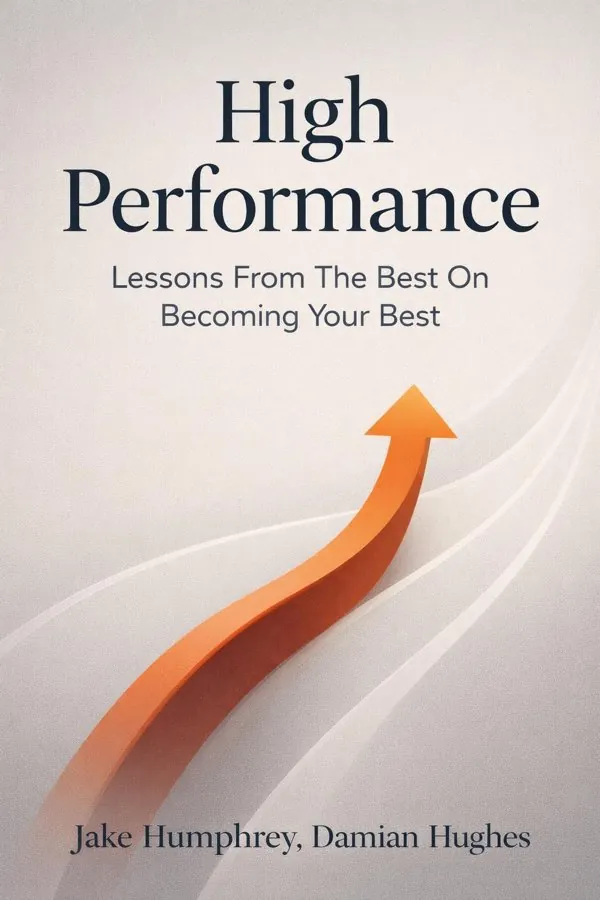
High Performance: Lessons from the Best on Becoming the Best: Summary & Key Insights
by Jake Humphrey, Damian Hughes
 10 min9 chapters
Key Takeaways from High Performance: Lessons from the Best on Becoming the Best
Before people change their results, they usually have to change the story they tell themselves about who they are.
Motivation is exciting, but purpose is dependable.
People often admire peak moments while ignoring the systems that made them possible.
Pressure does not create character as much as expose it.
Failure only becomes useless when it is denied, romanticized, or allowed to define identity.
What Is High Performance: Lessons from the Best on Becoming the Best About?
High Performance: Lessons from the Best on Becoming the Best by Jake Humphrey, Damian Hughes is a general book. High Performance: Lessons from the Best on Becoming the Best explores a question that fascinates athletes, entrepreneurs, leaders, and anyone pursuing excellence: what truly separates consistent high performers from everyone else? Drawing on conversations with elite sports figures, business leaders, coaches, and high achievers from many fields, Jake Humphrey and Damian Hughes argue that exceptional performance is not a mystery reserved for a gifted few. It is built through habits, mindset, emotional discipline, purpose, and the ability to keep improving under pressure. What makes this book especially compelling is the combination of the authors’ backgrounds. Jake Humphrey is a respected broadcaster known for interviewing top performers in sport and business, while Damian Hughes is an organizational psychologist and performance expert who has spent years studying winning cultures and leadership. Together, they translate elite-level insights into lessons that ordinary readers can apply to work, relationships, health, and personal goals. This matters because most people do not fail from lack of talent alone. They struggle with inconsistency, fear, distraction, and self-doubt. High Performance offers a practical framework for building resilience, clarity, and sustained excellence in a world that constantly tests both ambition and character.
This FizzRead summary covers all 9 key chapters of High Performance: Lessons from the Best on Becoming the Best in approximately 10 minutes, distilling the most important ideas, arguments, and takeaways from Jake Humphrey, Damian Hughes's work.
High Performance: Lessons from the Best on Becoming the Best
High Performance: Lessons from the Best on Becoming the Best explores a question that fascinates athletes, entrepreneurs, leaders, and anyone pursuing excellence: what truly separates consistent high performers from everyone else? Drawing on conversations with elite sports figures, business leaders, coaches, and high achievers from many fields, Jake Humphrey and Damian Hughes argue that exceptional performance is not a mystery reserved for a gifted few. It is built through habits, mindset, emotional discipline, purpose, and the ability to keep improving under pressure.
What makes this book especially compelling is the combination of the authors’ backgrounds. Jake Humphrey is a respected broadcaster known for interviewing top performers in sport and business, while Damian Hughes is an organizational psychologist and performance expert who has spent years studying winning cultures and leadership. Together, they translate elite-level insights into lessons that ordinary readers can apply to work, relationships, health, and personal goals.
This matters because most people do not fail from lack of talent alone. They struggle with inconsistency, fear, distraction, and self-doubt. High Performance offers a practical framework for building resilience, clarity, and sustained excellence in a world that constantly tests both ambition and character.
Who Should Read High Performance: Lessons from the Best on Becoming the Best?
This book is perfect for anyone interested in general and looking to gain actionable insights in a short read. Whether you're a student, professional, or lifelong learner, the key ideas from High Performance: Lessons from the Best on Becoming the Best by Jake Humphrey, Damian Hughes will help you think differently.
- ✓Readers who enjoy general and want practical takeaways
- ✓Professionals looking to apply new ideas to their work and life
- ✓Anyone who wants the core insights of High Performance: Lessons from the Best on Becoming the Best in just 10 minutes
Want the full summary?
Get instant access to this book summary and 100K+ more with Fizz Moment.
Get Free SummaryAvailable on App Store • Free to download
Key Chapters
Before people change their results, they usually have to change the story they tell themselves about who they are. One of the strongest themes in High Performance is that elite achievement is not driven only by external goals like trophies, money, or status. It grows from identity. High performers often act in ways that are consistent with the person they believe themselves to be, especially when no one is watching.
The book suggests that lasting excellence comes when performance is connected to self-concept. If someone says, "I want to get fit," that goal may fade when life gets busy. But if they begin to think, "I am a person who respects my body and trains consistently," their behavior becomes more stable. The same applies in business, leadership, or creative work. A person who sees themselves as calm under pressure, committed to learning, and responsible for standards is more likely to behave accordingly when challenged.
This does not mean pretending to be perfect. In fact, many high performers are honest about weakness. What distinguishes them is that they build an identity around improvement rather than excuses. They may not win every day, but they do not abandon the standards they have chosen.
A practical application is to audit your language. Notice whether you describe yourself in limiting ways: "I am disorganized," "I always procrastinate," or "I am not a natural leader." These statements become self-fulfilling. Replace them with identity statements tied to growth and action. For example: "I am learning to lead clearly," or "I am someone who finishes what I start."
Actionable takeaway: Write three identity statements that reflect the person you want to become, and choose one daily behavior that proves each statement true.
Motivation is exciting, but purpose is dependable. High Performance makes clear that the best performers do not rely on feeling inspired every day. They connect their effort to something deeper than short-term emotion. Purpose gives meaning to repetition, sacrifice, setbacks, and delayed rewards.
This matters because every serious goal eventually becomes difficult. Training becomes monotonous. Business growth feels uncertain. A leadership role becomes emotionally draining. In those moments, raw enthusiasm is rarely enough. Purpose answers the question, "Why does this matter so much that I will continue even when it becomes inconvenient?" For some people, the answer is contribution. For others, it is family, mastery, personal integrity, or the desire to honor opportunities they have been given.
The authors show that purpose does not have to be dramatic to be powerful. It simply needs to be real. A manager may perform at a higher level because they genuinely care about helping their team grow. A founder may endure difficult years because they believe in solving a meaningful problem. An athlete may push through discomfort because representing others gives significance to their effort.
Purpose also improves decision-making. When people know what they stand for, they are less easily distracted by vanity metrics or temporary praise. They can choose the hard but meaningful path over the easy but hollow one.
To apply this idea, define the difference between your goal and your reason. A goal might be to get promoted. A reason might be to create security for your family, develop your abilities, and become the kind of leader others trust. That reason gives the goal emotional weight.
Actionable takeaway: Complete this sentence in writing: "This goal matters to me because..." Then keep refining it until the answer feels deeply personal and energizing.
People often admire peak moments while ignoring the systems that made them possible. A central lesson of High Performance is that excellence is usually less glamorous than it appears. It is built through consistency: repeated preparation, disciplined routines, and standards that are maintained regardless of mood.
The book challenges the myth that success comes mainly from dramatic breakthroughs. In reality, high performers win because they make strong choices repeatedly. They show up when tired. They practice basics after others stop caring about them. They recover properly. They prepare in detail. They hold themselves accountable on ordinary days, not just during major opportunities.
This insight is valuable because many people sabotage progress by treating effort as seasonal. They work intensely for short periods, then drift. In contrast, consistent performers create momentum through modest but reliable actions. An executive who blocks time every week for strategic thinking is likely to make better long-term decisions than one who only reacts to emergencies. A writer who produces 500 words a day often outperforms someone waiting for perfect inspiration. A leader who gives regular feedback builds stronger culture than one who delivers occasional grand speeches.
Consistency also reduces the emotional cost of action. When behavior becomes routine, it requires less internal debate. The question is no longer, "Do I feel like doing this today?" but "This is what I do."
One practical method is to identify your non-negotiables: a small set of actions that define your standard. These should be sustainable, measurable, and tied directly to your goals. Done repeatedly, they compound.
Actionable takeaway: Choose three weekly non-negotiable habits that support your highest goal, and track them for 30 days without aiming for perfection, only consistency.
Pressure does not create character as much as expose it. In High Performance, one of the recurring ideas is that elite performers are not fearless people who somehow avoid stress. They are people who prepare thoroughly and learn to regulate their response when stakes rise.
Pressure is unavoidable wherever performance matters. It appears in boardroom presentations, difficult conversations, deadlines, competitions, public scrutiny, and moments of uncertainty. What separates strong performers is not the absence of nerves but the ability to stay effective despite them. This usually comes from two sources: preparation and emotional control.
Preparation builds trust in your process. When you know you have done the work, pressure becomes easier to handle because you are not trying to invent confidence in the moment. Emotional control helps you prevent anxiety from hijacking judgment. High performers often use routines, breathing, rehearsal, self-talk, and perspective to keep themselves grounded.
The book points toward an important truth: under stress, people tend to fall back to their habits, not rise magically to their hopes. That is why practicing under realistic conditions matters. If you only train when comfortable, you may struggle when circumstances become volatile. A sales professional can rehearse difficult objections. A leader can prepare for tough meetings by identifying likely emotional triggers. An athlete can simulate match pressure in practice.
Another useful principle is to separate what you can control from what you cannot. Outcomes are never fully controllable. Effort, preparation, attitude, and execution usually are.
Actionable takeaway: Before any high-pressure event, list three controllable actions you will focus on, and create a short pre-performance routine that helps you reset your mind and body.
Failure only becomes useless when it is denied, romanticized, or allowed to define identity. High Performance treats setbacks as unavoidable and often essential, but only if they are processed constructively. The best performers do not enjoy failure, yet they know how to turn it into information.
This is a difficult balance. On one side, some people collapse after mistakes. They interpret poor results as proof that they are inadequate. On the other side, some people talk about failure so casually that they never truly learn from it. The high-performance approach sits in the middle: be honest, be specific, and keep belief intact.
That means analyzing what happened without falling into self-destruction. Did preparation fall short? Was communication unclear? Did ego interfere? Was the strategy flawed? Were external conditions misunderstood? By asking precise questions, failure becomes a source of feedback instead of shame.
The book also suggests that resilience is not just toughness. It is adaptability. A resilient person adjusts methods while protecting purpose. If one route does not work, they do not necessarily abandon the destination. This mindset is critical in entrepreneurship, leadership, sport, and personal development. A failed project can improve future planning. A lost client can sharpen service quality. A difficult season can reveal weaknesses in team culture.
Importantly, confidence should come from the ability to respond, not from the fantasy of never struggling. When belief is tied to flawless outcomes, it becomes fragile. When belief is tied to growth and response, it becomes durable.
A helpful habit after setbacks is structured reflection: what worked, what did not, what I learned, and what changes next.
Actionable takeaway: After your next disappointment, complete a one-page review within 24 hours that identifies one lesson, one adjustment, and one reason your long-term goal still matters.
Few people reach exceptional levels alone, and even fewer stay there alone. High Performance emphasizes that environment and relationships strongly influence whether talent is expressed, sustained, or wasted. The quality of people around you affects standards, confidence, accountability, and emotional stability.
This is especially important because modern culture often celebrates individual genius. Yet in reality, elite performance usually depends on coaches, mentors, teammates, supportive families, honest colleagues, and leaders who create the right conditions. A gifted individual in a toxic environment may underperform. A moderately talented person in a high-standard, supportive culture may exceed expectations.
The authors highlight the role of trusted people who tell the truth. High performers benefit from feedback that is clear, challenging, and constructive. They also benefit from emotional support: people who steady them when confidence dips and prevent success from becoming isolating. This combination of care and challenge is powerful. It helps people grow without becoming complacent.
You can apply this idea by examining your performance environment. Who raises your standards? Who drains your energy? Who tells you what you need to hear rather than what is easy to say? In workplaces, culture can be improved through regular feedback, psychological safety, shared expectations, and leaders who model discipline. In personal life, choosing relationships that support your values is equally important.
Another practical lesson is to become part of someone else’s performance environment. Encouragement, accountability, and honesty are not only things to seek but also things to offer. Strong cultures are built reciprocally.
Actionable takeaway: Identify three people who influence your performance most, strengthen one relationship that helps you grow, and reduce exposure to one influence that consistently pulls you away from your best.
Confidence is often misunderstood as a personality trait that some people naturally possess. High Performance presents a more useful view: real confidence is constructed through evidence, preparation, self-awareness, and repeated recovery from difficulty. It is less about always feeling certain and more about trusting your capacity to respond.
This matters because many people wait to act until they feel confident. That delay can become a trap. High performers usually reverse the sequence. They act, prepare, practice, and accumulate evidence. Confidence then follows from having done hard things before. A speaker becomes more confident after delivering many talks, learning from mistakes, and refining their message. A manager gains confidence through handling conflicts, making decisions, and surviving imperfect outcomes.
The book’s perspective also helps separate confidence from arrogance. Arrogance assumes superiority and resists feedback. Genuine confidence remains open to learning because it does not depend on appearing flawless. It can say, "I may not control everything, but I trust my preparation and I can adapt."
Practical confidence-building often includes several steps: keeping promises to yourself, rehearsing key skills, reviewing past wins, and managing internal dialogue. Self-talk matters. If your mind becomes a constant source of criticism, performance suffers. Replacing catastrophic thoughts with grounded reminders can stabilize action: "Focus on the next step," "I have prepared for this," or "I can handle discomfort."
Another strong method is to collect evidence intentionally. Keep a record of moments when you solved problems, improved, or showed courage. This becomes especially valuable during periods of doubt.
Actionable takeaway: Start a confidence file with five examples of challenges you have already handled well, and review it before situations that normally trigger self-doubt.
Ambition can drive people forward, but unmanaged energy eventually pushes them into burnout, poor decisions, and declining performance. High Performance reminds readers that elite output is not only about doing more. It is about managing physical, mental, and emotional resources so excellence can be sustained.
Many people confuse high performance with constant intensity. The result is overwork, shallow recovery, and inconsistent results. The book points toward a healthier model. Top performers understand the rhythm between effort and recovery. They know when to push and when to reset. Rest is not treated as laziness but as part of the performance process.
This applies far beyond sport. In business, leaders who never switch off may become reactive, short-tempered, and strategically weak. In creative work, mental fatigue lowers originality. In personal life, chronic stress damages relationships and concentration. Sustainable excellence requires sleep, nutrition, movement, reflection, and boundaries around time and attention.
Energy management also involves emotional load. Unresolved conflict, constant digital distraction, and overcommitment consume capacity. Sometimes improving performance is less about adding another productivity technique and more about removing unnecessary drains. That might mean fewer meetings, clearer priorities, better delegation, or more deliberate recovery rituals.
A practical approach is to track when you perform best during the day and align high-value work with those windows. Protect recovery with the same seriousness as output. Short breaks, exercise, walking, journaling, and device-free time can all restore quality.
Actionable takeaway: For one week, monitor what activities energize you and what activities drain you, then remove one avoidable drain and schedule one reliable recovery habit into your calendar every day.
The moment people believe they have fully arrived, decline often begins. High Performance argues that elite performers remain students of their craft. Even at the top, they keep refining details, seeking feedback, and confronting uncomfortable truths about where improvement is still needed.
This mindset is powerful because success can be deceptive. Early wins may tempt people to protect their ego rather than their standards. They may avoid criticism, repeat old methods, or assume past performance guarantees future results. High performers resist that drift by staying curious. They ask what can be better, faster, clearer, simpler, or more resilient.
Continual refinement depends on honesty. Without accurate self-assessment, growth becomes random. This means facing gaps in skill, discipline, communication, or attitude without defensiveness. It also means distinguishing between activity and progress. Being busy is not the same as getting better.
A useful practical tool is regular review. Individuals and teams can set aside time to assess performance patterns, not just outcomes. What are we doing that works? Where are errors repeating? What assumptions need to change? Which habits support our goals, and which habits only create the appearance of effort? This process turns improvement into a system rather than a reaction to crisis.
Importantly, continual refinement should not become perfectionism. The aim is progress with clarity, not endless self-criticism. High performers improve by noticing small margins that compound over time.
Actionable takeaway: Schedule a weekly 20-minute performance review with yourself, and answer three questions: What moved me forward, what held me back, and what one adjustment will I make next week?
All Chapters in High Performance: Lessons from the Best on Becoming the Best
About the Authors
Jake Humphrey and Damian Hughes are the co-authors of High Performance and collaborators behind the widely known High Performance platform and podcast. Humphrey is an accomplished British broadcaster and interviewer, recognized for his work across major sports coverage and for his ability to draw out honest insights from elite performers. Hughes is an organizational psychologist, keynote speaker, and author whose work centers on leadership, culture, change, and sustained excellence. He has advised businesses and teams on how to build high-performing environments. Together, they combine real-world conversations with high achievers and evidence-based performance psychology. Their partnership brings a rare blend of accessibility and depth, translating lessons from top sport and business figures into practical ideas that readers can use in their own careers, goals, and everyday lives.
Get This Summary in Your Preferred Format
Read or listen to the High Performance: Lessons from the Best on Becoming the Best summary by Jake Humphrey, Damian Hughes anytime, anywhere. FizzRead offers multiple formats so you can learn on your terms — all free.
Available formats: App · Audio · PDF · EPUB — All included free with FizzRead
Download High Performance: Lessons from the Best on Becoming the Best PDF and EPUB Summary
Key Quotes from High Performance: Lessons from the Best on Becoming the Best
“Before people change their results, they usually have to change the story they tell themselves about who they are.”
“Motivation is exciting, but purpose is dependable.”
“People often admire peak moments while ignoring the systems that made them possible.”
“Pressure does not create character as much as expose it.”
“Failure only becomes useless when it is denied, romanticized, or allowed to define identity.”
Frequently Asked Questions about High Performance: Lessons from the Best on Becoming the Best
High Performance: Lessons from the Best on Becoming the Best by Jake Humphrey, Damian Hughes is a general book that explores key ideas across 9 chapters. High Performance: Lessons from the Best on Becoming the Best explores a question that fascinates athletes, entrepreneurs, leaders, and anyone pursuing excellence: what truly separates consistent high performers from everyone else? Drawing on conversations with elite sports figures, business leaders, coaches, and high achievers from many fields, Jake Humphrey and Damian Hughes argue that exceptional performance is not a mystery reserved for a gifted few. It is built through habits, mindset, emotional discipline, purpose, and the ability to keep improving under pressure. What makes this book especially compelling is the combination of the authors’ backgrounds. Jake Humphrey is a respected broadcaster known for interviewing top performers in sport and business, while Damian Hughes is an organizational psychologist and performance expert who has spent years studying winning cultures and leadership. Together, they translate elite-level insights into lessons that ordinary readers can apply to work, relationships, health, and personal goals. This matters because most people do not fail from lack of talent alone. They struggle with inconsistency, fear, distraction, and self-doubt. High Performance offers a practical framework for building resilience, clarity, and sustained excellence in a world that constantly tests both ambition and character.
More by Jake Humphrey, Damian Hughes
You Might Also Like
Duct Tape Marketing: The World's Most Practical Small Business Marketing Guide
John Jantsch
10 minDusk, Night, Dawn: On Revival and Courage
Anne Lamott
10 minFinish Big: How Great Entrepreneurs Exit Their Companies on Top
Bo Burlingham
10 minFirst As Tragedy, Then As Farce
Slavoj Zizek
10 minFirst Principles: What America's Founders Learned from the Greeks and Romans and How That Shaped Our Country
Thomas E. Ricks
10 minGood Habits, Bad Habits: The Science of Making Positive Changes That Stick
Wendy Wood
10 minBrowse by Category
Ready to read High Performance: Lessons from the Best on Becoming the Best?
Get the full summary and 100K+ more books with Fizz Moment.