
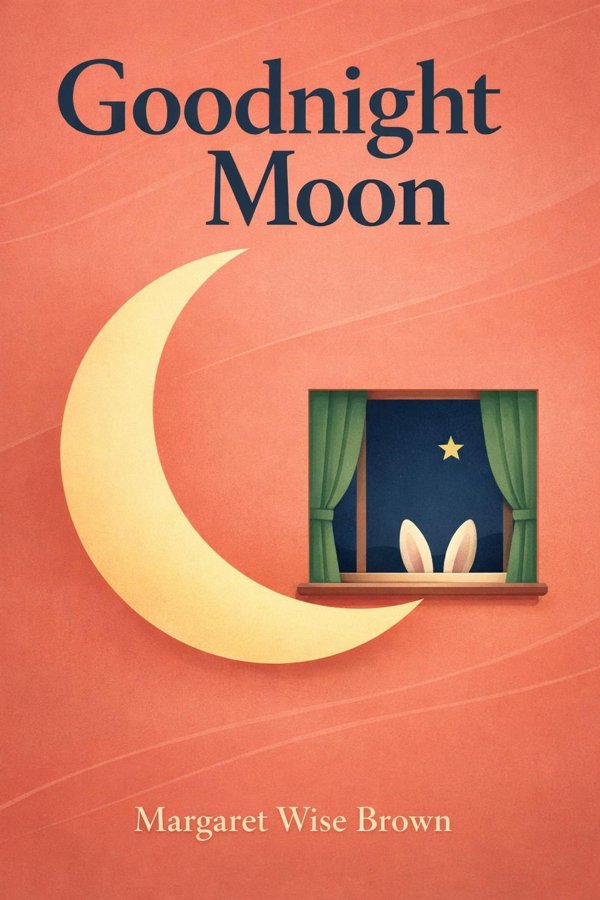
Goodnight Moon: Summary & Key Insights
 10 min8 chaptersAudio available
Key Takeaways from Goodnight Moon
One of the deepest truths in childhood is that predictability feels like love.
Adults often chase novelty, but children frequently crave repetition because it turns experience into mastery.
Comfort rarely comes from grand events; more often, it lives in ordinary things we come to recognize as ours.
Words do more than describe bedtime; they can actually prepare the body and mind for it.
Children do not experience rooms the way adults do.
What Is Goodnight Moon About?
Goodnight Moon by Margaret Wise Brown is a general book. Goodnight Moon by Margaret Wise Brown is one of the most cherished bedtime books ever written, yet its brilliance lies in how much comfort it creates with so little. Set in a quiet green room, the story follows a young bunny as he says goodnight to the familiar objects around him: the red balloon, the kittens, the mittens, the moon, and eventually the hush of the room itself. On the surface, it is a simple ritual of naming and parting. Beneath that simplicity, however, the book offers a profound lesson about security, routine, imagination, and the emotional transition from wakefulness to sleep. Brown understood children with unusual depth. A pioneer in early childhood literature, she rejected stiff moralizing and instead wrote in rhythms that matched how children actually think, feel, and observe. Her work helped redefine what picture books could do: soothe, delight, and honor a child’s inner world. Goodnight Moon matters because it transforms an ordinary bedtime into a reassuring ceremony, showing how language, repetition, and attention can make even the end of the day feel safe, gentle, and beautiful.
This FizzRead summary covers all 8 key chapters of Goodnight Moon in approximately 10 minutes, distilling the most important ideas, arguments, and takeaways from Margaret Wise Brown's work. Also available as an audio summary and Key Quotes Podcast.
Goodnight Moon
Goodnight Moon by Margaret Wise Brown is one of the most cherished bedtime books ever written, yet its brilliance lies in how much comfort it creates with so little. Set in a quiet green room, the story follows a young bunny as he says goodnight to the familiar objects around him: the red balloon, the kittens, the mittens, the moon, and eventually the hush of the room itself. On the surface, it is a simple ritual of naming and parting. Beneath that simplicity, however, the book offers a profound lesson about security, routine, imagination, and the emotional transition from wakefulness to sleep. Brown understood children with unusual depth. A pioneer in early childhood literature, she rejected stiff moralizing and instead wrote in rhythms that matched how children actually think, feel, and observe. Her work helped redefine what picture books could do: soothe, delight, and honor a child’s inner world. Goodnight Moon matters because it transforms an ordinary bedtime into a reassuring ceremony, showing how language, repetition, and attention can make even the end of the day feel safe, gentle, and beautiful.
Who Should Read Goodnight Moon?
This book is perfect for anyone interested in general and looking to gain actionable insights in a short read. Whether you're a student, professional, or lifelong learner, the key ideas from Goodnight Moon by Margaret Wise Brown will help you think differently.
- ✓Readers who enjoy general and want practical takeaways
- ✓Professionals looking to apply new ideas to their work and life
- ✓Anyone who wants the core insights of Goodnight Moon in just 10 minutes
Want the full summary?
Get instant access to this book summary and 100K+ more with Fizz Moment.
Get Free SummaryAvailable on App Store • Free to download
Key Chapters
One of the deepest truths in childhood is that predictability feels like love. Goodnight Moon is built around a bedtime ritual: the little bunny slowly says goodnight to everything in the room and beyond it. That act may seem small, but it reflects a powerful emotional need. Children often experience bedtime as a separation, a surrender of activity, attention, and control. By turning sleep into a sequence of familiar acknowledgments, the book transforms uncertainty into calm.
The genius of the story is that it does not rush the child toward sleep. Instead, it honors the transition. Every object named becomes part of a reassuring pattern: goodnight room, goodnight moon, goodnight comb, goodnight brush. The world is not disappearing; it is being gently put into order. The child listening learns that sleep is not chaos or loss. It is a peaceful closing ritual in which everything remains safe and in its place.
This idea has practical value far beyond the page. Parents and caregivers can use consistent bedtime routines to reduce resistance and anxiety. Reading the same book, dimming lights in the same order, saying goodnight to favorite toys, or repeating a simple phrase each night can help children anticipate rest rather than fear it. Even older children benefit from rituals that mark the end of the day, such as gratitude lists or quiet breathing.
The book reminds us that routine is not dull when it supports emotional security. For young children especially, repeated actions are calming because they create structure in a world that often feels large and unpredictable. Actionable takeaway: build a short, repeatable bedtime ritual that includes naming familiar comforts, so sleep becomes a trusted pattern instead of a daily struggle.
Adults often chase novelty, but children frequently crave repetition because it turns experience into mastery. Goodnight Moon uses repeated phrasing not as filler, but as emotional architecture. The recurring words create rhythm, expectation, and calm. Each “goodnight” feels like another soft step downward into rest.
This repetitive structure matters because children process the world by hearing, seeing, and revisiting the same things again and again. Repetition in the book strengthens memory and reduces cognitive strain. The child does not need to decode a new plot twist on every page. Instead, attention can shift toward tone, imagery, and anticipation. The familiar language becomes soothing precisely because it is familiar.
There is also a subtle emotional lesson here: reassurance often comes through what is reliable, not what is exciting. In families, this can mean reading the same bedtime story without apology, keeping comforting household patterns, or using recurring phrases like “You are safe, and it is time to rest.” Teachers can apply the same principle in classrooms through opening songs, daily greetings, and repeated reading. What seems repetitive to an adult may feel stabilizing to a child.
The book also shows that repetition can still contain variation. Though the phrase “goodnight” returns again and again, the objects change. This balance between sameness and difference keeps the reading experience alive. It offers just enough novelty inside a secure frame.
Goodnight Moon invites us to reconsider repetition as a tool for regulation, learning, and trust. It is not merely literary style; it is emotional design. Actionable takeaway: when supporting a child through transitions, use repeated words, rhythms, or actions to create familiarity that lowers stress and encourages calm engagement.
Comfort rarely comes from grand events; more often, it lives in ordinary things we come to recognize as ours. In Goodnight Moon, the stars are not the only wonders. The comb, the brush, the bowl full of mush, the chair, the clocks, and the quiet room itself are all worthy of farewell. This is one of the book’s most beautiful insights: the everyday environment of a child is full of emotional meaning.
Children develop attachment not just to people, but to places and objects. A room can become a map of safety. A blanket can represent continuity. A shelf, a picture, or a toy can anchor the feeling of home. By naming common things with care, the book teaches children that their world is worthy of attention. Nothing is too small to matter when it participates in comfort.
This perspective has practical implications for caregivers. Instead of thinking only in terms of entertainment or stimulation, adults can shape physical spaces that support peace. A child’s room need not be elaborate to feel magical. Familiar books, stable furniture, soft lighting, and a few beloved objects can create a strong sense of belonging. During stressful transitions such as travel, moving homes, or starting school, bringing along a few recognizable objects can ease adaptation.
The book also models mindfulness for adults. It suggests that calm can grow from noticing what is already present rather than searching for something more. A simple room, observed attentively, becomes enough.
In an age that often celebrates more, Goodnight Moon quietly celebrates enough. Actionable takeaway: identify the everyday objects and spaces that make a child feel secure, and intentionally preserve and honor them as part of a comforting daily environment.
Words do more than describe bedtime; they can actually prepare the body and mind for it. Goodnight Moon demonstrates how language, rhythm, and sound can create a settling effect. The sentences are short, musical, and unobtrusive. They do not demand energy. They lower it. The book’s cadence mirrors what a successful bedtime routine should do: slow breathing, narrow focus, and soften alertness.
This is a reminder that children respond not only to what is said, but to how it sounds. Harsh, rushed, or overly stimulating language can keep a child mentally activated. In contrast, soft repetition and gentle pacing can signal safety. The story’s language works almost like a lullaby in prose form. It reassures through sound before it reassures through meaning.
Caregivers can apply this insight in practical ways. Lowering vocal volume during bedtime, using fewer words, repeating calm phrases, and avoiding high-energy conversation late in the evening can help children shift states more smoothly. Teachers and caregivers in group settings can also use rhythmic language before naps or quiet time. Even simple phrases like “the day is ending” or “everything is resting now” can become powerful cues when repeated consistently.
The book further suggests that naming the world can help quiet it. By speaking each object into the bedtime ritual, the child no longer needs to mentally hold onto the room. It has been acknowledged. It can now rest.
Goodnight Moon is therefore not just a story about sleep; it is a demonstration of sleep-friendly language. Actionable takeaway: use slow, rhythmic, predictable language at bedtime to help children feel safe enough to relax into rest.
Children do not experience rooms the way adults do. They notice different things, assign meaning differently, and move fluidly between realism and imagination. Goodnight Moon succeeds because it does not impose an adult agenda on the child’s world. Instead, it enters that world respectfully. The selection of objects, the pacing, and the emotional tone all reflect how a young child might actually attend to bedtime.
This matters because many books written for children have historically tried to instruct, correct, or entertain from an adult point of view. Margaret Wise Brown did something more radical: she paid attention to the emotional and perceptual reality of early childhood. In Goodnight Moon, the bunny says goodnight not only to obvious things like the moon, but also to small and seemingly random items. That is how children often think. Their focus can be intimate, associative, and delightfully unconcerned with hierarchy.
For parents, educators, and writers, the lesson is clear. Supporting children well begins with observing how they actually experience the world rather than how adults assume they should. A bedtime routine may feel logical to an adult, but a child may care deeply about saying goodnight to one specific stuffed animal or lamp. Respecting those details builds trust.
This child-centered perspective also invites adults to slow down and listen. Asking children what they want to say goodnight to, what they notice in a room, or what makes them feel cozy can reveal meaningful emotional patterns. Their answers are often more insightful than expected.
Goodnight Moon endures because it treats childhood as a valid way of seeing, not just a stage to outgrow. Actionable takeaway: pay close attention to the specific details children care about, and let their perspective shape routines, conversations, and environments whenever possible.
Many transitions become difficult because they are framed as abrupt endings. Goodnight Moon offers a different model: letting go can happen gradually, lovingly, and without distress. The child does not simply stop the day. The day is released object by object, image by image, word by word. That slow release is one reason the book feels so calming.
Bedtime is one of the first regular transitions children must learn to navigate. It involves leaving behind play, attention, movement, and often the visible presence of caregivers. The book acknowledges this challenge without dramatizing it. Instead, it turns goodbye into a quiet ritual of acceptance. The child is not being forced away from the world; the world is being tenderly acknowledged and set aside.
This lesson extends beyond sleep. Children face many small separations: leaving home for school, saying goodbye after visits, ending screen time, finishing vacations, or moving between activities. Adults can make these transitions easier by borrowing from the book’s method. Rather than demanding instant disengagement, they can create bridge rituals. For example, a child might say goodbye to a playground slide before leaving, wave to the classroom door after pickup, or name three favorite moments before ending the day.
Even adults can learn from this approach. We often move from one task to another without closure, which leaves us mentally scattered. A brief ritual of completion can help any transition feel more manageable.
Goodnight Moon shows that endings do not have to feel harsh to be final. They can feel acknowledged, respectful, and safe. Actionable takeaway: help children navigate transitions by creating small rituals of goodbye that make letting go feel gradual rather than abrupt.
A truly great picture book does not merely pair images with words; it creates meaning through their interaction. Goodnight Moon is a masterclass in that partnership. The text is spare, but the illustrations enrich the emotional experience by showing the room, tracking subtle changes in light, and deepening the sense of passage toward sleep. The result is a reading experience that is felt visually as much as verbally.
This matters because young children are often reading the whole book through multiple channels at once. They absorb color, spatial familiarity, visual repetition, and details that may not even be named in the text. The room becomes a stable environment the child reader can return to over and over. As the pages turn, the visual world remains recognizable while growing quieter and darker. The artwork supports the same soothing arc that the language creates.
Parents can use illustrated books more intentionally by slowing down and inviting children to notice recurring details. Asking, “What do you see that we said goodnight to?” or “What changed on this page?” encourages visual literacy and attention without breaking the calm. Teachers can similarly use picture books to help children connect language, mood, and image.
The collaboration between Brown’s words and the illustrations also reminds us that design influences emotional tone. The right visuals can reduce overstimulation and support focus. In children’s spaces, books, and routines, visual simplicity and continuity often matter more than sensory excess.
Goodnight Moon endures partly because it understands that children do not just hear stories; they inhabit them. Actionable takeaway: when reading with children, treat the pictures as essential to the experience, and use them to reinforce calm, observation, and emotional understanding.
Some of the most enduring works for children are not complex in plot, but precise in emotional truth. Goodnight Moon proves that simplicity is not the absence of depth; it is often the clearest expression of it. The story has no dramatic conflict, no twist, and no explicit lesson. Yet generations return to it because it captures a universal human experience with unusual purity: the need to feel safe while surrendering to rest.
In a culture that often equates value with complexity, this book is a useful corrective. Young children do not need elaborate narratives to be moved or soothed. What they need is resonance. They need language they can hold, images they can revisit, and emotional experiences that feel honest. Brown trusted that a simple structure, if shaped with care, could do profound work.
There is a wider lesson here for adults, too. We often overcomplicate routines, teaching, and communication. But what helps most in moments of vulnerability is often simplicity delivered with consistency. A calm room, a repeated phrase, a familiar book, and an unhurried presence can do more than expensive solutions or overstimulating content.
The book’s simplicity also makes it durable. Children can enjoy it before they fully understand language, revisit it as they learn words, and later remember it as a symbol of comfort. That layered accessibility is part of its genius.
Goodnight Moon shows that depth need not announce itself. Sometimes it whispers. Actionable takeaway: when supporting a child’s emotional needs, choose simple, repeatable forms of comfort and trust that clarity and consistency often matter more than complexity.
All Chapters in Goodnight Moon
About the Author
Margaret Wise Brown was an American children’s author whose work helped transform modern picture books. Born in 1910, she became known for writing with a rare sensitivity to how children actually experience language, rhythm, imagination, and everyday life. Rather than using stories mainly to instruct or moralize, Brown focused on emotional truth, sensory detail, and the inner world of early childhood. She studied and worked in progressive educational circles, which shaped her belief that children’s books should respect a child’s perspective. Her best-known works include Goodnight Moon and The Runaway Bunny, both of which remain classics. Brown’s writing continues to influence authors, educators, and parents because of its simplicity, warmth, and deep psychological insight. She is widely regarded as one of the most important figures in twentieth-century children’s literature.
Get This Summary in Your Preferred Format
Read or listen to the Goodnight Moon summary by Margaret Wise Brown anytime, anywhere. FizzRead offers multiple formats so you can learn on your terms — all free.
Available formats: App · Audio · PDF · EPUB — All included free with FizzRead
Download Goodnight Moon PDF and EPUB Summary
Key Quotes from Goodnight Moon
“One of the deepest truths in childhood is that predictability feels like love.”
“Adults often chase novelty, but children frequently crave repetition because it turns experience into mastery.”
“Comfort rarely comes from grand events; more often, it lives in ordinary things we come to recognize as ours.”
“Words do more than describe bedtime; they can actually prepare the body and mind for it.”
“Children do not experience rooms the way adults do.”
Frequently Asked Questions about Goodnight Moon
Goodnight Moon by Margaret Wise Brown is a general book that explores key ideas across 8 chapters. Goodnight Moon by Margaret Wise Brown is one of the most cherished bedtime books ever written, yet its brilliance lies in how much comfort it creates with so little. Set in a quiet green room, the story follows a young bunny as he says goodnight to the familiar objects around him: the red balloon, the kittens, the mittens, the moon, and eventually the hush of the room itself. On the surface, it is a simple ritual of naming and parting. Beneath that simplicity, however, the book offers a profound lesson about security, routine, imagination, and the emotional transition from wakefulness to sleep. Brown understood children with unusual depth. A pioneer in early childhood literature, she rejected stiff moralizing and instead wrote in rhythms that matched how children actually think, feel, and observe. Her work helped redefine what picture books could do: soothe, delight, and honor a child’s inner world. Goodnight Moon matters because it transforms an ordinary bedtime into a reassuring ceremony, showing how language, repetition, and attention can make even the end of the day feel safe, gentle, and beautiful.
You Might Also Like
Duct Tape Marketing: The World's Most Practical Small Business Marketing Guide
John Jantsch
10 minDusk, Night, Dawn: On Revival and Courage
Anne Lamott
10 minFinish Big: How Great Entrepreneurs Exit Their Companies on Top
Bo Burlingham
10 minFirst As Tragedy, Then As Farce
Slavoj Zizek
10 minFirst Principles: What America's Founders Learned from the Greeks and Romans and How That Shaped Our Country
Thomas E. Ricks
10 minGood Habits, Bad Habits: The Science of Making Positive Changes That Stick
Wendy Wood
10 minFeatured In
Browse by Category
Ready to read Goodnight Moon?
Get the full summary and 100K+ more books with Fizz Moment.