
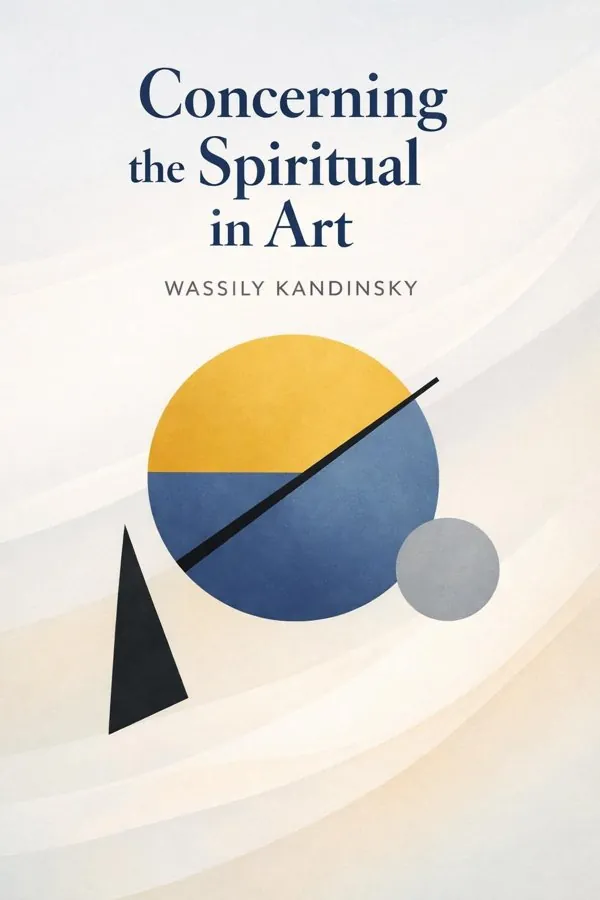
Concerning the Spiritual in Art: Summary & Key Insights
 10 min9 chaptersAudio available
What Is Concerning the Spiritual in Art About?
Concerning the Spiritual in Art by Wassily Kandinsky is a art_theory book spanning 9 pages. Concerning the Spiritual in Art is a foundational text in modern art theory by Wassily Kandinsky. In this work, Kandinsky explores the spiritual dimension of art, arguing that true art arises from an inner necessity of the artist and should evoke a spiritual resonance in the viewer. The book lays the theoretical groundwork for abstract art and discusses how colors and forms can produce emotional and spiritual effects.
This FizzRead summary covers all 9 key chapters of Concerning the Spiritual in Art in approximately 10 minutes, distilling the most important ideas, arguments, and takeaways from Wassily Kandinsky's work. Also available as an audio summary and Key Quotes Podcast.
Concerning the Spiritual in Art
Concerning the Spiritual in Art is a foundational text in modern art theory by Wassily Kandinsky. In this work, Kandinsky explores the spiritual dimension of art, arguing that true art arises from an inner necessity of the artist and should evoke a spiritual resonance in the viewer. The book lays the theoretical groundwork for abstract art and discusses how colors and forms can produce emotional and spiritual effects.
Who Should Read Concerning the Spiritual in Art?
This book is perfect for anyone interested in art_theory and looking to gain actionable insights in a short read. Whether you're a student, professional, or lifelong learner, the key ideas from Concerning the Spiritual in Art by Wassily Kandinsky will help you think differently.
- ✓Readers who enjoy art_theory and want practical takeaways
- ✓Professionals looking to apply new ideas to their work and life
- ✓Anyone who wants the core insights of Concerning the Spiritual in Art in just 10 minutes
Want the full summary?
Get instant access to this book summary and 100K+ more with Fizz Moment.
Get Free SummaryAvailable on App Store • Free to download
Key Chapters
Imagine a great triangle standing upright, slowly ascending through time. At its broad base dwell the masses, absorbed by material concerns, drawn to the tangible and the familiar. As one travels upward, the triangle narrows, and fewer souls inhabit each level. These are those who sense that there is more to life than what can be touched or measured—they aspire, they question. At the very apex stands the artist, almost alone, gazing into what others cannot yet perceive. The spiritual movement of humanity proceeds always upward along this triangle, but the artist, standing ahead, must first see what others will later come to feel.
To dwell at the upper tip is no enviable comfort. The artist bears misunderstanding, loneliness, sometimes even ridicule. And yet, it is from this solitude that the light emerges. The function of the artist is to lift the entire triangle toward the spiritual future, to reveal new visions that inspire ascent. In different epochs, the triangle’s movement may slow or quicken. At times it seems still, when materialism reigns; at other times it trembles with awakening. But always it moves upward, impelled by those few who listen to the dictates of the spirit rather than the demands of the marketplace.
To create art that leads is to create from necessity, not from ambition. The artist must neither flatter public taste nor replicate the past but point to what lies beyond, bearing witness to truths that the outer world has not yet named. Thus art becomes a prophetic act—the triangle’s very tip pressed against the yet-unseen future.
Every genuine work of art is born not from external compulsion but from an inner voice that insists on being heard. I call this the inner necessity—the spiritual engine that propels the artist’s work. It is this force that distinguishes art from mere decoration or technical exercise. Many painters can imitate nature with precision, reproducing its textures, its light, its forms. But art born of imitation merely reflects the external. True art must reveal the internal.
Inner necessity arises when the soul of the artist vibrates in response to something invisible yet profoundly alive. This vibration seeks expression, and painting becomes its language. Neither tradition nor technique can dictate this impulse; they can merely serve as instruments. One may paint a mountain, an abstract form, a single red square—it matters little. What matters is whether the form has emerged from inner compulsion and whether it carries within it the breath of spiritual life.
When I work, I never ask whether my painting corresponds to reality. I ask only whether it corresponds to my inner truth. The line that bends, the color that clashes, the rhythm that disturbs—they are all legitimate if they speak the language of necessity. Obedience to this inner law frees the artist from imitation, allowing art to resonate with the higher harmony of the cosmos. In that instant, the work ceases to be a picture—it becomes a living being.
+ 7 more chapters — available in the FizzRead app
All Chapters in Concerning the Spiritual in Art
About the Author
Wassily Kandinsky (1866–1944) was a Russian painter and art theorist, widely regarded as one of the pioneers of abstract art. He taught at the Bauhaus and influenced generations of artists through his writings on the spiritual and emotional power of color and form.
Get This Summary in Your Preferred Format
Read or listen to the Concerning the Spiritual in Art summary by Wassily Kandinsky anytime, anywhere. FizzRead offers multiple formats so you can learn on your terms — all free.
Available formats: App · Audio · PDF · EPUB — All included free with FizzRead
Download Concerning the Spiritual in Art PDF and EPUB Summary
Key Quotes from Concerning the Spiritual in Art
“Imagine a great triangle standing upright, slowly ascending through time.”
“Every genuine work of art is born not from external compulsion but from an inner voice that insists on being heard.”
Frequently Asked Questions about Concerning the Spiritual in Art
Concerning the Spiritual in Art by Wassily Kandinsky is a art_theory book that explores key ideas across 9 chapters. Concerning the Spiritual in Art is a foundational text in modern art theory by Wassily Kandinsky. In this work, Kandinsky explores the spiritual dimension of art, arguing that true art arises from an inner necessity of the artist and should evoke a spiritual resonance in the viewer. The book lays the theoretical groundwork for abstract art and discusses how colors and forms can produce emotional and spiritual effects.
You Might Also Like
Browse by Category
Ready to read Concerning the Spiritual in Art?
Get the full summary and 100K+ more books with Fizz Moment.