
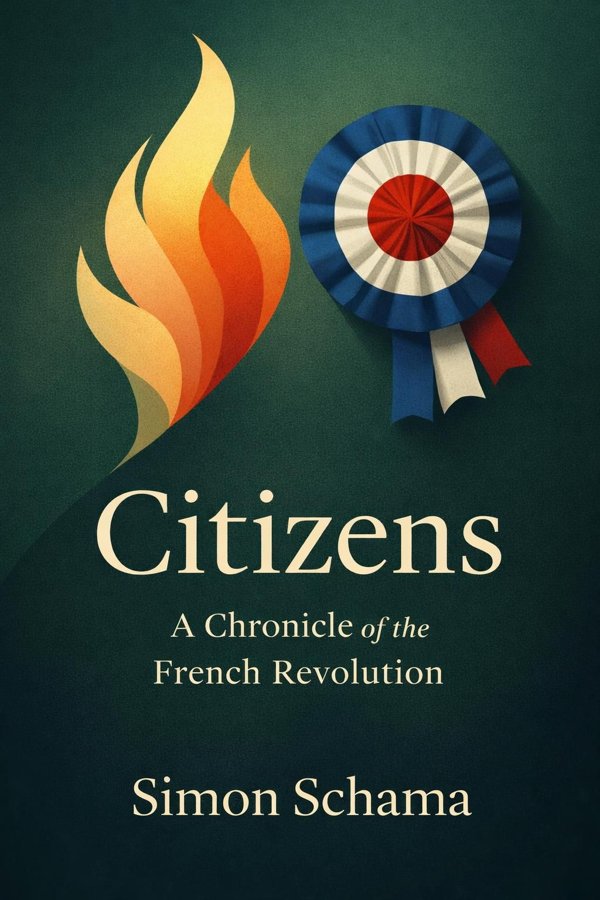
Citizens: A Chronicle of the French Revolution: Summary & Key Insights
by Simon Schama
 10 min8 chaptersAudio available
Key Takeaways from Citizens: A Chronicle of the French Revolution
History often gets reduced to iconic moments, but Schama insists that the French Revolution did not suddenly appear on 14 July 1789.
He challenges the comforting narrative that noble principles were later corrupted by extremists.
Politics became theater, and theater became politics.
A powerful feature of Citizens is Schama’s refusal to treat prerevolutionary France as a flat caricature of oppression waiting to be swept away.
The language of citizenship sounds inclusive, but Schama shows how quickly it can become selective, moralized, and coercive.
What Is Citizens: A Chronicle of the French Revolution About?
Citizens: A Chronicle of the French Revolution by Simon Schama is a general book. Simon Schama’s Citizens: A Chronicle of the French Revolution is not a simple retelling of one of history’s most famous upheavals. It is a sweeping, dramatic, and deeply argued account of how a movement launched in the name of liberty, citizenship, and national renewal became inseparable from violence, fear, and political theater. Rather than presenting the French Revolution as an inevitable march toward democracy, Schama examines the passions, symbols, ambitions, and brutal choices that drove events from reform to terror. He pays close attention to people as well as ideas: monarchs, journalists, lawyers, crowds, soldiers, and ordinary citizens pulled into extraordinary times. What makes this book matter is its challenge to comforting myths. Schama asks readers to confront whether violence was not merely an accident of the Revolution, but embedded in its political culture from the start. That argument makes the book provocative, memorable, and essential for anyone trying to understand modern politics, mass movements, or the dangers of moral certainty. A renowned historian and gifted storyteller, Schama combines archival depth with narrative force, making Citizens both a major work of scholarship and an engrossing historical drama.
This FizzRead summary covers all 8 key chapters of Citizens: A Chronicle of the French Revolution in approximately 10 minutes, distilling the most important ideas, arguments, and takeaways from Simon Schama's work. Also available as an audio summary and Key Quotes Podcast.
Citizens: A Chronicle of the French Revolution
Simon Schama’s Citizens: A Chronicle of the French Revolution is not a simple retelling of one of history’s most famous upheavals. It is a sweeping, dramatic, and deeply argued account of how a movement launched in the name of liberty, citizenship, and national renewal became inseparable from violence, fear, and political theater. Rather than presenting the French Revolution as an inevitable march toward democracy, Schama examines the passions, symbols, ambitions, and brutal choices that drove events from reform to terror. He pays close attention to people as well as ideas: monarchs, journalists, lawyers, crowds, soldiers, and ordinary citizens pulled into extraordinary times.
What makes this book matter is its challenge to comforting myths. Schama asks readers to confront whether violence was not merely an accident of the Revolution, but embedded in its political culture from the start. That argument makes the book provocative, memorable, and essential for anyone trying to understand modern politics, mass movements, or the dangers of moral certainty. A renowned historian and gifted storyteller, Schama combines archival depth with narrative force, making Citizens both a major work of scholarship and an engrossing historical drama.
Who Should Read Citizens: A Chronicle of the French Revolution?
This book is perfect for anyone interested in general and looking to gain actionable insights in a short read. Whether you're a student, professional, or lifelong learner, the key ideas from Citizens: A Chronicle of the French Revolution by Simon Schama will help you think differently.
- ✓Readers who enjoy general and want practical takeaways
- ✓Professionals looking to apply new ideas to their work and life
- ✓Anyone who wants the core insights of Citizens: A Chronicle of the French Revolution in just 10 minutes
Want the full summary?
Get instant access to this book summary and 100K+ more with Fizz Moment.
Get Free SummaryAvailable on App Store • Free to download
Key Chapters
History often gets reduced to iconic moments, but Schama insists that the French Revolution did not suddenly appear on 14 July 1789. Long before the storming of the Bastille, France had already been transformed by financial crisis, administrative reform, social resentment, and a growing public culture of criticism. The monarchy was not simply overthrown by starving masses; it had been weakened by war debts, fiscal paralysis, elite resistance, and its own inability to modernize authority without undermining itself. In Schama’s telling, the old regime was both fragile and surprisingly dynamic, trying to reform while provoking new expectations it could no longer contain.
This matters because it changes how we think about political collapse. Revolutions are rarely born in a single day. They build through cumulative failures: institutions lose credibility, leaders appear indecisive, and public debate becomes a stage for escalating demands. The calling of the Estates-General, the writing of cahiers de doleances, and the spread of pamphlets all widened political participation before the monarchy lost control on the streets. The Bastille became a symbol not because it caused the Revolution, but because it dramatized a legitimacy crisis already far advanced.
You can apply this insight beyond eighteenth-century France. In modern organizations, governments, or communities, breakdown usually follows a long period in which warning signs are ignored. Financial stress, poor communication, and conflicting expectations can make a system unstable long before a visible crisis erupts. Paying attention only to the explosive moment means missing the real causes.
Actionable takeaway: When evaluating any major disruption, look for the slow-building structural tensions behind the headline event instead of treating the final rupture as the true beginning.
One of Schama’s most controversial claims is also one of his most memorable: violence was not a tragic detour from the French Revolution’s ideals but a central element of its political energy from very early on. He challenges the comforting narrative that noble principles were later corrupted by extremists. Instead, he shows how public humiliation, intimidation, mob action, and bloodshed helped create revolutionary legitimacy. From the fall of the Bastille to the October Days and the murders of perceived enemies, force was not just reactive; it became performative, a way of proving who represented the people.
Schama does not deny the power of revolutionary ideals. Rather, he asks readers to see how those ideals became fused with coercion. If sovereignty belongs to the nation, then opponents can quickly be cast not as rivals but as traitors. Once politics becomes a moral struggle between virtue and conspiracy, violence becomes easier to justify. In that environment, moderation appears weak, due process appears suspicious, and killing can be reframed as purification.
This insight remains painfully relevant. In contemporary politics, movements of all kinds can begin with genuine grievances and still drift toward dehumanization when they divide the world into patriots and enemies. The language may be less bloody, but the logic is familiar: dissent is betrayal, pressure is justice, and escalation proves sincerity. Schama’s point is a warning against romanticizing any cause simply because its stated ideals sound uplifting.
A practical application is to examine how groups talk about opponents. Do they debate them, or do they strip them of legitimacy? Are emotional spectacles replacing institutions? These are signs that political conflict is moving into dangerous territory.
Actionable takeaway: Judge political movements not only by their ideals, but by the means they normalize and the enemies they create.
Schama shows that the French Revolution was fought not only in assemblies, ministries, and battlefields, but also in symbols, ceremonies, slogans, clothing, festivals, and public rituals. Politics became theater, and theater became politics. The cockade, the liberty cap, patriotic festivals, triumphal processions, newspapers, songs, and revolutionary iconography all helped define who belonged to the new order. This was not mere decoration. Public performance created emotional unity, signaled loyalty, and turned abstract principles into visible identity.
Why does this matter? Because people do not live by constitutions alone. They respond to stories, images, and communal drama. Schama argues that revolutionary leaders understood this and invested enormous energy in shaping public feeling. The nation had to be seen, enacted, celebrated, and defended. But spectacle had a darker side. Once politics becomes highly symbolic, outward signs of devotion can matter more than practical competence or thoughtful disagreement. A tricolor cockade or a shouted slogan may become tests of purity, while nuance starts to look suspect.
This dynamic is easy to recognize today. Modern politics is saturated with symbols: hashtags, rallies, visual branding, viral clips, patriotic displays, and ritual gestures. Public allegiance can become performative, rewarding intensity over understanding. Organizations experience similar patterns when culture becomes about signaling commitment rather than solving problems.
Schama’s insight encourages readers to ask what political spectacle accomplishes. Does it build shared civic purpose, or does it pressure people into conformity? Does it communicate values, or replace them with image management? Understanding this helps us become more critical consumers of public performance.
Actionable takeaway: Pay close attention to the symbols and rituals of any movement, because they often reveal its real values and methods more clearly than formal statements do.
A powerful feature of Citizens is Schama’s refusal to treat prerevolutionary France as a flat caricature of oppression waiting to be swept away. He depicts the old regime as unequal and often unjust, but also lively, reform-minded, commercially active, culturally innovative, and partially modernizing. France before 1789 was not frozen in medieval darkness. It had energetic urban life, ambitious administrators, Enlightenment debate, expanding consumer culture, and attempts at economic and political reform. This complexity matters because it undermines the easy story that Revolution brought modernity to a stagnant world.
Schama argues that the monarchy’s problem was not simply resistance to change. In many ways, it had already embraced change, but incompletely and inconsistently. Reforms raised hopes, disturbed established privileges, and exposed the state’s limitations. Elites who supported modernization often resisted losing power. The crown wanted efficiency without surrendering authority. As a result, reform destabilized the very order it was meant to save.
This broader lesson applies far beyond eighteenth-century France. Institutions often collapse not because they never change, but because they change unevenly. A company that digitizes operations without changing culture, or a government that expands participation without strengthening trust, can create frustration instead of stability. Transitional periods are especially volatile because expectations rise faster than institutions can respond.
Seeing complexity also helps readers resist simplistic moral binaries. Historical systems can be unjust and still contain real achievements. New regimes can promise emancipation and still produce catastrophe. Schama trains readers to think in layers rather than slogans.
Actionable takeaway: When assessing any failing institution, avoid assuming that reform and collapse are opposites; partial reform can actually intensify instability if expectations outrun capacity.
The language of citizenship sounds inclusive, but Schama shows how quickly it can become selective, moralized, and coercive. The Revolution introduced a thrilling idea: individuals would no longer be mere subjects of a king but members of a sovereign nation. This redefinition of political identity was transformative. It elevated public participation, tied rights to belonging, and turned the nation into a collective project. Yet the same concept also generated suspicion. If true citizens embody the nation, then those who disagree can be accused of being false citizens, hidden enemies, or internal conspirators.
Schama traces how the revolutionary celebration of active citizenship gradually hardened into scrutiny and exclusion. Loyalty had to be demonstrated. Neutrality became questionable. Religious nonconformity, political caution, aristocratic origin, or insufficient enthusiasm could all attract suspicion. Citizenship was therefore both empowering and disciplinary. It gave ordinary people a larger role in public life, but it also created a demanding civic identity that could punish ambiguity.
This tension is visible in modern democracies as well. Public belonging is often presented as shared freedom, but it can also be turned into a test of cultural conformity or ideological loyalty. In workplaces, teams, and communities, the language of belonging can inspire contribution while also marginalizing those who do not fit expected norms. Schama reminds us that collective identity is never neutral; it always raises the question of who gets to define the group.
A practical use of this idea is to examine how institutions invite participation. Do they make room for disagreement, minority perspectives, and gradual commitment? Or do they equate belonging with uniformity? Healthy citizenship requires space for difference.
Actionable takeaway: Defend forms of belonging that expand participation without demanding ideological sameness, because inclusion becomes dangerous when it depends on moral purity.
Schama portrays the French Revolution as a drama in which leaders repeatedly unleash forces they believe they can direct, only to discover that public emotion, factional competition, and escalating expectations outrun their plans. Reformers, journalists, monarchists, constitutionalists, and radicals all misjudged the speed and intensity of events. The monarchy tried to manage a fiscal crisis through political concessions and ended up exposing its weakness. Moderate revolutionaries sought constitutional balance but found themselves pressed by street politics and suspicion. Radicals mobilized popular energies to defeat enemies, then became trapped in cycles of purification they could not safely stop.
This is one of the book’s strongest lessons about political agency. Individuals matter, but they do not operate in a vacuum. Once authority becomes unstable and legitimacy is contested, every gesture can produce consequences far beyond intention. Words spoken to rally support may incite panic. Temporary emergency measures may become permanent habits. Public passions, once mobilized, rarely obey the scripts of those who summon them.
In practical terms, this insight applies to leadership in any high-pressure environment. Executives can stir internal competition to accelerate change and then find trust collapsing. Political actors can weaponize outrage and later discover that compromise has become impossible. Social movements can widen support through emotional messaging and then struggle to govern the intensity they helped generate.
Schama’s account cautions against overconfidence. Charisma, intelligence, and conviction do not guarantee control. Responsible leadership means anticipating second-order effects, preserving institutional brakes, and avoiding tactics that depend on continuous escalation.
Actionable takeaway: Before using outrage, fear, or dramatic confrontation as tools of leadership, ask whether you can still govern the consequences once others amplify them.
The Terror did not emerge from nowhere, and Schama’s analysis highlights a crucial driver: moral certainty. Once the Revolution increasingly defined itself as a struggle between virtue and corruption, patriotism and treason, survival and conspiracy, politics became an arena in which compromise looked dishonorable and mercy looked dangerous. Schama argues that this moral absolutism helped make extreme violence thinkable and then respectable. The guillotine was not merely an instrument of fear; it was defended as a tool of civic justice in a world where the nation was said to be surrounded by enemies within and without.
This is a chilling lesson because moral language often feels noble. People are most dangerous not when they think they are doing evil, but when they are convinced that cruelty is necessary for a higher good. Schama does not suggest that all strong convictions lead to terror. His point is subtler: when movements collapse complexity into righteousness versus treason, they create a climate in which procedural safeguards seem like obstacles to justice. Under those conditions, emergency measures expand, suspicion multiplies, and exceptional violence becomes normalized.
The modern relevance is obvious. In polarized settings, individuals and groups can come to believe that their cause is so urgent that ordinary rules no longer apply. Character assassination, censorship, intimidation, and institutional shortcuts are then rationalized as defensive necessities. The names change, but the psychology remains.
A useful practice is to pay attention whenever a cause insists that urgency overrides restraint. Ethical seriousness should produce humility, not fanatic certainty. Durable justice depends on institutions that protect rights even when emotions run hot.
Actionable takeaway: Treat any politics that presents opponents as inherently illegitimate and rules as dispensable as a warning sign of moral certainty turning into coercion.
One of Schama’s greatest achievements is his refusal to flatten the French Revolution into a morality play of villains and heroes. He resists both royalist nostalgia and revolutionary romanticism. Instead, he presents a world of mixed motives, unstable alliances, idealism, vanity, courage, cruelty, fear, and improvisation. Individuals who speak the language of liberty can endorse repression. Defenders of order can be blind, selfish, or incapable of reform. Crowds can act with genuine political purpose and with terrifying brutality. This complexity is not a flaw in the story; it is the story.
That approach matters because readers often seek reassurance from history. We want a clear side to admire and a clean lesson to apply. Schama denies us that comfort. By doing so, he offers something more valuable: historical maturity. Political crises are shaped by structural pressures, emotions, personalities, accidents, and narratives that no single theory can fully explain. The result is a chronicle that invites judgment without permitting simplification.
This has practical value in everyday civic life. When we read current events through simplistic templates, we become vulnerable to propaganda and disappointment. We overestimate good intentions, underestimate unintended consequences, and ignore the trade-offs built into real decisions. Schama models a more disciplined way of thinking: admire principles, but examine behavior; care about justice, but study means; recognize grievance, but track escalation.
For leaders, students, and citizens alike, this method is essential. It builds intellectual resilience against the seductive appeal of one-sided stories. History becomes less about choosing a camp and more about learning how power, belief, and fear interact.
Actionable takeaway: Whenever a political story seems too neat, pause and ask which motives, costs, and contradictions are being left out.
All Chapters in Citizens: A Chronicle of the French Revolution
About the Author
Simon Schama is a British historian, author, and broadcaster celebrated for his ability to combine rigorous scholarship with vivid, literary storytelling. Born in London in 1945, he studied at Cambridge and went on to teach at major institutions including Cambridge, Oxford, Harvard, and Columbia University. His work ranges widely across political history, art history, cultural memory, and identity, and he is known for bringing historical subjects to broad audiences through both books and television documentaries. Among his best-known works are Citizens, The Embarrassment of Riches, Landscape and Memory, and The Story of the Jews. Schama’s writing is marked by narrative energy, interpretive boldness, and a deep interest in how power, imagery, and human emotion shape historical events.
Get This Summary in Your Preferred Format
Read or listen to the Citizens: A Chronicle of the French Revolution summary by Simon Schama anytime, anywhere. FizzRead offers multiple formats so you can learn on your terms — all free.
Available formats: App · Audio · PDF · EPUB — All included free with FizzRead
Download Citizens: A Chronicle of the French Revolution PDF and EPUB Summary
Key Quotes from Citizens: A Chronicle of the French Revolution
“History often gets reduced to iconic moments, but Schama insists that the French Revolution did not suddenly appear on 14 July 1789.”
“He challenges the comforting narrative that noble principles were later corrupted by extremists.”
“Schama shows that the French Revolution was fought not only in assemblies, ministries, and battlefields, but also in symbols, ceremonies, slogans, clothing, festivals, and public rituals.”
“A powerful feature of Citizens is Schama’s refusal to treat prerevolutionary France as a flat caricature of oppression waiting to be swept away.”
“The language of citizenship sounds inclusive, but Schama shows how quickly it can become selective, moralized, and coercive.”
Frequently Asked Questions about Citizens: A Chronicle of the French Revolution
Citizens: A Chronicle of the French Revolution by Simon Schama is a general book that explores key ideas across 8 chapters. Simon Schama’s Citizens: A Chronicle of the French Revolution is not a simple retelling of one of history’s most famous upheavals. It is a sweeping, dramatic, and deeply argued account of how a movement launched in the name of liberty, citizenship, and national renewal became inseparable from violence, fear, and political theater. Rather than presenting the French Revolution as an inevitable march toward democracy, Schama examines the passions, symbols, ambitions, and brutal choices that drove events from reform to terror. He pays close attention to people as well as ideas: monarchs, journalists, lawyers, crowds, soldiers, and ordinary citizens pulled into extraordinary times. What makes this book matter is its challenge to comforting myths. Schama asks readers to confront whether violence was not merely an accident of the Revolution, but embedded in its political culture from the start. That argument makes the book provocative, memorable, and essential for anyone trying to understand modern politics, mass movements, or the dangers of moral certainty. A renowned historian and gifted storyteller, Schama combines archival depth with narrative force, making Citizens both a major work of scholarship and an engrossing historical drama.
You Might Also Like
Duct Tape Marketing: The World's Most Practical Small Business Marketing Guide
John Jantsch
10 minDusk, Night, Dawn: On Revival and Courage
Anne Lamott
10 minFinish Big: How Great Entrepreneurs Exit Their Companies on Top
Bo Burlingham
10 minFirst As Tragedy, Then As Farce
Slavoj Zizek
10 minFirst Principles: What America's Founders Learned from the Greeks and Romans and How That Shaped Our Country
Thomas E. Ricks
10 minGood Habits, Bad Habits: The Science of Making Positive Changes That Stick
Wendy Wood
10 minBrowse by Category
Ready to read Citizens: A Chronicle of the French Revolution?
Get the full summary and 100K+ more books with Fizz Moment.