
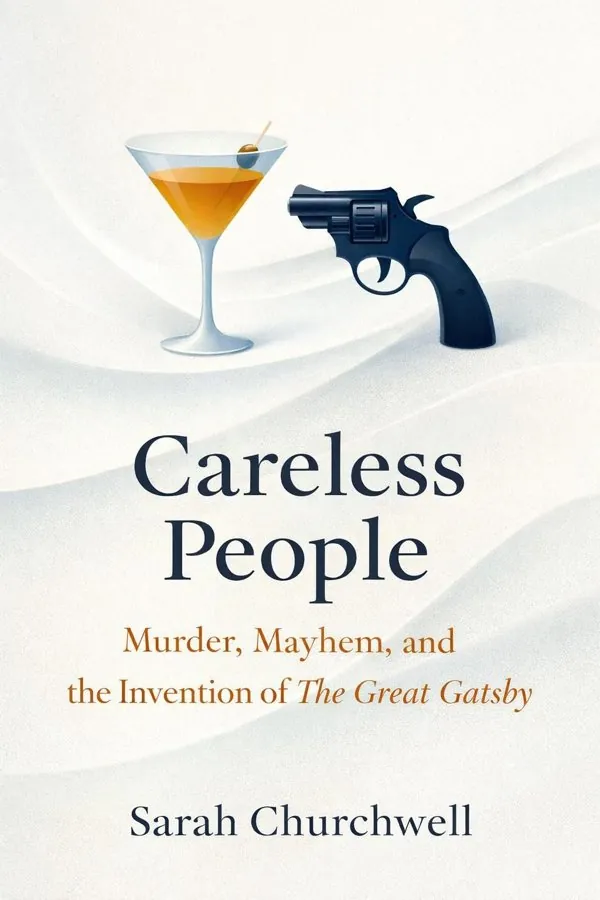
Careless People: Murder, Mayhem, and the Invention of The Great Gatsby: Summary & Key Insights
 10 min9 chaptersAudio available
Key Takeaways from Careless People: Murder, Mayhem, and the Invention of The Great Gatsby
Great novels often rise from moments when a culture is trying to convince itself that everything is fine.
Writers do not merely record their age; they translate it into stories that feel larger than life.
Sometimes a crime becomes important not only because of what happened, but because a society cannot stop staring at it.
A culture changes when its media stop reporting events and start staging them as emotional spectacles.
Masterpieces rarely arrive in a flash; they are built through persistence, dissatisfaction, and refinement.
What Is Careless People: Murder, Mayhem, and the Invention of The Great Gatsby About?
Careless People: Murder, Mayhem, and the Invention of The Great Gatsby by Sarah Churchwell is a literary_criticism book spanning 11 pages. Sarah Churchwell’s Careless People: Murder, Mayhem, and the Invention of The Great Gatsby is far more than a companion to Fitzgerald’s classic novel. It is a vivid reconstruction of 1922 America, a year buzzing with glamour, corruption, celebrity, sexual anxiety, tabloid obsession, and moral confusion. At the center of Churchwell’s study is a daring argument: The Great Gatsby did not emerge from imagination alone, but from a culture saturated with scandal, reinvention, and public spectacle. By placing Fitzgerald alongside the notorious Hall-Mills murder case and the media frenzy that followed, she shows how crime reporting, social performance, and the mythology of wealth helped shape one of the most enduring novels in American literature. What makes the book matter is its refusal to separate literary art from lived history. Churchwell reveals how Gatsby’s world of parties, gossip, class aspiration, and emotional carelessness was deeply rooted in the headlines and social tensions of its time. As a leading scholar of twentieth-century American literature, she brings both academic rigor and narrative energy, making this an illuminating read for anyone interested in Fitzgerald, the Jazz Age, or the hidden origins of literary masterpieces.
This FizzRead summary covers all 9 key chapters of Careless People: Murder, Mayhem, and the Invention of The Great Gatsby in approximately 10 minutes, distilling the most important ideas, arguments, and takeaways from Sarah Churchwell's work. Also available as an audio summary and Key Quotes Podcast.
Careless People: Murder, Mayhem, and the Invention of The Great Gatsby
Sarah Churchwell’s Careless People: Murder, Mayhem, and the Invention of The Great Gatsby is far more than a companion to Fitzgerald’s classic novel. It is a vivid reconstruction of 1922 America, a year buzzing with glamour, corruption, celebrity, sexual anxiety, tabloid obsession, and moral confusion. At the center of Churchwell’s study is a daring argument: The Great Gatsby did not emerge from imagination alone, but from a culture saturated with scandal, reinvention, and public spectacle. By placing Fitzgerald alongside the notorious Hall-Mills murder case and the media frenzy that followed, she shows how crime reporting, social performance, and the mythology of wealth helped shape one of the most enduring novels in American literature. What makes the book matter is its refusal to separate literary art from lived history. Churchwell reveals how Gatsby’s world of parties, gossip, class aspiration, and emotional carelessness was deeply rooted in the headlines and social tensions of its time. As a leading scholar of twentieth-century American literature, she brings both academic rigor and narrative energy, making this an illuminating read for anyone interested in Fitzgerald, the Jazz Age, or the hidden origins of literary masterpieces.
Who Should Read Careless People: Murder, Mayhem, and the Invention of The Great Gatsby?
This book is perfect for anyone interested in literary_criticism and looking to gain actionable insights in a short read. Whether you're a student, professional, or lifelong learner, the key ideas from Careless People: Murder, Mayhem, and the Invention of The Great Gatsby by Sarah Churchwell will help you think differently.
- ✓Readers who enjoy literary_criticism and want practical takeaways
- ✓Professionals looking to apply new ideas to their work and life
- ✓Anyone who wants the core insights of Careless People: Murder, Mayhem, and the Invention of The Great Gatsby in just 10 minutes
Want the full summary?
Get instant access to this book summary and 100K+ more with Fizz Moment.
Get Free SummaryAvailable on App Store • Free to download
Key Chapters
Great novels often rise from moments when a culture is trying to convince itself that everything is fine. Churchwell presents 1922 as exactly such a moment: dazzling on the surface, unsettled underneath. America had emerged from World War I with money, energy, and technological momentum, yet the country was also marked by disillusionment, social division, and a deep uncertainty about what modern life meant. Prohibition turned drinking into a fashionable rebellion. New wealth created the appearance of limitless possibility. Newspapers fed the public a daily diet of scandal, sensation, and spectacle. Beneath the glitter, however, lay fear about class change, sexual freedom, immigration, race, crime, and the erosion of older moral codes.
This setting matters because Churchwell argues that The Great Gatsby is not simply about individual longing or romantic failure. It is a novel born from a culture that celebrated excess while dreading its consequences. Gatsby’s parties, Daisy’s allure, Tom’s aggression, and Nick’s uneasy fascination all make more sense when viewed against a society intoxicated by novelty and haunted by instability. Fitzgerald was not inventing a symbolic dreamscape from nowhere; he was distilling the emotional weather of his time.
A practical way to apply this insight is to read literature historically rather than abstractly. When a novel feels timeless, ask what very specific pressures made it possible. In classrooms, book clubs, or personal reading, pairing fiction with newspapers, advertisements, and public scandals from the same year can radically deepen interpretation.
Actionable takeaway: Read Gatsby not as a detached classic, but as a compressed portrait of 1922 America’s thrill, dread, and moral confusion.
Writers do not merely record their age; they translate it into stories that feel larger than life. In 1922, F. Scott Fitzgerald was young, famous, ambitious, and restless. Churchwell shows him at a career crossroads: celebrated for This Side of Paradise, yet determined to prove he could write something more durable and artistically serious. He and Zelda Fitzgerald were already public figures, living as both participants in and symbols of the Jazz Age. Their marriage, social life, financial instability, and hunger for status all fed Fitzgerald’s imagination.
Churchwell emphasizes that Fitzgerald’s life was not simply background to his work. It supplied him with emotional patterns, social observations, and recurring contradictions: attraction to wealth mixed with contempt for it, fascination with glamour mixed with awareness of its emptiness, and the desire for reinvention paired with the knowledge that the past never disappears. These tensions became the architecture of Gatsby. Fitzgerald understood what it meant to long for admission into worlds that simultaneously repelled and seduced him.
This idea is useful beyond literary biography. It reminds readers and aspiring writers that creative work often comes from pressure points in one’s life rather than from detached inspiration. Personal instability, ambition, envy, love, and insecurity can become material when shaped with intelligence and form. The key is transformation, not confession.
For readers, Churchwell’s account also offers a method: when studying a writer, look for the recurring emotional dilemmas that migrate from life into art. In Fitzgerald’s case, status anxiety and self-invention are not side notes; they are central motifs.
Actionable takeaway: When reading an author, identify the personal contradictions they repeatedly turn into narrative power.
Sometimes a crime becomes important not only because of what happened, but because a society cannot stop staring at it. Churchwell uses the Hall-Mills murder case as one of the book’s most revealing anchors. In 1922, the deaths of minister Edward Hall and choir singer Eleanor Mills became a sensational national obsession. The case involved illicit romance, class tension, conflicting testimony, public voyeurism, and endless speculation. It seemed to expose the rot beneath respectable appearances, which is precisely why it captivated so many Americans.
Churchwell’s point is not that Fitzgerald copied the case directly into The Great Gatsby. Instead, she demonstrates how the murder and its lurid afterlife helped define a cultural atmosphere in which adultery, wealth, performance, and spectacle were inseparable. The case dramatized a world where private desire became public entertainment and where truth was distorted by gossip, status, and media appetite. Those are also central conditions of Gatsby’s universe. Characters in the novel are constantly watched, interpreted, misrepresented, and consumed as social stories.
The Hall-Mills case also reveals how scandal works as a form of collective storytelling. Facts become secondary to what people want a story to mean. That insight applies powerfully today, in an age of viral outrage and true-crime obsession. Public narratives are shaped not only by evidence but by fantasy, prejudice, and emotional need.
Readers can apply this by paying attention to the social uses of scandal. Ask not just what a public controversy is about, but why certain details become irresistible. What anxieties does the story allow people to act out? Why do some crimes become myths while others disappear?
Actionable takeaway: Treat sensational cases as mirrors of cultural desire, fear, and prejudice, not just as isolated events.
A culture changes when its media stop reporting events and start staging them as emotional spectacles. Churchwell shows that 1920s journalism helped create the very atmosphere Gatsby captures. Newspapers were becoming faster, louder, more competitive, and more invested in sensation. Crime, sex, wealth, and impropriety sold papers. The Hall-Mills case became an ideal media product because it offered all of them at once. Journalists amplified rumors, repeated vivid details, and transformed uncertain evidence into public drama.
This media environment matters because it shaped how Americans imagined themselves. Public identity became increasingly performative. Reputation could be made or destroyed through headlines. Respectability became theatrical, and scandal became mass entertainment. Churchwell links this directly to Fitzgerald’s world, where image often matters more than truth. Gatsby is almost entirely a media creation within the novel before he becomes a person: people know him through whispers, embellishments, and invented histories.
The practical application is strikingly contemporary. Social media has intensified dynamics already visible in the 1920s: rumor spreads faster than verification, spectacle outruns substance, and audiences help produce the stories they claim merely to consume. Churchwell’s historical account makes modern readers more alert to how platforms reward exaggeration and emotional charge.
For students of literature, this also deepens Gatsby’s themes. Gossip in the novel is not incidental background; it is a structural force. Characters are assembled out of narrative fragments circulating in their social world. To understand Gatsby, we must understand the age’s machinery of publicity.
Actionable takeaway: Notice how media forms shape character, truth, and power in both literature and everyday life.
Masterpieces rarely arrive in a flash; they are built through persistence, dissatisfaction, and refinement. Churchwell follows Fitzgerald as he moved toward The Great Gatsby, showing that the novel was not simply inspired by the Jazz Age but painstakingly wrestled into form. He was trying to write something leaner, sharper, and more controlled than his earlier work. That meant stripping away excess, concentrating symbolism, and finding a structure capable of holding glamour and ruin at once.
Churchwell’s account highlights the labor behind literary elegance. Fitzgerald experimented with titles, struggled over emphasis, and kept searching for the right balance between social satire and emotional tragedy. The final novel feels effortless partly because so much effort went into its compression. Gatsby’s brevity is deceptive; behind it lies a dense matrix of observation, historical detail, and thematic coordination.
This idea offers an important lesson for writers, creators, and professionals of any kind. Cultural brilliance is often romanticized as pure talent, but Churchwell reminds us that ambition requires revision. Fitzgerald’s achievement was not merely that he had a compelling subject. It was that he recognized the need to reshape raw material until it became art.
Readers can apply this by revisiting polished works with attention to what has been left out. Ask why a scene is brief, why a description feels exact, or why a symbol returns with such force. In creative practice, the implication is equally useful: clarity often comes from cutting, not adding.
Actionable takeaway: Study Gatsby as proof that great work depends on disciplined revision as much as inspiration.
An era reveals itself by what it teaches people to want. Churchwell portrays the Jazz Age as a period in which the American Dream was increasingly tied to display, speed, and visible abundance. Success was no longer just about security or hard work; it was about style, access, and the ability to project a desirable self. In that climate, wealth became theatrical. Possession had to be seen. Reinvention became a national fantasy, especially for those trying to cross class boundaries.
Gatsby embodies this distorted dream. He believes money can produce not just comfort but identity, legitimacy, and even the recovery of lost time. Churchwell situates that fantasy in a broader historical shift. Postwar consumer culture and Prohibition-era illegality created a world where fortunes could appear suddenly, respectability could be purchased, and moral boundaries seemed negotiable. Yet the dream remained rigged by old class structures. The gates looked open, but true acceptance still depended on birth, pedigree, and social codes.
This insight has obvious modern relevance. Many contemporary versions of success still revolve around branding, luxury, and the performance of upward mobility. We continue to ask wealth to solve existential problems it cannot solve. Churchwell helps readers see Gatsby not as an outdated cautionary tale but as an enduring diagnosis of aspiration under capitalism.
A practical application is to question the stories attached to achievement. When we pursue a status marker, are we seeking usefulness, admiration, belonging, or emotional repair? Gatsby fails because he confuses material power with human meaning.
Actionable takeaway: Examine whether your idea of success reflects genuine values or inherited fantasies of status and display.
Modernity did not free people from social roles; it often made those roles more theatrical. Churchwell pays close attention to how gender, power, and class operated in the world surrounding Gatsby. The 1920s promised liberation through flapper culture, changing sexual norms, and new public freedoms for women. But those freedoms were uneven, conditional, and often filtered through male fantasy or media caricature. At the same time, upper-class identity remained guarded through manners, speech, taste, and the subtle codes of exclusion.
In Gatsby, these pressures are everywhere. Daisy is not simply shallow; she is a woman shaped by a culture that values her beauty and charm while limiting her agency. Myrtle reaches upward through sexuality and display but is destroyed by class power. Tom wields entitlement as if it were nature. Gatsby tries to master the performance of gentility, yet his origins remain visible to those invested in preserving hierarchy.
Churchwell’s broader contribution is to show that identity in this era was neither wholly authentic nor wholly fake. It was negotiated through repeated acts of performance under unequal conditions. That makes the novel richer and more unsettling. Characters are judged not only by who they are but by how convincingly they occupy their assigned or desired roles.
Readers can apply this by paying more attention to the social scripts in both fiction and life. How much of confidence, femininity, masculinity, prestige, or sophistication is enacted rather than innate? Which performances are rewarded, and who gets punished for attempting them?
Actionable takeaway: Read social identity as a performance shaped by power, and notice who is allowed to perform successfully.
Cultural value is often recognized slowly, and sometimes a work must outlive its moment to be fully seen. Churchwell traces not only the making of The Great Gatsby but also its initial reception and long afterlife. When it appeared in 1925, the novel was admired by some critics but did not immediately become the monumental text it is now. Fitzgerald wanted both artistic triumph and broad success, yet Gatsby’s early impact was more muted than later mythology suggests.
This delayed recognition matters because it reminds us that classics are not born fully crowned. Their status emerges through changing readers, institutions, and historical needs. Gatsby eventually became central to American literary culture because later generations found in it a language for aspiration, corruption, nostalgia, and national self-deception. Churchwell’s study effectively explains why the novel kept growing in importance: it captured not just the 1920s but a repeating pattern in American life.
The same is true of Churchwell’s own method. By reconstructing the forgotten or dimly remembered world around the novel, she changes how we understand both the text and its endurance. Literary history is not static; interpretation evolves as scholars recover contexts and ask new questions.
This has a practical lesson for readers and creators. First impressions, sales numbers, and contemporary buzz do not settle a work’s worth. Some books need time because they speak most clearly when history catches up to them. Likewise, readers should allow room for reevaluation rather than assuming consensus equals truth.
Actionable takeaway: Treat literary reputation as historically made, and revisit works whose significance may deepen over time.
All Chapters in Careless People: Murder, Mayhem, and the Invention of The Great Gatsby
About the Author
Sarah Churchwell is an American academic, critic, and author known for her work on modern American literature and culture. She has served as Professor of American Literature and Public Understanding of the Humanities at the University of London and has built a reputation for making scholarly ideas accessible to general readers. Her writing often explores the intersection of literature, celebrity, politics, and national mythology, with notable work on F. Scott Fitzgerald and Marilyn Monroe. In Careless People, Churchwell brings together archival research, literary analysis, and cultural history to illuminate the world that produced The Great Gatsby. Her combination of academic rigor and narrative clarity has made her an influential voice in contemporary literary criticism.
Get This Summary in Your Preferred Format
Read or listen to the Careless People: Murder, Mayhem, and the Invention of The Great Gatsby summary by Sarah Churchwell anytime, anywhere. FizzRead offers multiple formats so you can learn on your terms — all free.
Available formats: App · Audio · PDF · EPUB — All included free with FizzRead
Download Careless People: Murder, Mayhem, and the Invention of The Great Gatsby PDF and EPUB Summary
Key Quotes from Careless People: Murder, Mayhem, and the Invention of The Great Gatsby
“Great novels often rise from moments when a culture is trying to convince itself that everything is fine.”
“Writers do not merely record their age; they translate it into stories that feel larger than life.”
“Sometimes a crime becomes important not only because of what happened, but because a society cannot stop staring at it.”
“A culture changes when its media stop reporting events and start staging them as emotional spectacles.”
“Masterpieces rarely arrive in a flash; they are built through persistence, dissatisfaction, and refinement.”
Frequently Asked Questions about Careless People: Murder, Mayhem, and the Invention of The Great Gatsby
Careless People: Murder, Mayhem, and the Invention of The Great Gatsby by Sarah Churchwell is a literary_criticism book that explores key ideas across 9 chapters. Sarah Churchwell’s Careless People: Murder, Mayhem, and the Invention of The Great Gatsby is far more than a companion to Fitzgerald’s classic novel. It is a vivid reconstruction of 1922 America, a year buzzing with glamour, corruption, celebrity, sexual anxiety, tabloid obsession, and moral confusion. At the center of Churchwell’s study is a daring argument: The Great Gatsby did not emerge from imagination alone, but from a culture saturated with scandal, reinvention, and public spectacle. By placing Fitzgerald alongside the notorious Hall-Mills murder case and the media frenzy that followed, she shows how crime reporting, social performance, and the mythology of wealth helped shape one of the most enduring novels in American literature. What makes the book matter is its refusal to separate literary art from lived history. Churchwell reveals how Gatsby’s world of parties, gossip, class aspiration, and emotional carelessness was deeply rooted in the headlines and social tensions of its time. As a leading scholar of twentieth-century American literature, she brings both academic rigor and narrative energy, making this an illuminating read for anyone interested in Fitzgerald, the Jazz Age, or the hidden origins of literary masterpieces.
Browse by Category
Ready to read Careless People: Murder, Mayhem, and the Invention of The Great Gatsby?
Get the full summary and 100K+ more books with Fizz Moment.