
Thomas C. Schelling Books
Thomas Crombie Schelling (1921–2016) was an American economist and professor known for his pioneering work in game theory and complex social systems. He taught at Harvard University and the University of Maryland and received the Nobel Prize in Economic Sciences in 2005 for his contributions to understanding conflict and cooperation through game-theoretic analysis.
Known for: The Strategy of Conflict
Books by Thomas C. Schelling
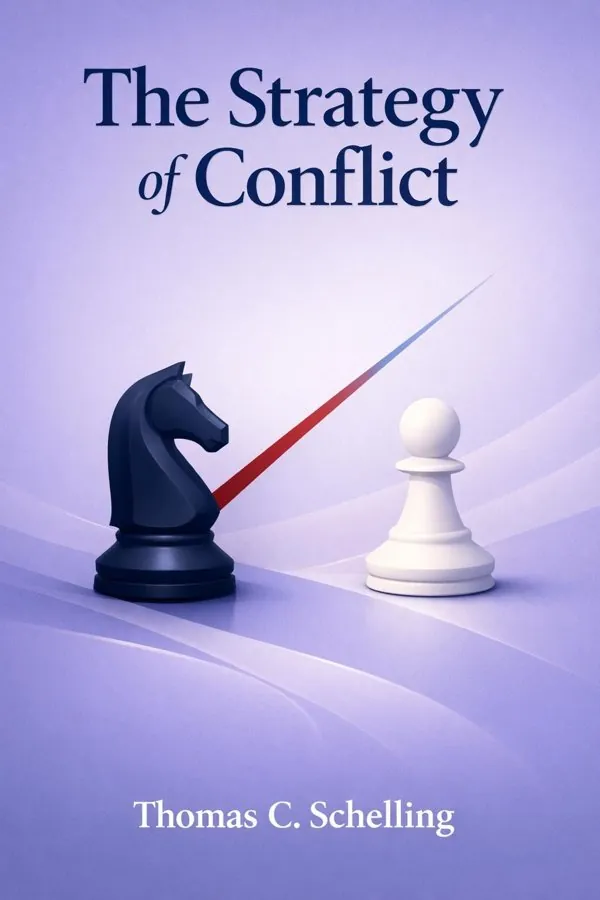
The Strategy of Conflict
Conflict is often imagined as a clash of brute force, but Thomas C. Schelling shows that it is just as much a contest of expectations, communication, restraint, and calculated risk. In The Strategy of Conflict, Schelling transformed the study of strategy by applying game theory not only to war and diplomacy, but also to bargaining, negotiation, business rivalry, and everyday situations in which people need to anticipate one another’s moves. His core insight is simple yet profound: in many conflicts, opponents are not purely enemies. They are interdependent actors whose choices shape each other’s outcomes, creating room for threats, promises, bargaining, tacit coordination, and mutual accommodation. This book matters because it explains how power works when direct control is impossible. Instead of asking only who is stronger, Schelling asks who can commit, who can signal resolve, who can influence expectations, and who can make a threat believable. These ideas became foundational in nuclear strategy and international relations, but they remain equally relevant to labor disputes, pricing battles, political standoffs, and personal negotiations. Written by Nobel Prize–winning economist Thomas C. Schelling, this classic remains one of the clearest and most original guides to strategic thinking ever written.
Read SummaryKey Insights from Thomas C. Schelling
Strategy Begins with Interdependence
The most important fact about conflict is that your success depends on the other side’s choices as much as your own. Schelling argues that strategy is not simply about selecting the best independent action. It is about acting in situations where every meaningful move changes what others are likely t...
From The Strategy of Conflict
Mixed Motives Create Room for Bargaining
Conflicts become manageable the moment you realize that enemies often need each other. Schelling’s great contribution is to emphasize that most strategic situations are neither pure cooperation nor pure competition. They are mixed-motive games, where people simultaneously share and oppose interests....
From The Strategy of Conflict
Threats Work Only When Believable
A threat that no one expects you to carry out has no strategic value. Schelling distinguishes between deterrence and compellence to show how coercion actually functions. Deterrence aims to prevent an action by making the cost of taking it too high. Compellence aims to force an action by pressuring s...
From The Strategy of Conflict
Commitments Can Create Strategic Power
One of Schelling’s most paradoxical insights is that giving up choices can make you stronger. In ordinary thinking, flexibility seems like an advantage. But in strategic conflict, the ability to commit yourself—to remove options, lock in a course, or make retreat costly—can increase your bargaining ...
From The Strategy of Conflict
Focal Points Guide Coordination Without Agreement
People often coordinate successfully without discussion because some solutions simply stand out. Schelling called these naturally salient solutions focal points. When individuals must align their choices without direct communication, they tend to gravitate toward options that seem prominent, simple,...
From The Strategy of Conflict
Risk and Uncertainty Are Strategic Tools
Sometimes the most powerful threat is not a definite promise of harm, but a deliberate increase in the risk of disaster. Schelling famously argued that strategic conflict often involves the manipulation of risk rather than direct control of outcomes. In crises, one side may not be able to dictate ev...
From The Strategy of Conflict
About Thomas C. Schelling
Thomas Crombie Schelling (1921–2016) was an American economist and professor known for his pioneering work in game theory and complex social systems. He taught at Harvard University and the University of Maryland and received the Nobel Prize in Economic Sciences in 2005 for his contributions to unde...
Read more
Thomas Crombie Schelling (1921–2016) was an American economist and professor known for his pioneering work in game theory and complex social systems. He taught at Harvard University and the University of Maryland and received the Nobel Prize in Economic Sciences in 2005 for his contributions to unde...
Thomas Crombie Schelling (1921–2016) was an American economist and professor known for his pioneering work in game theory and complex social systems. He taught at Harvard University and the University of Maryland and received the Nobel Prize in Economic Sciences in 2005 for his contributions to understanding conflict and cooperation through game-theoretic analysis.
Frequently Asked Questions
Thomas Crombie Schelling (1921–2016) was an American economist and professor known for his pioneering work in game theory and complex social systems. He taught at Harvard University and the University of Maryland and received the Nobel Prize in Economic Sciences in 2005 for his contributions to understanding conflict and cooperation through game-theoretic analysis.
Read Thomas C. Schelling's books in 15 minutes
Get AI-powered summaries with key insights from 1 book by Thomas C. Schelling.