
Primo Levi Books
Primo Levi (1919–1987) was an Italian Jewish writer and chemist, best known for his works on the Holocaust and human condition. A survivor of Auschwitz, Levi dedicated his life to bearing witness through literature, combining scientific insight with moral reflection.
Known for: The Periodic Table
Books by Primo Levi
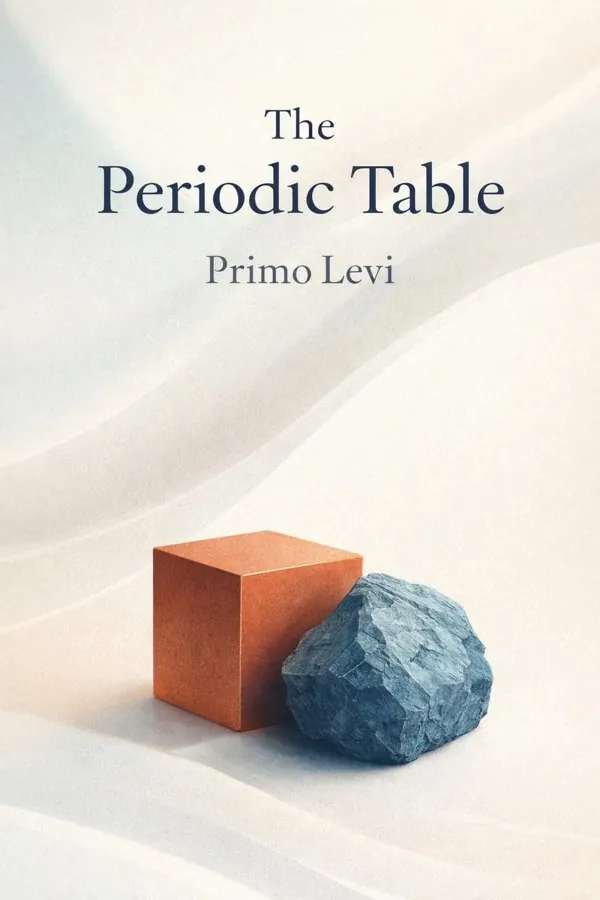
The Periodic Table
Primo Levi’s The Periodic Table is a rare kind of classic: intellectually rigorous, emotionally exact, and deeply humane. First published in 1975, it consists of twenty-one linked pieces, each named after a chemical element and tied to a stage of Levi’s life, his work as a chemist, his Jewish upbringing in Turin, and his survival of Auschwitz. The result is neither a conventional memoir nor a simple collection of stories. It is a book about how matter behaves, how memory endures, and how character is tested under pressure. What makes the book extraordinary is Levi’s ability to move between laboratory precision and moral reflection without losing either clarity or feeling. Chemistry is never just decoration here. Elements become lenses through which he examines family inheritance, youthful curiosity, friendship, work, danger, suffering, and survival. Levi writes with the authority of someone who understood substances in the lab and human beings in extremity. As a Holocaust survivor, a trained chemist, and one of the twentieth century’s greatest witnesses, he offers a vision of life in which science and literature illuminate one another. The Periodic Table matters because it shows that even in broken times, attention, intelligence, and memory can preserve human dignity.
Read SummaryKey Insights from Primo Levi
Argon and the Inheritance of Distance
Identity often feels less like a declaration than an atmosphere we inherit before we can name it. Levi begins with Argon, the noble gas, because its chemical inertness mirrors the secluded, self-contained world of his Piedmontese Jewish ancestors. They are not dramatic heroes or grand philosophers. ...
From The Periodic Table
Hydrogen and the Spark of Curiosity
The beginning of a vocation is often a small controlled explosion. In Hydrogen, Levi recalls youthful experiments and the exhilaration of discovering that matter is not passive but full of hidden energy. Hydrogen, the lightest and simplest element, becomes a symbol of intellectual youth: volatile, e...
From The Periodic Table
Zinc and the Value of Resistance
Progress does not happen in a perfectly smooth world; it often begins where something refuses to yield. In Zinc, Levi reflects on a metal that seems dull and unremarkable, yet its very resistance helps reveal an essential truth: impurities and irregularities make reactions possible. Pure systems can...
From The Periodic Table
Iron and the Temper of Friendship
Character is easiest to admire in theory and hardest to recognize in the ordinary work of living. In Iron, Levi recounts his friendship with Sandro, a young man whose toughness, integrity, and physical confidence become a model of human strength. Iron is the perfect emblem: strong, practical, and fo...
From The Periodic Table
Potassium and the Discipline of Precision
A tiny error can separate mastery from disaster. In Potassium, Levi describes the dangers of handling reactive substances and the unforgiving exactness required in chemical work. Potassium reacts violently under the wrong conditions, making it a symbol of a broader truth: reality does not negotiate ...
From The Periodic Table
Cerium and Survival Through Ingenuity
Under extreme conditions, intelligence becomes a form of bread. In Cerium, one of the book’s most memorable chapters, Levi recounts how his knowledge of chemistry helped him survive in Auschwitz. By extracting cerium from laboratory scraps and fashioning it into flints for cigarette lighters, he was...
From The Periodic Table
About Primo Levi
Primo Levi (1919–1987) was an Italian Jewish writer and chemist, best known for his works on the Holocaust and human condition. A survivor of Auschwitz, Levi dedicated his life to bearing witness through literature, combining scientific insight with moral reflection. His works, including 'If This Is...
Read more
Primo Levi (1919–1987) was an Italian Jewish writer and chemist, best known for his works on the Holocaust and human condition. A survivor of Auschwitz, Levi dedicated his life to bearing witness through literature, combining scientific insight with moral reflection. His works, including 'If This Is...
Primo Levi (1919–1987) was an Italian Jewish writer and chemist, best known for his works on the Holocaust and human condition. A survivor of Auschwitz, Levi dedicated his life to bearing witness through literature, combining scientific insight with moral reflection. His works, including 'If This Is a Man' and 'The Periodic Table,' are considered classics of twentieth-century literature.





Frequently Asked Questions
Primo Levi (1919–1987) was an Italian Jewish writer and chemist, best known for his works on the Holocaust and human condition. A survivor of Auschwitz, Levi dedicated his life to bearing witness through literature, combining scientific insight with moral reflection.
Read Primo Levi's books in 15 minutes
Get AI-powered summaries with key insights from 1 book by Primo Levi.