
Christof Koch Books
Christof Koch is a German-American neuroscientist known for his pioneering work on the neural basis of consciousness. He served as Chief Scientist and President of the Allen Institute for Brain Science and has collaborated extensively with Francis Crick.
Known for: The Feeling of Life Itself: Why Consciousness Is Widespread but Can't Be Computed
Books by Christof Koch
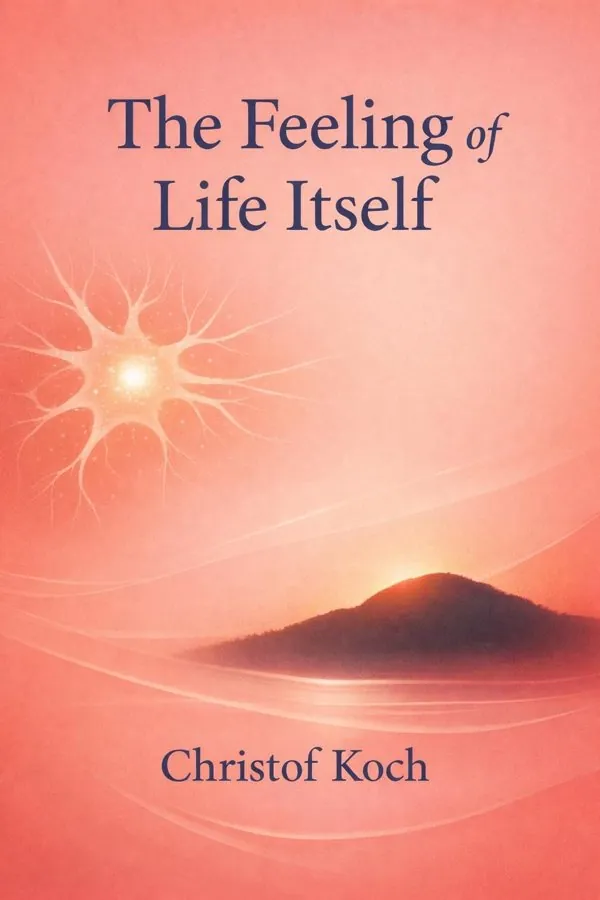
The Feeling of Life Itself: Why Consciousness Is Widespread but Can't Be Computed
What if consciousness is not a rare miracle found only in human minds, but a basic feature of life woven throughout the animal world? In The Feeling of Life Itself, neuroscientist Christof Koch explores one of the deepest questions in science and philosophy: why subjective experience exists at all. He argues that consciousness is real, measurable, and more widespread than many people assume, yet it cannot be reduced to mere computation or simulated by shuffling symbols in a machine. Drawing on decades of research in neuroscience, brain imaging, perception, and the science of awareness, Koch offers a bold but disciplined framework for thinking about the mind. He is not speculating from the sidelines. As a leading consciousness researcher and former chief scientist of the Allen Institute for Brain Science, Koch has spent his career studying the neural basis of experience. This book matters because it challenges both simplistic materialism and hype around artificial intelligence, while giving readers a serious scientific lens for understanding what it means to feel, perceive, and be a conscious self in the world.
Read SummaryKey Insights from Christof Koch
Consciousness Is a Fact Before Theory
Before we explain consciousness, we have to admit the obvious: experience is the most certain thing we know. You can doubt the external world, doubt memory, and even doubt logic for a moment, but you cannot doubt that there is something it feels like to be you right now. Koch begins from this first-...
From The Feeling of Life Itself: Why Consciousness Is Widespread but Can't Be Computed
The Brain Generates Experience Through Structure
Not all neural activity is equal. Koch argues that consciousness depends less on raw brain size or sheer computation and more on how a system is organized and causally integrated. A brain is not conscious simply because it processes information quickly. It is conscious because its internal structure...
From The Feeling of Life Itself: Why Consciousness Is Widespread but Can't Be Computed
Integrated Information Offers a New Framework
One of Koch's central commitments is Integrated Information Theory, or IIT, developed primarily by Giulio Tononi and championed by Koch as a serious scientific account of consciousness. The theory begins from phenomenology—from what consciousness is like—and then asks what physical properties a syst...
From The Feeling of Life Itself: Why Consciousness Is Widespread but Can't Be Computed
Consciousness Extends Beyond Human Minds
A powerful implication of Koch's view is that consciousness is likely widespread in nature. If subjective experience depends on certain kinds of organized causal structure rather than on human language or abstract reasoning, then many animals may possess some degree of consciousness. The octopus nav...
From The Feeling of Life Itself: Why Consciousness Is Widespread but Can't Be Computed
Machines May Simulate Without Feeling
One of the book's most provocative claims is that consciousness cannot be computed in the ordinary sense. Koch does not deny that machines can perform astonishing tasks. They can translate languages, recognize images, generate text, beat champions at games, and imitate human conversation. But none o...
From The Feeling of Life Itself: Why Consciousness Is Widespread but Can't Be Computed
The Self Is Real but Constructed
Much of what we call the self feels stable, central, and indivisible, yet neuroscience reveals a more dynamic picture. Koch presents the self not as a mystical soul detached from biology, but as a constructed model generated by the brain. This model integrates bodily sensations, memory, goals, socia...
From The Feeling of Life Itself: Why Consciousness Is Widespread but Can't Be Computed
About Christof Koch
Christof Koch is a German-American neuroscientist known for his pioneering work on the neural basis of consciousness. He served as Chief Scientist and President of the Allen Institute for Brain Science and has collaborated extensively with Francis Crick. Koch’s research focuses on the biological ori...
Read more
Christof Koch is a German-American neuroscientist known for his pioneering work on the neural basis of consciousness. He served as Chief Scientist and President of the Allen Institute for Brain Science and has collaborated extensively with Francis Crick. Koch’s research focuses on the biological ori...
Christof Koch is a German-American neuroscientist known for his pioneering work on the neural basis of consciousness. He served as Chief Scientist and President of the Allen Institute for Brain Science and has collaborated extensively with Francis Crick. Koch’s research focuses on the biological origins and mechanisms of conscious experience.


Frequently Asked Questions
Christof Koch is a German-American neuroscientist known for his pioneering work on the neural basis of consciousness. He served as Chief Scientist and President of the Allen Institute for Brain Science and has collaborated extensively with Francis Crick.
Read Christof Koch's books in 15 minutes
Get AI-powered summaries with key insights from 1 book by Christof Koch.