

Viktor Frankl Books
Viktor E. Frankl (1905–1997) was an Austrian neurologist, psychiatrist, and Holocaust survivor.
Known for: Man's Search for Meaning
Books by Viktor Frankl
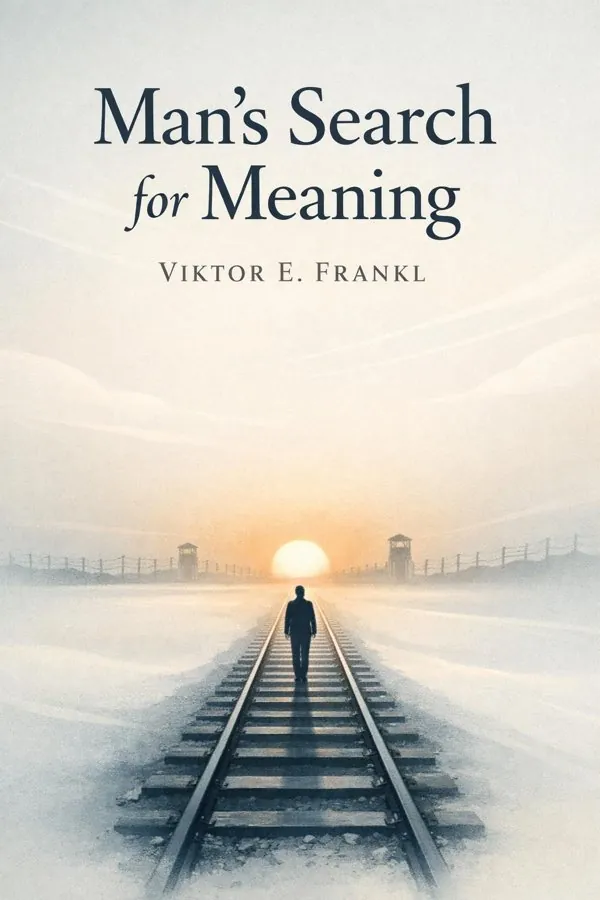
Man's Search for Meaning
What keeps a person going when everything familiar has been taken away—comfort, identity, loved ones, freedom, and even the expectation of tomorrow? That is the unbearable and essential question at the heart of *Man's Search for Meaning*. Viktor E. Frankl’s landmark book is far more than a Holocaust memoir. It is a profound study of human endurance, an examination of suffering, and a practical philosophy for anyone trying to live with purpose in hard times. Drawing on his experiences in Nazi concentration camps, Frankl explores how people respond when life is reduced to its barest terms and why some still manage to preserve dignity, hope, and inner freedom. What makes this book endure is that Frankl does not offer empty inspiration. He writes as an Austrian neurologist, psychiatrist, and Holocaust survivor who later developed logotherapy, a school of psychotherapy centered on meaning as the primary human motivation. His insight is simple but life-changing: even when we cannot change our circumstances, we can still choose our response. That idea has made this book one of the most influential works in psychology and self-help, especially for readers facing grief, burnout, uncertainty, or the quiet fear that life has lost direction.
Read SummaryKey Insights from Viktor Frankl
The Shock of Arrival and the Dehumanization of Camp Life
When Frankl first arrived at Auschwitz, the destruction of the self began immediately. The process was systematic: prisoners were separated, stripped, shaved, robbed of belongings, and reduced to numbers. This was not only physical brutality; it was psychological warfare. The camp existed to erase p...
From Man's Search for Meaning
Emotional Detachment and the Apathy that Defines Survival
After the first shock came a second psychological stage: apathy. Frankl shows that this numbness was not indifference in the ordinary sense but a survival mechanism. Faced with starvation, exhaustion, violence, and constant death, prisoners could not afford to respond emotionally to everything aroun...
From Man's Search for Meaning
Moral Choice and Inner Freedom in the Midst of Suffering
One of the book’s most powerful claims is that even under extreme oppression, a human being retains a final freedom: the freedom to choose one’s attitude. Frankl does not romanticize suffering or deny the crushing power of circumstance. He saw clearly that hunger, fear, and brutality distort behavio...
From Man's Search for Meaning
Spiritual Resistance: Love and Inner Life as Sources of Meaning
Frankl discovered that one of the strongest defenses against despair was the life of the spirit. In the camps, where physical reality was brutal and degrading, inner life became a sanctuary. Memory, imagination, prayer, beauty, and especially love gave prisoners access to a reality that the guards c...
From Man's Search for Meaning
Liberation and the Psychological Aftermath of Freedom
Frankl’s account does not end with liberation as a simple happy ending. Instead, he shows that freedom after prolonged suffering can be psychologically complicated. Prisoners who had dreamed endlessly of release often felt strangely numb when it finally came. After living for so long in a state of t...
From Man's Search for Meaning
The Principles of Logotherapy: Responding to Existential Suffering
In the second half of the book, Frankl introduces logotherapy, the psychological approach that grew from his experiences and clinical work. Unlike theories that place pleasure or power at the center of human motivation, logotherapy argues that the deepest human drive is the will to meaning. People s...
From Man's Search for Meaning
About Viktor Frankl
Viktor E. Frankl (1905–1997) was an Austrian neurologist, psychiatrist, and Holocaust survivor. He founded logotherapy, a school of psychotherapy centered on the search for meaning as the primary human motivation. Frankl served as a professor of neurology and psychiatry at the University of Vienna a...
Read more
Viktor E. Frankl (1905–1997) was an Austrian neurologist, psychiatrist, and Holocaust survivor. He founded logotherapy, a school of psychotherapy centered on the search for meaning as the primary human motivation. Frankl served as a professor of neurology and psychiatry at the University of Vienna a...
Viktor E. Frankl (1905–1997) was an Austrian neurologist, psychiatrist, and Holocaust survivor. He founded logotherapy, a school of psychotherapy centered on the search for meaning as the primary human motivation. Frankl served as a professor of neurology and psychiatry at the University of Vienna and authored numerous works on existential analysis and human resilience.


Frequently Asked Questions
Viktor E. Frankl (1905–1997) was an Austrian neurologist, psychiatrist, and Holocaust survivor.
Read Viktor Frankl's books in 15 minutes
Get AI-powered summaries with key insights from 1 book by Viktor Frankl.